The obituaries make it sound as if only two things ever happened in her life: first, she had a massive global hit in 1990 with a cover of Prince’s Nothing Compares 2U, and then, two years later, she blew up her career by tearing up a picture of the Pope on SNL, exclaiming “fight the real enemy”. But for that intemperate, ill-considered little tantrum, so the story goes, she could have been huge, a continually multi-platinum rival to Madonna, and it was such a shame, you know. Such a squandering of potential. Was it deliberate self-sabotage? Was she some sort of kook? Didn’t she want to be a star?
Well no, actually, she didn’t. Not a pop star like Madonna, at any rate. A brilliant seeker with a troubled past, if she wanted to be anyone, it was more likely somebody like Woody Guthrie or Bob Dylan. She wanted to be – was, as far as she was concerned – a protest singer. She wanted to fight for justice and make a difference, and what better place to start than by calling out the Catholic Church for its horrific record of child sexual abuse? So it cost her – so what? In later years, when asked if she had any regrets, the answer was always a swift, emphatic, and entirely heartfelt “Hell no!!” The way she saw it, the SNL affair wasn’t a derailment, it was a necessary course correction.
Was this antipathy to conventional pop stardom the reason for the shaved head? Was it a sort of declaration of purpose, an attempt to distract from her extraordinary physical beauty, a signal that she meant to be taken seriously and wouldn’t allow herself to be objectified? Yes, probably, all of that, but only as a continuation of a tactic she’d adopted as a child, as a rebellion against her mother’s cruel habit of introducing her and her sister to strangers as “my pretty one and my ugly one”. It enraged her, every time. What sort of mother does such a thing? It wasn’t even true. Her sister wasn’t homely; she had beautiful red flowing hair, and enviable looks, and Sinéad was sick to death of being pushed forward as the “pretty one” to the denigration of her sibling. So she cut off most of her own long hair, leaving, one suspects, a deliberately jagged mess. There. Try calling her the pretty one now.
When somebody was being wronged, you had to stand up and do something, didn’t you?
Anyway, she didn’t want to be pretty, pretty girls catch predatory eyes and suffer endless harassment almost everywhere they go. She’d learned that the hard way.
Nothing Compares 2U remains the one that everybody remembers, and featured a vocal performance for the ages – one of many – but for some reason I never much liked the song, despite my high regard for its composer. I much prefer today’s selection, a scorching, anthemic rocker from her 1987 debut album that should have been every bit as big. Lord above, that voice. The range, and sheer power of it. In an era that enjoyed more than its fair share of remarkable female vocalists, from Whitney Houston and Janet Jackson to Annie Lennox and Delores O’Riordan, O’Connor still managed to stand out. I don’t think there was ever anybody better.
So what’s Mandinka about, anyway? Beats me. Curiously, most of the American rock press seemed to have no idea what a “mandinka” even was, which is strange in a country in which upwards of 130 million viewers had tuned into Roots, the epic TV miniseries based on Alex Haley’s bestseller, in which the author purported to trace his family’s lineage all the way back to a member of the West African Mandinka tribe. Even understanding it that much, though, why this group of Africans? What did that have to do with the life of an Irish girl? Sinéad herself said it was related somehow to the events in Haley’s book, and left it at that, leaving the rest of us to wonder whether she was identifying with the victims of the slave trade (a high percentage of those abducted into slavery were Mandinka), or protesting, as a young woman not so far removed from her own sexual awakening (she was only 20!), the abuse that she, as a female, was sure to endure, much as Mandinka girls are expected upon maturity to submit to ritual genital mutilation. Both maybe? Or what?
Man, I don’t even have an opinion. Doesn’t matter. Whatever it’s about, it rocks like nobody’s business. You could slot it in on a mixed tape between U2’s Gloria and the Velvet Underground’s Rock and Roll, keeping company with the Clash doing Safe European Home and the Stones cranking Street Fighting Man, and buddy, that’s plenty good enough for me.
Look at her in 1987, all of 20, fierce and confident. She burned so very brightly, didn’t she? How can it be she’s gone? She was only 56. Younger than I am.
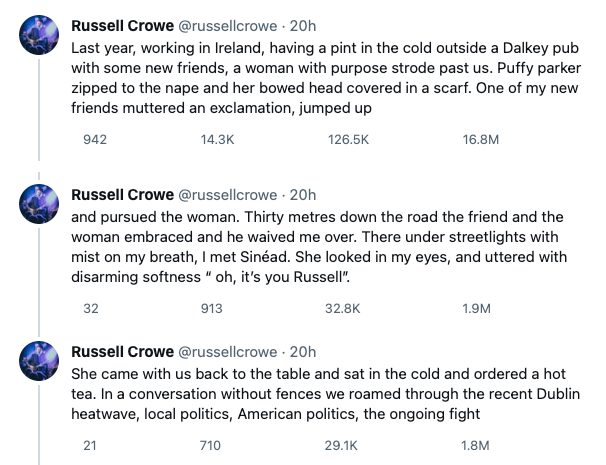
A touching thread posted on Twitter today by Russel Crowe:


To enjoy another aspect of her vast talent, listen to this rendition of Silent Night, to my ears the most beautiful ever performed:
 the needlefish