While all eyes are turned towards the appalling mess in Gaza, the war in Eastern Europe grinds on, in what looks increasingly like a WW I-style stalemate along a lengthy and largely static front line. This thread posted from the battlefield will give you some idea of the conditions, if you can bear it (it’s grim, but not gory):
Up and down the line it’s eerily similar to what one would have seen on the Western Front in 1916, so much so that it’s almost startling to see certain pieces of high-tech equipment amidst all the mud and squalor.
The last time I wrote about the Ukraine War, the much-anticipated counteroffensive, with new brigades armed and trained by NATO presumably taking the vanguard, was just about to begin. Hopes ran high that there’d be another breakthrough like the one achieved in Kherson in August, 2022. I was hopeful too, but also anxious. Here’s what I wrote, in a column titled “Chewing My Nails”:
Are they ready? Have they amassed sufficient forces? Has NATO training equipped them with the crucial skills for combined arms operations? How much Western armour have they really obtained – how many Leopard and Challenger tanks are actually in theatre and ready to go? How many Bradleys, Strykers and Marders? There haven’t yet been any deliveries of the vaunted American M1 Abrams, of which only 31 were promised anyway – does that matter? What about air power – can the good guys prevail even though we in the West have steadfastly refused to supply them with fourth generation types like the F-16, to the point, now, that it’s simply too late? Have the Ukrainians done enough to lay the groundwork for a decisive assault?…there’s all that to be concerned about, but here’s what’s really got me worried: everyone knows this is coming. It’s inevitable. The Russians have been preparing for it, as best they can (and we don’t really know how well they’ve done, so we can only hope they’ll be as incompetent at defending as they have been at attacking). Worse, even the most likely lines of attack seem to be well understood; all week long I’ve been reading Twitter threads written by both actual and purported experts, and they all seem to outline the same general strategy we’re likely to see, involving a thrust on the southern flank of the eastern front, probably towards Melitopol, designed to cut the “land bridge” to the Donetsk region and isolate the Crimean peninsula.
There’s nothing more likely to fail than an offensive against an enemy who knows not just that it’s coming, but also where and when it’s coming, and has known for months.
As it turns out, my concerns seem to have been borne out, at least in part. This is because everything went more or less as expected. While there have been probing attacks all over the 600 mile front line, with the Ukrainians attempting to advance at three separate points, as things developed the main thrust of the present counter-offensive occurred right where everyone anticipated, at the southern flank. The most progress has been made in the general direction of Mariupol, north of Melitopol. The long-term objective is indeed, apparently, to sever the land bridge to Crimea. As seemed inevitable, the eventual arrival of F-16s will be too late for them to get into the present fray, and of course there can never be enough tanks and armoured infantry fighting vehicles. How dispiriting, then, to discover that the Russians were actually preparing very, very well, and have, unfortunately and somewhat unexpectedly, proven much better at defense than offence. The Ukrainian push has by no means led to a disaster or anything like it, and some ground has been gained, but only some. Not enough. Two factors are most responsible for this, one novel to warfare, and one quite ancient.
Let’s deal with the ancient one first: fortification. The Russians, working at what must have been a feverish pace to build their defences, constructed what wasn’t quite, but was quite nearly, an impenetrable barrier to mechanized warfare. First they laid down miles upon miles of large concrete “dragon’s teeth”, just as the Germans did in WW II, meant to hamper the movement of vehicles. Like so:
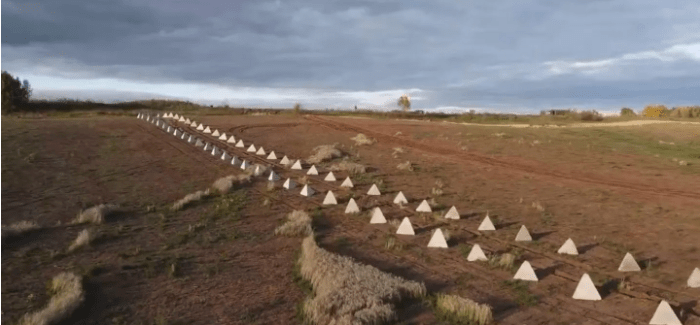
By themselves, these things aren’t terribly imposing, about three feet high and weighing a few hundred pounds, but the problem is that to clear a path through them you need to bring in heavy vehicles, like bulldozers, or better than that, tanks with bulldozer attachments, and at that point the teeth are like flypaper, holding the vehicles (and the forces behind them) in one place, perhaps long enough for them to become unacceptably vulnerable to artillery. If they’re bolstered by land mines, it’s that much more difficult, and a lot also depends upon how many rows of teeth they’ve constructed. Sometimes, deliberate gaps are left, in hopes that the enemy will choose to use them rather than deal with the concrete pyramids; these are, of course, traps, surveilled and pre-registered by artillery batteries.
Next, they built multiple layers of active defence. Once past the passive barrier, the Ukrainians had to confront dense, successive lines of complex fortifications, known as the “Surovikan lines” after the general officer (later sacked by Putin) who oversaw their construction. There are three of them, and each line has several layers of trenches, strong points, and more anti-vehicle obstacles, while being protected by an ungodly quantity of mines. You almost have to admire the effort involved in laying a virtually inconceivable number of landmines all over the theatre, vastly complicating the task for the advancing Ukrainians, and all but ruling out any sort of rapid mechanized thrust. It’s reckoned that they’ve planted 200,000 square kilometres of minefield, with a density in some places approaching one mine per square metre. Think about it: there are a million square metres in a square kilometre. NATO operational doctrine advises that minefields of that density should be considered practically impenetrable, and bypassed whenever possible. Failing that, they have to be cleared, sometimes using specialized equipment, sometimes extracting the mines by hand, in either case a relatively slow and laborious process in which the mine-clearing vehicles and personnel are, again, vulnerable to artillery fire. The mines needn’t all be cleared, of course, but even ploughing a useful corridor through them is difficult. It can be done, but be glad you’re not among the courageous souls doing it.
In short, the Russians have, especially along the strategically crucial southern front, constructed a very competent, very old-school, very fearsome set of barriers to provide what the military folks call a “defence in depth”.
Then there’s the factor that’s novel, so much so, in fact, that it’s changing the way wars are fought: drones. Drones have become ubiquitous as the conflict has dragged on. The Ukrainians have become famous for their skill and ingenuity in the tactical use of these small, remotely-piloted vehicles, and are building them by the thousand, but the Russians have them too, and they’ve created a new kind of hell for infantry and armour alike, on both sides.
The Ukrainians have discovered that drones can be configured for all sorts of missions. Some are essentially little flying bombs, and are remotely-piloted towards their targets, whether moving or sitting still, upon which they detonate, usually with devastating effect. They’ve even been used, gruesomely, to dispatch individual Russian soldiers. Others aren’t flying bombs, but little bombers, in effect tactical aircraft, that drop explosive charges on top of anything they can find. The Ukrainians have become especially adept at using these against infantry in trenches, but they’re just as useful against stationary targets like artillery pieces, trucks, missile launchers, and even tanks, especially if the latter happen to have any of their crew hatches left open. Video after video has been posted of drone’s-eye-view attacks in which the operators deftly drop small bombs right through the openings, into the tanks’ interiors. Then there’s a very big explosion. It’s an incredibly economical way to destroy a multi-million dollar asset (when watching, despite how much I want the Russians to be defeated, I find myself hoping that nobody’s inside). They’ve even developed “mothership” drones that fly into enemy territory and drop other drones, extending the latter’s effective range. Finally, and perhaps most importantly, drones have revolutionized battlefield reconnaissance. No matter where you go, or what you do, there’s apt to be some sort of quadcopter, perhaps equipped with infra-red as well as optical sensors, keeping track of your every movement. They won’t just find you on the roads and open fields, they’ll spot you in trenches, crouching behind or even inside buildings, hiding under trees, wherever, with or without camouflage netting, and no matter how furtive you think you’re being. Then they’ll either attack you themselves, or, even worse, relay your GPS coordinates back to the heavy hitters so you can be dispatched by guided artillery or HIMARS. Serving as artillery spotters, drones have proved themselves to be utterly devastating force multipliers.
The Russians aren’t as skilled in their drone operations, and they don’t seem to have as many, but those they possess have still been sufficient to wreak their own thoroughly unnerving havoc, as well as perform effective reconnaissance. They inflict continual attrition, and must be terrifying to Ukrainian soldiers who never know when they’re going to be hit, but even more damaging to the counteroffensive is the way their constant presence makes any sort of surprise attack practically impossible. As soon as you begin to assemble forces on a scale sufficient to mount an assault, you’re spotted, and they’re already preparing for the onslaught and bringing artillery to bear. How do you accomplish any kind of major breakthrough if the element of surprise has been completely eliminated? Under these conditions, how do you move at all?
So, we wind up with a lot of this:
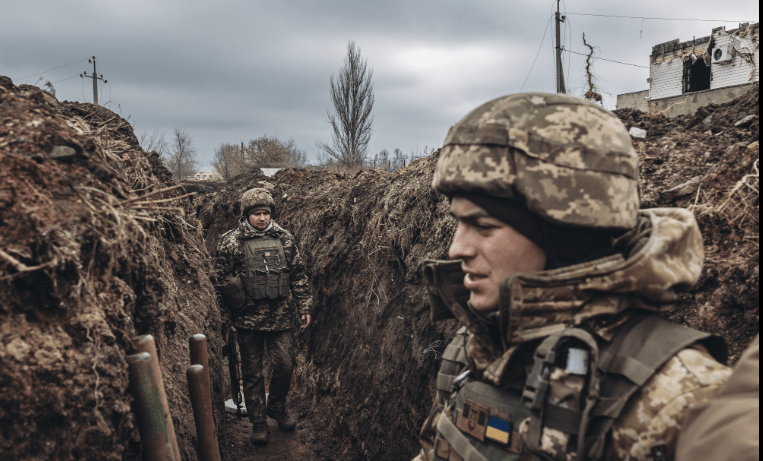
Trench warfare. Artillery duels. Fixed lines and little movement. Attrition as the main measure of success. In World War I, it was new technology – the machine gun – that caused everyone to dig in and figure out how to cope. Now, in large measure, it’s the first widespread battlefield implementation of what once seemed like innocuous little playthings, perhaps destined to be useful mainly to FedEx, Amazon, and the like. You’re not immune to the various predations of drones in trenches, but you’re safer than if you’re trying to advance in large numbers across open terrain.
Still, it’s not trench warfare everywhere. Mechanized attack in strength is still being attempted (much as troops kept pouring out of their trenches into hails on machine gun fire in WW I), thus far with only moderate success. The Russians, trying to regain the initiative, have been fighting tooth and nail to capture the now-destroyed town of Avdiivka to the north, in Donetsk oblast.
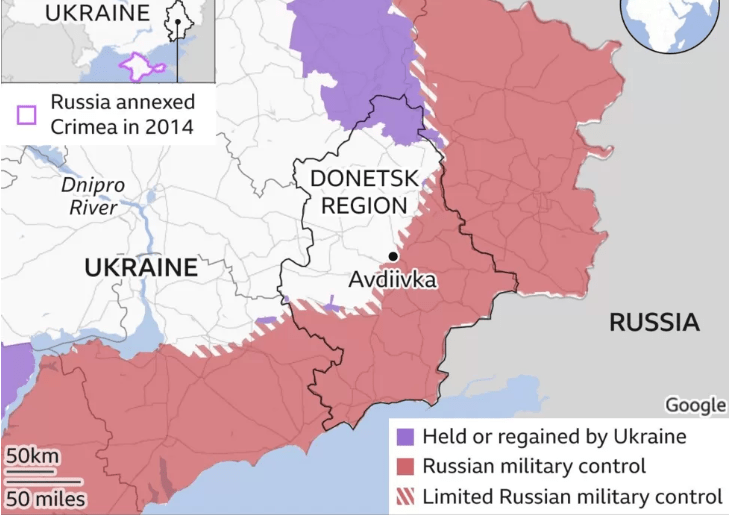
It’s turned into something highly reminiscent of the battle for little Bakhmut a few months back, except Avdiivkva has real strategic significance. It’s sometimes described as the “gateway to Donetsk”, in that it’s situated right in the centre of the oblast, and its occupation by Ukraine is preventing the Russians from operating freely in the region. The Russians are fighting for it with almost everything they can muster, and the Ukrainians, behind heavy fortifications but increasingly encircled, are thus far holding out, while inflicting terrible casualties on the attackers. In just one day of combat in October, the Russians are thought to have lost 34 tanks and 91 other armoured vehicles, while suffering over 3000 casualties, of which about 2400 were wounded. The Ukrainians claim that since October 10 their enemy has sacrificed about 10,000 troops, 100 tanks, 250 other armoured vehicles, 50-100 artillery pieces, and, rubbing salt in it, seven attack jets. That’s an average of more than 300 men killed in action every day, and on some days, when they’ve been pushing the hardest, the totals have risen to anything from 800 to 1400 killed. All for just one fairly small objective. This should be devastating.
Yet, they show no signs of quitting, and the Ukrainians are suffering heavy losses too, though they won’t disclose how many.
To the south, the going has been hard, but the Ukrainians are beginning to punch their way through, and they’ve breached the most formidable of the Surovikan lines. They’ve also managed to cross the Dnipro, establishing small but potentially pivotal bridgeheads on what had long been the Russian side of the river. If these bridgeheads can be held and expanded, they’ll pose a grave threat to Putin’s coveted eastern land bridge, and possibly serve, at last, as the launchpads for a thrust that isolates Crimea.

However, winter is upon us. From what I’ve been able to gather it’s still the muddy season, when anything on wheels or tracks – or wearing boots for that matter – is liable to get mired and immobilized in deep, dreadfully sucking mud. It’s not clear yet whether the Ukrainians will try to continue their assault when the ground freezes, or take a pause to reconstitute their forces and rethink their strategy. It may depend on whether they have to abandon their Dnipro bridgeheads, as well as what happens to the north in Avdiivka. A Russian breakthrough there could throw Ukraine back on the defensive, forcing them to shift forces north to contain the threat, thus bringing a halt to offensive operations in the south.
Meanwhile, Ukrainians on the home front must now face another long, hard winter of fending off Russian attempts to destroy their electrical grid and plunge them all into the freezing dark. This time around, however, attacking vital Ukrainian infrastructure, especially in and around Kiev, isn’t going to be so easy, partly because some things haven’t happened, and partly because other things have changed. The Russians, thankfully, have never been able to secure the large shipments of ballistic missiles they were hoping to get from Iran (one wonders whether there has been some sort of behind-the-scenes “diplomacy” to dissuade the Iranians from supplying the weapons). They have some of their own, but their objective would be much more attainable if the Iranians were giving them hundreds more of the damnable things. At the same time, Ukraine’s air defences have become much more powerful, equipped with everything from Patriot batteries that can intercept ballistic weapons to German-supplied “Gepard” flakpanzers, sporting radar-aimed cannons that make it much more economical and sustainable to bring down the cheap Iranian drones/cruise missiles that Russia is still sending in droves.
Maybe the Russians will fail, just as they did last winter.
The prospect of another trying winter highlights how protracted Putin’s planned three-day program of conquest has become. We’re now about 21 months in. How long can this go on? Well, maybe for a long, long time. Some of the analysts I follow think it could be several years before this is over, other things being equal, but there are a few readily imaginable developments that could soon break the deadlock and prove decisive.
First, the Ukrainians might manage a large-scale breakout of their bridgeheads in the south, drive all the way to the Sea of Azov, and cut off Russian land access to Crimea. At that point, Russian occupation forces on the peninsula would have nothing but the vulnerable and already partially disabled Kerch bridge over which to receive resupply, and the occupation could become untenable. If the Russians could be driven from Crimea, that might be the turning point. Don’t bet the mortgage, they’re still a long way from being able to accomplish anything so muscular, but it’s a possibility that must be giving the Russians a few sleepless nights.
Second, the Russian army could simply break under the strain and run. From this vantage point, it’s actually difficult to understand why it hasn’t already happened. If Ukrainian claims are even halfway accurate, the Russians have lost enough manpower that they’ve had to replace the entirety of their initial 180,000 man invasion force. Before long, it may reach the point that they’ve had to replace that entire force twice, while losing horrendous amounts of tanks, armoured vehicles, artillery pieces, anti-aircraft assets, trucks, and everything else an army requires. Their best troops are, for the most part, long since dead. Freed convicts and essentially untrained draftees have been replenishing the ranks, poorly equipped, poorly led, and used all too often as expendable cannon fodder to wear down the Ukrainians. Morale is terrible. Desertion is becoming a real problem. Poor battlefield medicine is resulting in countless deaths that a western army would have the medics and medevacs to prevent, further sapping morale. To make sure the increasingly restive troops at the front keep fighting, so-called “barrier forces” have been placed behind them, there to shoot anyone who tries to run away from the battle, a move straight out of Stalin’s playbook. Most of their best equipment has been destroyed. They’re pulling obsolete tanks out of storage, and buying sub-par artillery shells and tubes from North Korea. Their logistical train is under constant attack by NATO weapons of increasing range and hitting power. Their air forces still can’t operate over the battlefield. Their vaunted surface-to-air missile systems have proved less capable than thought, and many batteries have been destroyed by cruise missiles they were supposed to be able to intercept. They’ve even had to withdraw the Black Sea Fleet from Sevastopol. By any objective measure, Putin’s escapade in Ukraine has been an ill-conceived, poorly executed fiasco. How in the world will they be able to keep this up indefinitely?
Third, American support could dry up owing to the efforts of the “Putin wing” of the GOP, a disorganized and often idiotic mess of a caucus which now controls the House of Representatives. If the U.S. turns off the tap at this crucial juncture, the Europeans won’t be able to make up the difference, and that will probably be it for Ukraine. Putin, clearly, has been persisting largely on the basis of this possibility, failing which – and please, sweet Jesus, no – there’s always the pretty good chance that Donald will regain the White House. Putin can be counted upon to maintain his mismanaged “special operation” for as long as he can, no matter how horrendous the losses, hoping to hold on long enough to see how the 2024 election plays out. Maybe Donald will be able to hand him the victory, and he can run around boasting about his strategic genius, triumphant. In which case, God damn Trump and the Republicans to Hell.
Or, something else could happen, which isn’t readily imaginable. Wars are funny that way.
That Russia remains in possession of close to 20% of sovereign Ukrainian territory despite the counteroffensive, upon which so many hopes had been pinned, is infuriating, frustrating, and downright frightening. It’s a brute fact that should also be clarifying for those of us in the West, as it leaves us with only one righteous choice: we have to ramp up our support, help Ukraine get through this winter, then next winter if need be, and as many subsequent winters as it takes, arming them all the while to continue pushing at the Russians until it’s Putin’s will, not ours, that breaks. The idea that it’s perfectly legitimate to grow weary at the lack of progress, to the point that we might have good reason to withdraw support, is, frankly, immoral. Moreover, the notion promoted by many in the MAGA crowd that it’s actually fine if Russia wins, and it’s none of our business anyway, is not merely unconscionable, it’s disgusting, and reveals an infantile and authoritarian-friendly appreciation of what’s really at stake, an inability to tell right from wrong, and a breathtakingly witless selfishness. It would once have been unthinkable in the nation that expended so much blood and treasure to build the world order that Putin now seeks to destroy. A pox on those who spew such drivel. A miserable pox on all of them.
Slava Ukraini.

 the needlefish