This is Ben Fong Torres, right? O.K. Tell him it’s “a think piece about a mid-level band struggling with its own limitations in the harsh face of stardom”. He’ll wet himself.
If there’s a movie in which Philip Seymour Hoffman isn’t pitch-perfect and brilliant, Cameron Crowe’s wonderful Almost Famous certainly isn’t it. His is one of the key performances in a film that manages to capture the true essence of that strange moment of cultural transition in the early 1970s, when the Sixties were over, but not quite, and certainly not musically. Disco, Punk, and the full-scale Invasion of the Singer-Songwriters were still in the future, the whole West Coast Eagles/Fleetwood Mac thing hadn’t yet kicked into high gear, nobody had yet heard of the Captain and Tennille or the Starland Vocal Band, and established acts like the Who, the Stones, and Rod Stewart were putting out albums that stood with, and in a way were still among, the best of the Sixties – check out, for example, Who’s Next, Exile on Main Street, and Every Picture Tells a Story, enduring classics released during 1971-72. Badfinger was out there picking up where the Beatles left off, Bridge Over Troubled Water and Tapestry were huge sellers, and it might have seemed that everything was rolling along just as it should. But there were those, like the legendary music critic Lester Bangs of Creem Magazine, who could feel the rot setting in, and smell the creeping corporatization of Rock as it became a big business.
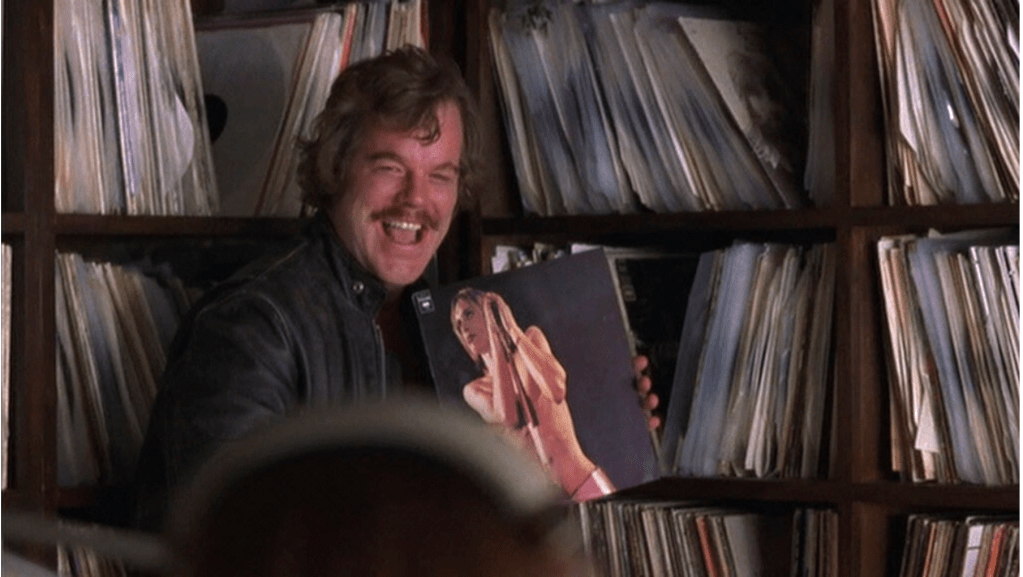
It may seem that Hoffman’s portrayal of Bangs is a little kind, given the way dispassionate observers usually portrayed him. An article in the New Yorker put it this way:
Lester Bangs was a wreck of a man, right up until his death in April of 1982, at the age of thirty-three. He was fat, sweaty, unkempt—an out-of-control alcoholic in torn jeans and a too-small black leather jacket; crocked to the gills on the Romilar cough syrup he swigged down by the bottle. He also had the most advanced and exquisite taste of any American writer of his generation, uneven and erratic as it was.
https://www.newyorker.com/books/page-turner/lester-bangs-truth-teller
A brilliant but erratic and off-putting kook, then. Maybe, to most. But he was also a fabulous writer, keenly perceptive, smart as a whip, and funny as hell, and remember, Cameron Crowe knew Bangs, up close and personal. Almost Famous is semi-autobiographical, with young William Miller standing in for the director, and it’s a safe bet that the on-screen conversations between Bangs and his teenaged protéger echo those that actually occurred all those years ago, as do many of the weird and wonderful episodes depicted during Miller’s cross-country rollercoaster ride with emerging band Stillwater, a fictional outfit merging the personal traits and foibles of the members of the Eagles, Led Zeppelin, and a few other up-and-coming bands that Crowe toured with as a budding writer for Rolling Stone.
What a way to grow up, eh?
Those who really knew him invariably describe Bangs just as Hoffman plays him, sympathetic, helpful, full of really sage advice, and profoundly influential in their own lives and career choices. Crowe, obviously, loved the guy, and it was a tribute to Hoffman that nobody else was even considered for the role, plain as it was to the writer/director that nobody else had the range and emotional depth to do right by his screenplay. Even at that, Hoffman exceeded all expectations, particularly in the pivotal scene in which William reaches Lester late at night, all in a panic, and Lester talks him out of his tree, reminding the kid that he’s just not cool like the people he writes about, and shouldn’t want to be. Cool people are boring. Their art never lasts. It’s the nerds like us, insists Lester, the guys home alone on Friday nights, the guys who never get the pretty girls, who turn angst into real art that stands the test of time, impliedly and generously accepting William into a select group of fellow writers. This is what Cameron Crowe wrote about Hoffman’s performance in 2014, upon learning of the actor’s untimely death:
My original take on this scene was a loud, late night pronouncement from Lester Bangs. A call to arms. In Phil’s hands it became something different. A scene about quiet truths shared between two guys, both at the crossroads, both hurting, and both up too late. It became the soul of the movie. In between takes, Hoffman spoke to no one. He listened only to his headset, only to the words of Lester himself. (His Walkman was filled with rare Lester interviews.) When the scene was over, I realized that Hoffman had pulled off a magic trick. He’d leapt over the words and the script, and gone hunting for the soul and compassion of the private Lester, the one only a few of us had ever met. Suddenly the portrait was complete. The crew and I will always be grateful for that front row seat to his genius.
Cameron Crowe Recalls How Philip Seymour Hoffman Became Lester Bangs In Almost Famous
Hoffman, like Bangs before him, was killed by drug addiction. In his obituary, the NY Times described him as “perhaps the most ambitious and widely admired American actor of his generation”, and I’ve never encountered criticism or commentary that said any different. The man had a gift.
I’ve found it’s best not to contemplate the monstrous cumulative loss of talent and human potential inflicted upon our culture by drugs. I don’t follow that advice myself, of course, but you should try.
There are lots of other reasons, besides Hoffman’s portrayal of Bangs, to watch Almost Famous. Everyone is terrific, and the film is by turns hilarious, nostalgic, wryly observant, and almost unbearably poignant, with a core of pure human decency. If you’ve never seen it, do yourself a favour, maybe the next time you’re feeling grumpy or depressed. There are scenes that will stick with you for the rest of your life.
 the needlefish