This is a post about the limits of protest in a free society. So, before we begin what aims to be a fair and balanced analysis of the siege laid by various convoys of truckers upon border crossings in Ontario and Alberta, as well as at the heart of the National Capital, let me put my cards on the table.
As you may have gathered, supposing you’ve read anything posted on the Needlefish over the past six years or so, I’m generally about as much of a dyed-in-the-wool bleeding heart liberal as I can be. Except not dyed-in-the-wool; I didn’t start out this way, but over the years, after absorbing so many unpleasant truths, and having bathed in the warm and gentling influence of my wonderful wife, I’ve come to see things differently. Yes, indeed, I support voices of dissent, peaceful protest, and moral outrage in all manner of circumstances. But there’s enough left of the hard-line, unsympathetic core I developed as a much younger man, a child, really, that I still feel there’s a line beyond which, were it my call, there would be no mercy. No quarter given.
It’s this: when you’re coming at me with the calculated intent to prove that any time you feel like it, for just as long as you please, you can defy all norms and laws, intending to demonstrate that it’s entirely at your whim whether duly constituted authority still gets to run the joint, and whether, moreover, I can continue to go about my own lawful business unmolested, well, that’s it. This may be a free society, but it’s not so ludicrously free that any old group of brazen chuckleheads can decide to go beyond peaceful protest, beyond civil disobedience, beyond making a point, beyond even riot, in my view, and graduate to challenging the very sovereignty of civil authority. That cannot stand. That’s not a message we can allow anyone to send. Never. No matter what.
I admit this gets tricky in practice. Today, for example, a bunch of farmers in France have decided to block some major arteries with their tractors, in protest of environmental and agricultural policies they say are wiping them out. Does that cross my deadly line? Maybe not, if they choose to make their point over a day or two and go home; if they move aside to allow passage for emergency vehicles; if they concede that certain vital commodities must also get through; If they don’t harass anyone in particular, shout racist taunts or wave Nazi flags; if they clean up after themselves; I realize, this isn’t easy to pin down. I’ll also acknowledge that one’s opinion on the matter is bound to be influenced by a subjective assessment of the justness of the underlying cause. Still, I know it when I see it.
Let’s take an extreme example: I can assure you that had it been up to me on January 6, the various freaks, idiots, white supremacists, neo-Nazis, Confederate flag-wavers, and insurrectionists of Trump’s private MAGA army would not have been allowed to disperse that day and go back home to crow about their exploits on social media. They’d have been surrounded and suppressed by disciplined troops with bayonets fixed. Instead, the stupid bastard with the viking horns was sitting in the Speaker’s chair, imagining, for that moment, that he’d overthrown the government, as he condescended to converse with a lone, pleading Capitol Police officer who didn’t know what to do. It was a powerfully symbolic tableau that sent an extremely dangerous message, and no amount of belated, long-after-the-fact prosecutions leading to short prison sentences can ever undo the damage done that day.
All right then. As we used to say in my home out East, what’s that got to with the price of fish?
A lot, actually.
The impetus for this column was a recent decision by the Federal Court of Canada, ruling on the government response to the unprecedented disruptions caused across the country by the mass protest of truckers in January through February, 2002. In the abstract, it sounds implausible, really: the mass protest of truckers? WTF? What was going on to make a bunch of commercial long-haul truckers lose their shit and declare war on society? If you didn’t already know, if you hadn’t already experienced the utter madness that swept through both Canada and America in the throes of the COVID pandemic, you’d never guess: these truckers were enraged at being made to vaccinate themselves against a deadly pathogen. We were in the midst of a once-in-a-hundred-years plague, and barely holding our own. Public health measures needed to be taken. The vaccination mandate was imposed by both the Canadian and US governments upon those truckers whose routes crossed the border, presumably because people who drive hundreds or even thousands of miles, stopping multiple times in crowded places along the way, while interacting with populations in more than one country, are the Platonic ideal of vectors for disease transmission. The truckers were being ordered not to save their own lives, but to spare the health and lives of others, at a time, you’ll recall, when the new Delta variant was killing thousands and threatening to run rampant. They refused.
The truckers’ quintessentially antisocial insistence upon personal freedom over the legitimate interests of society at large bore all the hallmarks of the pernicious cult of individual autonomy so prevalent south of the border, and you can rest assured that more than a few American shit disturbers were involved in planning and financing what the truckers decided to do.
I don’t want to use up a too much of your time and patience rehashing exactly what the truckers, dubbing themselves the “Freedom Convoy” (for the love of Christ) did to mess with the nation. You probably remember. Still, it was a couple of years ago now, and it’s important to set the scene as it then was. To begin with, as many as 18 thousand of them (some estimates are much lower) took over a part of downtown Ottawa, right in front of the Parliament buildings, while others were simultaneously blockading border crossings in Alberta and Ontario, most famously by denying transit of the Ambassador Bridge between Windsor and Detroit. Their numbers in Ottawa rose and fell, varying from several thousand to only a few hundred, but the continuous occupation of a section of the National Capital, literally in the shadow of the architectural symbol of federal power, dragged on for the better part of three weeks. While they were there, the noble freedom fighters shouted racist taunts at passers-by, harangued anyone they saw who was wearing a protective face-mask, honked their very loud horns all night, the better to harass Ottawa’s many downtown residents, and waved the Confederate flag around – the Stars and Bars, every white bigot’s favourite symbol of racist insurrection – as if this wasn’t Canada any more. As if all that South-Shall-Rise-Again-Lost-Cause bullshit has anything to do with us. As if they identified not with the values of this country, but those of the most vile segment of Donald Trump’s deplorable American base. As if they fully expected us to put up with it indefinitely. Oh, they were feeling it. They were powerful. They were in charge.
The border blockades were potentially a serious impediment to Canada-US trade, and of enough economic importance to prompt direct discussion between P.M. Trudeau and President Biden. Provincial authorities cleared them out, a little more slowly than they should have, but still, they were dealt with. Of course they were. The Americans had a dog in the fight, and Big Money was complaining.
In Ottawa, though, nothing seemed to change. Both the City and the Province declared states of emergency, but there was no emergency response. The protesters took to desecrating monuments, demanded food from local soup kitchens set up to feed the homeless, spread out into residential areas and began harassing homeowners, made racist fun of First Nations people by drumming and dancing around hollering “yabba dabba doo”, and set up a logistics hub at a local baseball stadium where they stockpiled trailers full of food, tents, portable toilets and fuels like gas and propane. They even set up hot tubs, and, honest to God, bouncy castles to amuse the children they’d brought along with them (can you imagine? They brought children to a confrontation with the authorities). They were in it for the long haul. They declared they’d never leave until the laws they didn’t like were changed. And still, nothing much happened. Get this, from the Wikipedia article:
By day 14, February 10, the newest tactic was “convoy circles”. Ottawa-Centre MPP Joel Harden noted that a “convoy organizer” had been encouraging protesters to form them around public schools in Ottawa.[198] A group of about 60 convoy vehicles headed to the Ottawa Macdonald–Cartier International Airport at 8 am, slow-circling it, honking and blocking traffic until about 10 am, then returned to their Coventry Road,[199] one of three Ottawa protest encampments.[200] Chief Stoly said many “vexatious calls” from the United States to 9-1-1 flooded the system and endangered lives.[201]
Mayor Watson sent a letter to Tamara Lich and Keith Wilson to negotiate terms with protesters.[202] On February 13 afternoon, Mayor Watson’s Office said that they had reached an agreement with protesters limiting the protest perimeter to “Wellington Street, between Elgin Street and the Sir John A. Macdonald Parkway” to “reduce pressure on residents and businesses”. Truckers will leave residential neighbourhoods.[203][202]
Great God in Heaven, we were negotiating with the bastards.
Finally, the Federal Government, watching this mess drag on, invoked the Emergencies Act, becoming the third level of government to take such a step, and at last brought an end to the nonsense. A part of the emergency measures were new regulations allowing the seizure of various sums of money the truckers had been raising via GoFundMe and other channels to fund their ongoing mission. This was all controversial. People have rights, don’t you know.
So, now to the crux of it: there were lawsuits brought in Federal Court by all sorts of groups to challenge the use of the Emergencies Act, among them the Canadian Civil Liberties Association, the Canadian Constitution Foundation, the Canadian Frontline Nurses, the AG of Alberta, and assorted individuals. The Court’s decision was rendered on January 23, and in taking in the media’s breathless coverage, you’d have thought the Court ruled that the Merry Freedom Convoy Chaos Agents had a constitutionally protected right to wreak havoc while snapping their fingers under the noses of three levels of government:
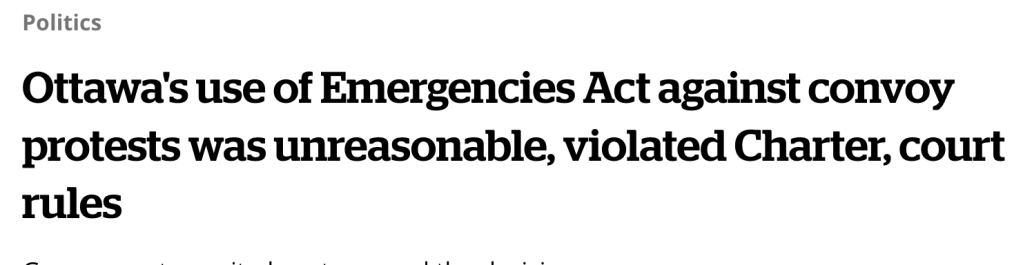
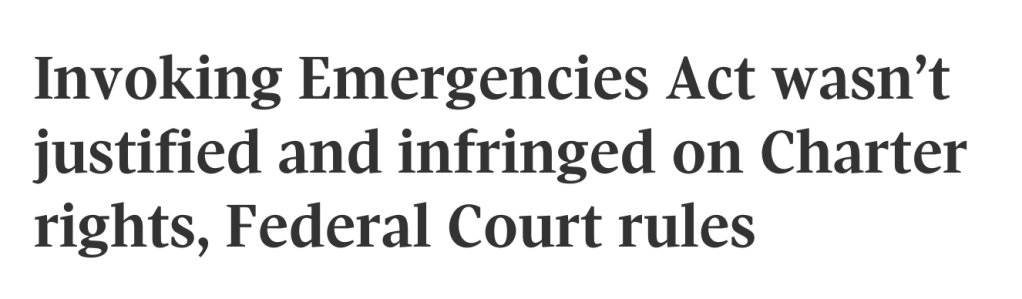

This, of course, was met with some chagrin here at Needlefish headquarters.
This is why you don’t just rely on the media reports, and read the decision itself. The headlines weren’t wrong, exactly, but they were awfully misleading. The most important aspect of the ruling is that the Charter of Rights barely comes into it, and the Court doesn’t rule that anything that eventually happened to the Truck-Fuckwits was by definition unconstitutional, and violated their sacred right to mount an attack on society, save for when it came to all that money the brainstems had raised, which the Feds seized. It’s really quite remarkable, when you get into it, how little sympathy the Court actually expressed for the dumbasses.
The legal analysis involved in decisions like this is detailed, nuanced, complicated, and lengthy, employing concepts and terms of art the explanation of which would put the lay reader to sleep. We don’t want to delve too far into the weeds with that stuff. We don’t want to get all granular and technical. No worries. I’m a lawyer, and it was my particular job to figure these things out so that other lawyers didn’t have to, so you can trust me to summarize without leading you astray. No misleading headlines out of this guy, count on it.
So let’s distill the Charter arguments, discussion of which doesn’t even begin until you’re a hundred pages into it (no fooling). I’m paraphrasing here, of course, and abbreviating mightily, but this was the essence of the legal Q&A:
On behalf of the Truck-Turds: Did rousting the truckers out of town, finally, breach their rights under Section 2 of the Charter of Rights and Freedoms to freedom of thought, belief, opinion, and expression?
Federal Court: No. Fuck off.
On behalf of the Truck-Hooligans: Was the belated squelching of the truckers’ occupation of the National Capital a violation of their rights under Section 2 of the Charter to freedom of peaceful assembly?
Federal Court: Oh for chrissakes, you idiots want me to rule that the bullshit you were up to was peaceful? Do you even know what a “breach of the peace” is? No. And didn’t I just tell you to fuck off?
On behalf of the Truck-Chucklefucks: Did the curtailing of the truckers’ usurpation of civil authority and outright seizure of sovereign Canadian territory deprive them of their right under Section 2 of the Charter to freedom of association?
Federal Court: No. Get off the crack pipe and go fuck yourselves.
On behalf of the Truck-Driving Anti-Vaxx Dickwads: Okee Dokey, what about Section 7? Did the measures taken to regain control of the streets around Parliament Hill deprive the truckers of their rights under Section 7 of the Charter to life, liberty, and security of the person?
Federal Court: Look, it’s OK to deprive you of those things, which nobody did anyway, unless doing so is fundamentally unjust – it’s one of those tricky legal limits we like to impose – and, well, tell you what, since “fuck off” isn’t doing the trick, you are cordially invited to eat shit and die.
On behalf of the Truck-Hillbillies: Jesus Christ, throw us a frickin’ bone here. How about Section 8? Huh? Did seizing our bank accounts violate our right to be free of unreasonable search and seizure?
Federal Court: Ummm…yeah, all right, I’ll give you that one. Shit. We have all sorts of legal criteria and rules relevant to this very issue, and it looks like you have a point. Assholes.
(That’s paraphrasing, like I said.)
And that’s it. That’s the extent to which any Charter rights prevailed over the Federal Government’s need to restore order on its own doorstep.
Bear in mind, amid all this bellyaching by the anti-vaxxer anarchists, no one, nobody at all, was charged under any provisions adopted under the Emergencies Act. There was no mass arrest, no kettling, no transport to a mass detention facility. The Ottawa police laid all sorts of charges for various offences, but in the main, the morons were sent back home while the authorities all but asked, pretty please, for forgiveness, because the people of Canada are awfully sorry you can’t always do anything you want, anywhere you want, for as long as you want, honest, we wish you could, but the rest of us have to live here too. Maybe some day you’ll understand.
Anyway, if that’s where the court came down, then how was the invocation of the Emergencies Act unconstitutional? It came down to whether, given the circumstances on the ground at the time, the threshold criteria of a “national emergency”, as defined in the Emergencies Act itself, were ever met, a question that determines the constitutional legitimacy of invoking the legislation. In other words, did the Federal Government have the power, according to its own rules, to take the actions it did?
Legally, then, it comes down to the definition of “national emergency” in the Act, which is:
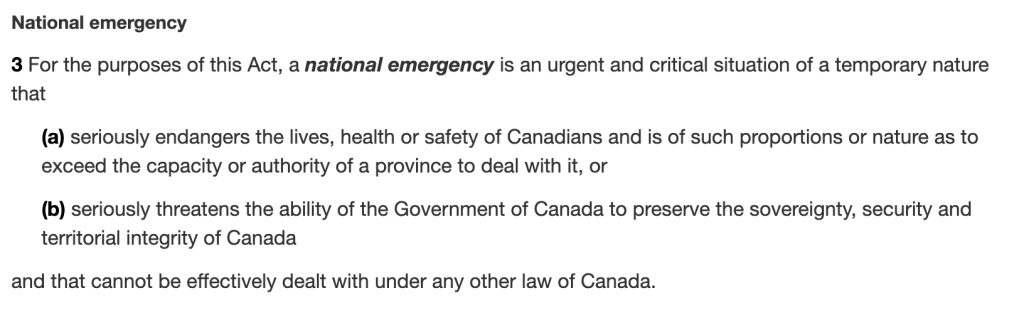
Now, right away, you can see where the Feds run into trouble. To begin with, it’s questionable that the statutory requirement for threats against all of Canada was ever met (as in “lives, health, or safety of Canadians, and “sovereignty, security, and territorial integrity of Canada“). Certainly, there were border blockades independent of what was going on in Ottawa, including one in Alberta, and these could have had a serious national impact if left to fester too long, but things never went that far because provincial authorities cleared them out in a somewhat timely matter. The problem in Ottawa was local; I can imagine arguments on both sides, but the fact is, the occupation in front of the Parliament buildings never got to the point of interfering with the ability of the Federal Government to function (as indeed was demonstrated by that Government’s ability to get down to brass tacks and invoke the Emergencies Act in the first place). I’m hoping the conclusion would have been different if the truckers had marched on Parliament itself, and taken over the building, along with other government offices – surely that would be a local event with national repercussions? – but they never went that far. There was also the danger of similar trucker actions all across the country, but that never happened either.
Moreover, despite several charges of assaulting a police officer being laid, and the presence of some weaponry among the truckers, there was no huge outburst of violence, which the Court judged necessary before anything like a “public order emergency” could have been declared pursuant to section 58 of the Act (which is a whole other kettle of fish, to continue with my colourful Maritime sayings).
I’m oversimplifying, obviously; there’s a great deal of legal reasoning needed to reach these conclusions, and getting into the section 58 analysis would add further unnecessary grief. You get the gist of it. From the get-go, the Act required the existence of circumstances that weren’t in evidence.
That wasn’t all. The real kickers were the qualification in the definition’s first sub-paragraph, “exceed the capacity or the authority of a province to deal with it”, and the final modifying language of the entire definition of “national emergency”: and that cannot be effectively dealt with under any other law of Canada.
This alone is decisive. To qualify, the emergency has to be occurring in a legal vacuum, such that no other laws are available to any level of government to deal with it, forcing the Feds to step in to plug the gap. Absent that, you can’t have a “national emergency”, and of course there were laws in place that provincial and municipal governments, which had all the authority they needed, could have used to deal with the problem, as we saw in Alberta, in Quebec (where the nascent protest movement was quickly snuffed out by the Sûreté du Québec), and on the Ambassador Bridge in Ontario. This led to a perfectly sound legal conclusion, as spelled out in the decision:
While I agree that the evidence supports the conclusion that the situation was critical and required an urgent resolution by governments the evidence, in my view, does not support the conclusion that it could not have been effectively dealt with under other laws of Canada, as it was in Alberta, or that it exceeded the capacity or authority of a province to deal with it. That was demonstrated not to be the case in Quebec and other provinces and territories including Ontario, except in Ottawa.
So it wasn’t enough that the applicable laws weren’t being enforced. They could have been.
This leaves me to question how protracted, and how dangerous, a failure by the proper authorities to act would have to get before a Court implied the words “or will not” after “cannot” in the phrase “and that cannot be effectively dealt with”. Of course it would be awfully hard for the Courts to define when it was, exactly, that the Feds could reasonably conclude that the “will not” line was crossed, (is a month the cut-off? A year? Does it vary with the severity of the crisis? The scope?) but the Courts are good at that sort of thing when they want to be. The bigger hurdle is that a straightforward reading of the language of the statutory definition seems to rule any such expansive interpretation out of the question, regardless. Still, I wonder. What if, say, Ontario Premier Doug Ford had declared himself on the side of the truckers, and used his authority to prevent any use of existing laws against them (and no, I’m not doing the extra legal research to figure out if this is possible); does that go far enough to satisfy “and cannot be dealt with”? Arguably no. Arguably, “will not” is never equivalent to “cannot”, not if the tools exist, and simply aren’t being used by those empowered to wield them.
The Hell of it, of course, is that something did need to be done, and only the Feds seemed willing to do it. Justice Mosely, in writing the decision, admits as much in this really quite remarkable passage of the decision:
[370] At the outset of these proceedings, while I had not reached a decision on any of the four applications, I was leaning to the view that the decision to invoke the EA was reasonable. I considered the events that occurred in Ottawa and other locations in January and February 2022 went beyond legitimate protest and reflected an unacceptable breakdown of public order. I had and continue to have considerable sympathy for those in government who were confronted with this situation. Had I been at their tables at that time, I may have agreed that it was necessary to invoke the Act. And I acknowledge that in conducting judicial review of that decision, I am revisiting that time with the benefit of hindsight and a more extensive record of the facts and law than that which was before the GIC.
(“GIC” stands for “Governor in Council, that is, the Federal Government).
Nevertheless, the invocation of the Emergencies Act was improper because there was no triggering “national emergency”, and thus was ultra vires, Latin for “beyond one’s legal authority”.
This doesn’t mean that anything that was done to those miserable, antisocial truckers, with the exception of the cash seizures, violated their constitutional rights. It means that the Federal Government should have sat on its hands, apparently indefinitely, while the truckers made the compelling case that the authorities didn’t run that piece of the country, because they did.
Really?
I find myself forced – and this pains me greatly – to agree with an opinion piece that appeared in the arch-conservative National Post, written by Chris Selley,
…in which he concludes:
It’s one thing to have the legal “capacity” and “authority” to clear out protesters who step over the line. All provinces have that. It’s another thing to have the willingness to do it.
In early 2022, Ottawa police had none. Ontario police forces have none as a general rule … though the relatively quick and painless end to the blockade of the Detroit-Windsor crossing showed it is, in fact, possible for Ontario cops to enforce a court injunction without first defying it for weeks. So maybe it’s more accurate to say this is pretty much all Ottawa’s fault — the city, not the feds. The federal government did overreach, clearly, but should never have been forced to decide whether to take extraordinary measures in the first place.
That a Federal Court judge would in 100-odd pages both sympathize with the government’s decision and find it to have been ultra vires and Charter-deficient is a pretty perfect outcome for a broken country like Canada: The only things that work, we mustn’t do. Pending appeal to the Supreme Court, at least.
Yup. Concur (except with the typical right wing shit about Canada being a “broken country”, for which read “a country within which conservative ideology favouring white capitalist interests does not always hold sway). When this is the weeks-long scene anywhere, let alone right in front of the national legislature, somebody has to do something:


I’m supposed to get all exercised when the legal conclusion is that the Federal Government was the wrong one to do the right thing?
Look at these A-holes. “United against tyranny”. Oh, fuck off.
I’d advise them to amend the Act, but that would probably set off another constitutional shit storm. I can imagine the arguments…ah, never mind. Enough of this law shit for now. Meanwhile, I’ll be following this closely, dear readers. Appeal is pending. Stay tuned.
 the needlefish