All the news stories over the past couple of days have been screaming about how the Alabama Supreme Court just ruled that God Himself decrees that all unborn children, in utero or not, including frozen embryos created for the purpose of IVF procedures, are fully human children, perhaps for all purposes of the law, with implications stretching far beyond who bears liability if a fertility clinic screws up embryonic storage.
I was about to write an off-the-cuff impassioned screed about the Evangelical Christo-Fascist war on women, but then, being a lawyer and all, I decided I’d better read the decision first. Having done so, I gotta say, I think the situation might be as bad or even worse than everybody thinks, but not just because of this one decision, or any language it contains, awful though it is. So an impassioned screed it is, I guess, but one that includes much less than I first expected about how the Alabama Supreme Court is populated by dogmatic religious morons twisting the law to suit their low-down Evangelical agenda.
To begin with, in another context, this could have been characterized as an innocuous decision, really. Allow me to explain. Imagine some guy, minding his own business, gets run over on the sidewalk by a moron on a mountain bike. Imagine, too, that there’s a Compensation For Pedestrians Hit By Motor Vehicles Act, under which the victim claims compensation. He really deserves compensation, but is a bike a “motor vehicle” for the purpose of the Act? The Act contains no definition of “motor vehicle”, and in everyday usage a bike doesn’t fit the bill, but the court decides that the purpose of the thing was to grant some redress for people run over by things with wheels, and so, for the purposes of this Act, it’s determined that a bike qualifies. Let’s say the guy peddling was the motor, the Court suggests. That, however, is just for the purpose of this Act. It doesn’t mean a bike is a motor vehicle under any other law or for any other purpose; it doesn’t mean, say, that a kid needs a driver’s licence if he wants to ride a bike. That’s a whole other statutory regime, and the Court is very clear on that.
That’s exactly how this IVF decision could have, and should have, gone, and practically was, save for the intemperate bloviating of the Chief Justice.
The narrow question being litigated was whether aggrieved clients of an IVF clinic, whose frozen embryos had been inadvertently (and on its face negligently) destroyed, were entitled to compensation under an old Alabama statute called The Wrongful Death of a Minor Act, dating from 1872. The majority agreed that yes, they were, but here’s the first wrinkle: there are four concurring opinions that set out varying reasons for why that should be so, and only one of those presents the sort of dire implications that have everybody up in arms.
The first opinion, by Justice Mitchell, adheres to the very sound principle that a court should never rule on matters beyond those necessary to reach a decision. This is classic, cautious judicial reasoning:

In other words: don’t come at us with arguments that would require me to make vast and sweeping changes to our entire legal landscape. I only have to decide what this one statute means, purely for the purpose of granting compensation under that statute, and not another damned thing.
He concludes that it’s settled law that an unborn child, including an embryo, is a “child” for the purposes of that Act, a decision not without potentially unpleasant consequences for IVF clinics or their clients, to be sure, but that’s the extent of it. He also declares that any policy questions about how this ruling might affect IVF in general belong before the legislature, not the courts:
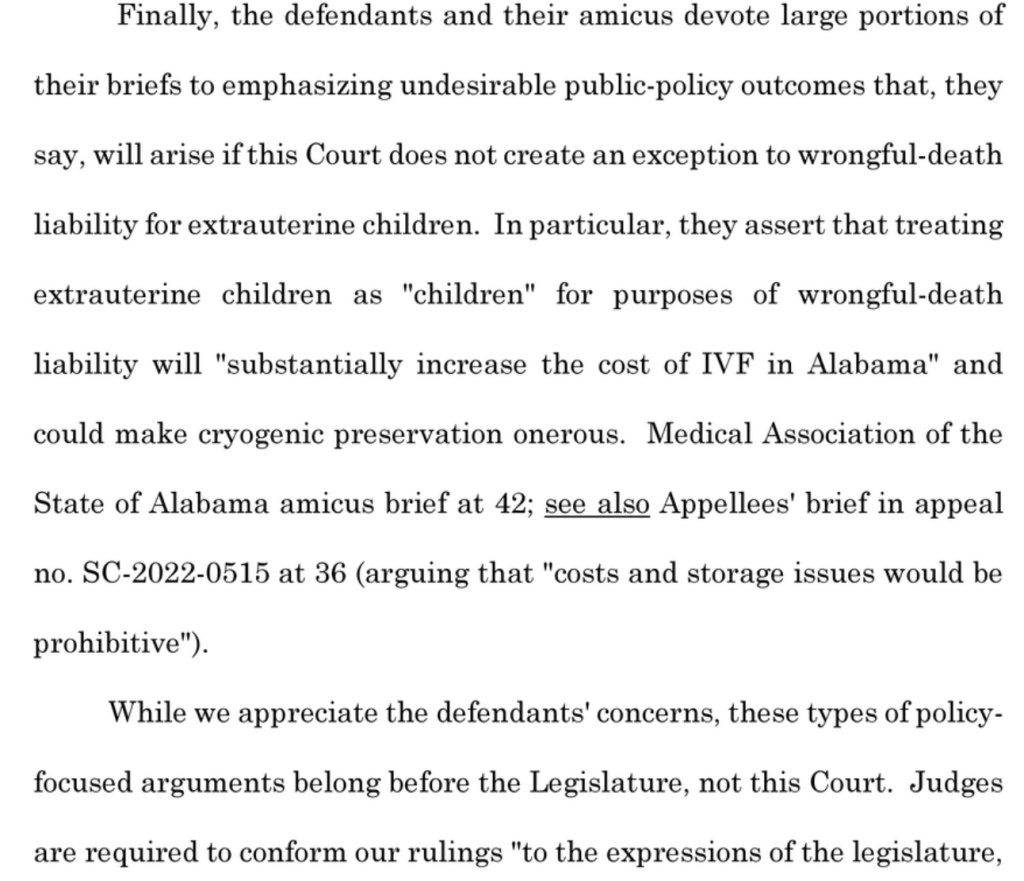
Again, not great for those running fertility clinics, but nothing, legally, beyond the minimum that needed to be determined to resolve the case.
Justice Shaw’s opinion uses somewhat different reasoning, based on general principles that can seem to have broad application, but in essence he too is ruling only with respect to the statute, and he’s really rather thoughtful in concurring with Mitchell:


In other words: we’re applying some general principles here, reflecting what I take to be the will of the people of Alabama, but today all we’re talking about is how this informs our interpretation of this one statute in this one narrow context. Still, there’s an obvious implication that this reasoning might apply to any other statutes that come before the Court.
Justice Mendheim, while concurring, has obvious reservations about where the correct interpretation of the statute, as it stands, leaves those who practice and benefit from a scientific procedure that was beyond anyone’s wildest imaginings when The Wrongful Death of a Minor Act became law:

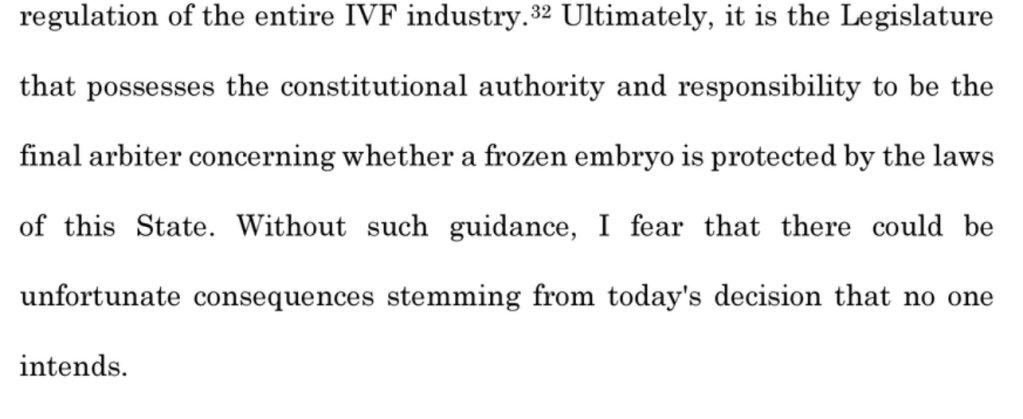
In other words: the Act says what it says, and I guess that ties my hands here, especially because the ethical and public policy concerns of what this statute means should be addressed by the legislature, not we judges, but whoo boy, the plain reading of the law in this case is bound to create a real mess and I’m sorry to have to concur here. Again, he’s confining himself to the interpretation of a single statute in a single (albeit fraught and important) context. He’s not saying anything about the legal status of the unborn as a general matter, though clearly he’s worried about that very question.
So far, not great then, but nothing quite sufficient to get us screaming from the rooftops that the Judicial Evangelicals have declared war on women. In fact, if it ended on that note, I’d be telling people to calm the fuck down, it doesn’t mean what they think.
The problem is the fourth concurring opinion by Justice Parker, who is, sadly, the Chief Justice, and thus the one with the largest bully pulpit. He’s the one who wrote all the Christian-centric language being quoted in the media, and no doubt about it, this guy is the sort of religious freak that the constitutional separation of church and state was meant to banish from the business of deciding how people should live their lives.
Right off the bat, Parker rejects the idea that his ruling should be limited to anything so narrow as the interpretation of one little statute. No, this is about the sanctity of life, the creation of living beings in God’s image, and indeed what the Almighty dictates with regard to all human life, as reflected, praise Jesus, in the very wording of the Alabama Constitution itself:

This isn’t just about frozen embryos, Ye Children of the Lord. This is about all of public policy, and the Constitution, and he doesn’t even care what the statute means, because if it didn’t uphold the Holy Writ of God in Heaven, it would be unconstitutional anyway, and he’d override it. Does the “sanctity of life” include all unborn life? Yes of course. Why? Because God says so, and the State Constitution merely reflects the will of the Supreme Being. To bolster this argument, he quotes the Bible, St. Thomas Aquinas, assorted late-Renaissance commentary on all human life being made in God’s image, and nothing else except God, God, and more God.
The whole opinion is a bold-faced and utter rebuke to the notion that the judiciary is a secular institution, and that’s arguably contrary to the Establishment Clause of the U.S. Constitution, but here’s the second, terrible wrinkle: strip away all the talk about God Almighty, and Parker’s opinion boils down to conventional precepts of statutory interpretation. He notes, correctly, that all State laws have be interpreted in light of the express wording of the State Constitution, which has primacy, so if there’s any ambiguity you resolve it as the Constitution dictates, and if the statute defies the Constitution, you strike it down. This is so, whether you think it’s also the will of God, or just what a bunch of old white guys in tri-corner hats intended back in the day, and sadly, he’s not wrong about what the State Constitution now says, following the addition of the Sanctity of Life Amendment:

This still leaves open the question whether “unborn child” is meant to include a frozen embryo not yet implanted in anyone’s uterus, and yes, he does resolve that issue by reference to Christian dogma about the beginning of life and personhood as he sees it, merrily quoting the Bible and Biblical scholars along the way, but given the plain intent of the State Constitution his opinion isn’t that much of a stretch. Listen, nobody could be more offended by this than me, believe me:

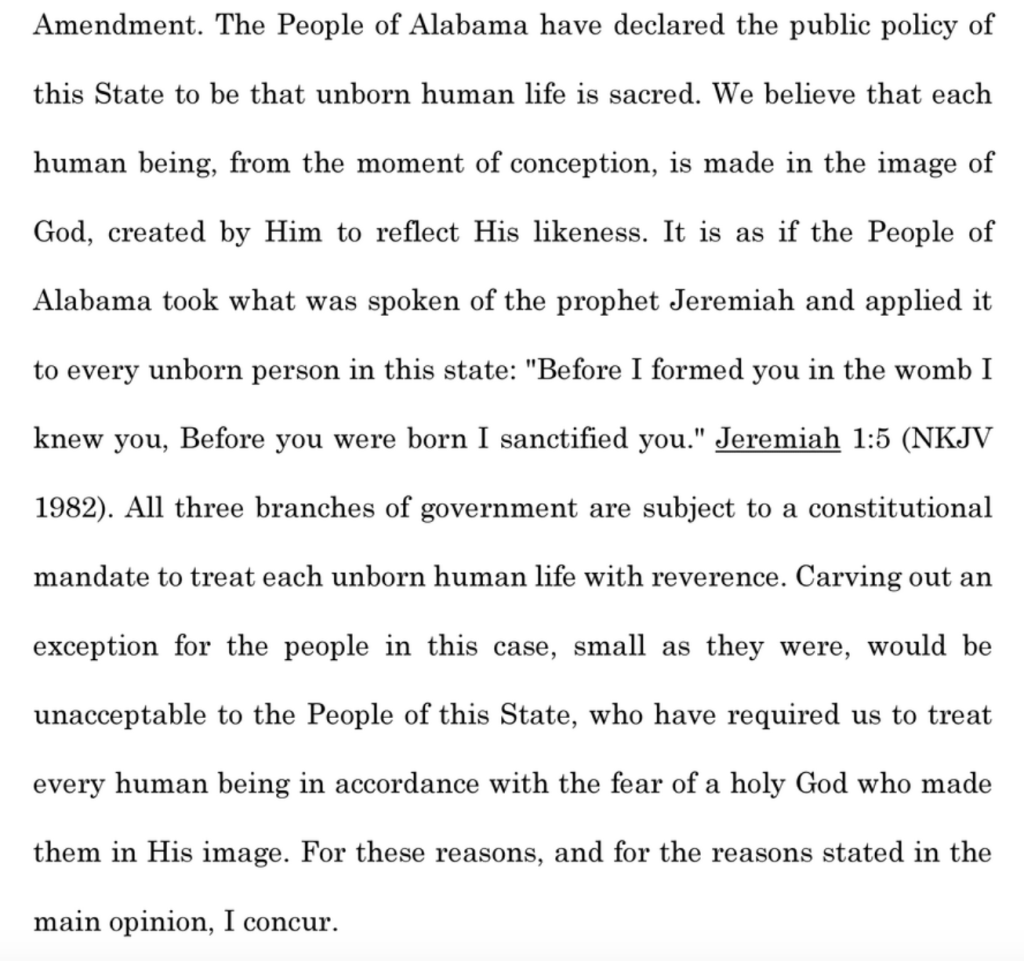
Yuck and go fuck yourself Parker, I think reflexively, because talking about your religious beliefs in a case of statutory interpretation is improper and indeed heinous as a general rule, and a complete perversion of the intent of the Framers that the American people should be governed by secular institutions; but what do you say about it when the State Constitution itself expressly adopts and imposes Evangelical thinking? The origins of the Sanctity of Life Amendment were clearly religious, and reflect the strength of the Christian Evangelical movement in Alabama. Justice Parker is probably – almost certainly, I’d say – correct in interpreting its intent to include all fertilized human eggs within the meaning of “unborn life”. This is precisely what those behind the Amendment would tell you.
Given the current provisions of the Alabama Constitution, Parker could have said nothing at all about God, and instead, like Justice Shaw, simply applied the supreme law to the question at hand, and the result in this case would have been the same.
What this means is that going forward, the larger problem isn’t this decision, or even other existing or potential legislation, it’s the Alabama Constitution. Yes, Justice Parker should have limited himself to the narrow question at bar, as did his fellow Justices, and then the more sweeping implications of this ruling would be limited mainly to fertility treatments involving IVF (though God knows what other situations might give rise to a remedy under The Wrongful Death of a Minor Act). Arguably that’s the case anyway, despite Parker’s Sermon on the Mount, because the majority ruled only on the meaning of one statute in one context.
But that’s neither here nor there when the argument next time turns entirely on the plain wording and likely intent of the Sanctity of Life Amendment in some other context. If such cases wend their way to the Alabama Supreme Court, the more moderate Justices won’t be able to duck the issue with the “we don’t have to decide that today” gambit; they will have to decide it. They may then be hard-pressed to disagree with their Bible-thumping Chief Justice. You might think that after that it’s off to SCOTUS we go – which would probably do us no good anyway, because as you’ve probably heard, SCOTUS is itself lousy with Jesus freaks who’ll like what they hear when Justice Parker drones on about the will of God – but SCOTUS doesn’t have the authority to review rulings on State constitutional interpretation, if I understand correctly.
I fear nightmarish consequences for the women of Alabama, with the opening up of whole new frontiers of liability, including criminal liability, over what goes on not just in the freezer units at fertility clinics, but within their own wombs, especially if the legislature starts passing new laws reflecting the Evangelical point of view (and why wouldn’t it?). Abortion is already illegal in Alabama, but it needn’t stop there. Women who fully intend to carry to term can easily be swept in too. The day may come when a pregnant woman who failed to take the proper dose of pre-natal folic acid is prosecuted for child endangerment and criminal negligence. Birth defects possibly connected to the mother’s behaviour when pregnant could lead to charges of child abuse. Child protection agencies may be given the authority to take custody of pregnant woman in order to safeguard the rights of the child she’s carrying. Miscarriage may be classified as homicide. Who knows how far these maniacs are going to run with this?
Today, most commentary quite rightly focuses on what this ruling means for women who desire IVF, and the doctors who practice in the field. It could well persuade those who’d provide IVF services that any such thing is practically impossible in Alabama, a miserable and soul-crushing outcome, and utterly unnecessary. If the court had simply made it clear that it wasn’t trying to define fertilized eggs as people generally, but only to satisfy the decent and humane provisions of that statute – after all, who wants to argue that a woman isn’t owed something when the negligence of a clinic destroys perhaps her last shot at becoming a parent? – and legally, that’s actually all they did decide. But of course the clinics are spooked, and the ruling is ham-fisted enough that it’s hard to say where they stand.
Here’s a pretty good little video on the matter:
Unfortunately, I don’t think that’s the half of it. It’s not the Court that’s declared war on women. The State of Alabama did that already, and it’s liable to get worse. Today, IVF. Tomorrow, everything else?
++++++++++++++++++++++++++++++++++++++++++++++++++++++++++++++++++++++++++++++++++++++++++++
UPDATE:
See below. They may try to legislate their way out of this. The question is, why can’t the Alabama Supreme Court strike down any such measure as unconstitutional? Justice Parker sure would. Maybe the others would conclude that they are trying to divine the will of the people as embodied in the Sanctity of Life Amendment, and a statute protecting IVF is an interpretive aid, indicating the people’s will is actually to exclude frozen embryos from “the unborn”.
I guess the backlash has scared them witless!

 the needlefish