From a humanitarian perspective, the sort of massive ground incursion the Israelis are now threatening is certain to be a catastrophe…This is a moral and strategic trap that Hamas has set, and to invade is inevitably to run right into it. Only God knows how many civilians will be caught in the crossfire, but surely it will be thousands, maybe tens of thousands, many of whom, given Gazan demographics, will be children, with much of the balance consisting of innocent victims of a war they didn’t want and had no chance to prevent. It will be a terrible thing to witness. It will cost Israel support in the nations predisposed to be sympathetic, and inflame the Muslim world to an extent that’s difficult to predict, or even imagine. The West Bank could blow up. Embassies could be burned. Terror attacks inside Israel may once more become a constant. It’s also likely that the sheer, bloody horror of the battle will overwhelm the memory of the 1,200 Jews who were murdered, and make it easy to paint Israel as a vengeful, oppressive, bloodthirsty state bent on carnage, and nothing else. When it’s over, no matter the outcome, it will have made any peaceful settlement of the Palestinian question vanishingly less likely, and possibly out of the question for as long as there’s living memory of the death and destruction...
Which brings us to the next problem: what does winning even look like? What’s the end game? The Israelis can’t want to reoccupy Gaza, but who replaces them when they withdraw, even supposing they’ve wiped Hamas off the face of the earth? What government comes into being? How? Who polices the peace? Who funds the rebuilding of civil society? Who convinces the bitter, battered young men just coming of age to ignore the exhortations of any infiltrating extremists, and choose peace instead? What stops Gaza from becoming the very same thing that it turned into after the last Israeli withdrawal – a frail state ripe for takeover by the latest set of fanatical jihadists, bent on revenge against the hated Jew?
Or maybe, considering such possibilities, Israel does want to reoccupy Gaza? How well can that be expected to go?
Dear God, what a mess.
When I was writing about this ongoing tragedy last October, I was much less certain than most of the pundits I follow about what Israel should do. I was inclined to acknowledge the overwhelming emotional, political, and strategic imperative to do something decisive in response to the most savage mass murder of Jewish innocents since the Holocaust, and came to view the invasion of Gaza as inevitable. Yet my first instinct, as expressed in the post excerpted above, was that a massive military incursion into the world’s most densely populated urban environment was bound to be a bloody mess that undermined Israel’s interests while accomplishing, ultimately, nothing but counterproductive carnage. The alternative – admitting the policy and intelligence failures, restoring the security perimeter, the strength of which had been sapped by the military demands of the unlawful colonization of the West Bank, and explaining to the enraged citizens of Israel that it was unthinkable for Jews, of all people, to avenge crimes against humanity with the wholesale slaughter of the innocent – was, of course, impossible. Even if somebody besides the despicable Benjamin Netanyahu was the one making the decisions, anything but the violent, almost spasmodic response that occurred was unimaginable in the terrible heat of that moment.
If the alternative was impossible and unthinkable, was it nevertheless the only sane policy option? I’m still not able to say, really, but I think it’s vital to be clear-eyed about the path chosen; look at what’s come of the inevitable invasion, and tell me whether this is, all other considerations aside, working out to Israel’s lasting strategic advantage. Six months into the invasion, what’s come of it? What’s been accomplished? What happens next? How does Israel now extricate itself from this increasingly reviled operation, and what, now, are the prospects for some sort of post-war peace and stability? What’s the end game?
That’s just it. Maybe nobody really thought the thing through to its logical conclusions. Maybe the feeling that a full-scale invasion was the only possibility convinced all concerned that they’d just have to figure out what came next as the situation evolved on the ground.
Now, the precision strike upon a convoy of aid workers from World Central Kitchen, killing seven of them in the midst of their mission to fend off an intensifying famine, is thought by some to provide the catalyst for a change in policy, for both the Americans and Israel. Maybe. If so, it’s all too typical that global opinion, including, crucially, within the United States, has finally been galvanized by the death of a few white citizens of western nations, and one can’t help but wonder what this sad but almost certainly accidental (perhaps negligent, but still accidental) tragedy should even be taken to mean. Is this the final proof that Israel has conducted its invasion without any restraint, in deliberate contravention of the rules of war? Or is it, perhaps, a little more murky than that, but still evidence that Israel should never have attempted the cleansing of Hamas from Gaza, given the inevitable collateral damage? Have we finally seen enough to turn against Israel, insist upon a cease fire, and pull the plug on the Israeli war effort if Netanyahu won’t come to heel and stop the bloodshed?
Set aside, for a moment, what’s right. What, at this point, even remains possible?
It’s plain that even now, as the Biden administration begins signalling that it may cut off at least some military support if Israel doesn’t moderate its military posture within Gaza, that Netanyahu and his right wing coalition government are going to attempt to finish the job they started half a year ago. Thus far, Hamas has been bloodied and severely weakened – it’s rarely mentioned in the Western media that the figure of 30,000+ deaths very likely includes over 10,000 Hamas fighters – but the organization hasn’t been destroyed. Indeed, it’s possible that it can’t be, not permanently; it’s nothing novel or clever to suggest that you can kill people, but you can’t kill an idea, and that sooner or later, when the dust settles, Hamas or something just like it will reconstitute itself amid the rubble, and capitalize on the seething hatred of those left standing. In that case, the obvious way to keep a lid on what rises from the ashes would be for Israel to resume an indefinite occupation of the Gaza Strip, a prospect that should sicken anyone reasonable within Israel, but might sound satisfactory to Netanyahu and his cronies.
Meanwhile, it remains to conquer the last bastion within which Hamas will make its final stand: Rafah, in the south, still relatively intact. As the war raged up north, and the bulk of Gaza’s urban areas were all but razed to the ground, anyone who could escape flocked to the relative safety of Rafah, where the prewar population of about 170,000 has now swollen to over 1.5 million increasingly desperate, and desperately hungry Palestinians. Burrowed in among them, intending, as usual, to force the Israelis to kill as many civilians as possible in any attempt to get at them, are whatever is left of Hamas and its fighters. Netanyahu is determined to move in and wipe them out, risking the piling of catastrophe upon tragedy, believing, apparently, that decisive military victory remains within Israel’s grasp. The Israeli Prime Minister has announced that a firm date for the assault on Rafah has been set, and as ever, I’m of two minds.
For the sake of Israel and the Jewish people, Bibi had better be right that something akin to a decisive military victory can still be achieved. Even at that, I can’t see how this ends well, taking the long view, even as I can’t see, either, what else there is to do at this point.
It’s hard, but to form any sort of responsible, balanced opinion on this mess, it’s necessary to take a step back and take a dispassionate look at what’s really going on. I’ve been arguing in this space for a while now that to accept the necessity of an Israeli military response to the atrocities of October 7 is to accept all which then flows from the general misery of urban combat and the remorseless logic of war, compounded by the additional horror of confronting an enemy death cult determined to ensure that as many of its own citizens die as possible. The appalling death toll was inevitable. Given Gazan demographics, that so many of the 30-35,000 dead, perhaps a third of that total, would be children, was also inevitable. Given how Hamas had fortified itself, embedded itself, and conducts itself in battle, the general destruction of buildings and infrastructure was inevitable too. It all flows from the decision to invade with the objective of striking a decisive blow, once and for all, which is the only rational goal of such an operation. Don’t talk to me about how Israel had every right to invade, but should have been kinder and gentler about it.
Moreover, we have to ask ourselves: would any nation in Israel’s position on October 8 have made a different choice? Would we have? I was about to ask what anyone supposes the Americans would do in the aftermath of such an attack, but we don’t have to speculate; the response to 9/11 was decades of warfare in Afghanistan and Iraq, with about 50,000 civilians killed in the former and perhaps over 600,000 losing their lives in the latter, the bulk of which can be laid at the doorsteps of the enemy only so long as you agree that it was proper to conduct those invasions in the first place. Operation Iraqi Freedom was, I suppose, a special case of a pointless war of choice which could easily have been forgone by more competent leaders, but Afghanistan? Suppose Al Gore had been in the White House when the towers fell? Do you suppose he and his advisors would have seen the wisdom of limiting the response to a Special Forces hunt for Bin Laden?
It’s also necessary to assert that despite the bleating of misguided elements in the Western Left, Israel is not committing genocide in Gaza, or anything like it. No attempt is being made to eradicate the Palestinians as a people. I suppose a little historical knowledge and perspective is necessary to realize that in an urban war of this intensity, involving this level of tactical difficulty, 35,000 deaths, probably a third of them combatants whose legitimacy as targets is unequivocal, isn’t even a particularly noteworthy outcome for six months of battle. What we’re seeing in Gaza isn’t much different from similar campaigns conducted by Western armies and their allies since the beginning of the 20th Century, from the destruction of European cities in two world wars to the damage inflicted in the more recent retaking the Iraqi cities of Mosul and Fallujah. When the Marines retook Hue in Viet Nam during 1968’s Tet Offensive, roughly 6,000 civilians were killed out of a population of 170,000 (a percentage that would equate to over 70,000 killed in Gaza*), and the city, including its historic citadel, was largely obliterated. Wresting Mosul from ISIS in 2017 caused between 9,000 and 10,000 civilian deaths out of a population of 1.7 million, a figure that makes the battle sound less violent and better managed, until one realizes that over a million inhabitants were evacuated during the fighting. I haven’t been able to find a tally of civilian casualties in the Korean war battles to take and then re-take Seoul, but the South Korean capital, then home to about 1.2 million people, was all but entirely destroyed; we do know that during the initial North Korean conquest of the city, almost 130,000 civilians were massacred, which gives you some idea of how many are killed when the invading army is targeting non-combatants as an end in itself. Throughout the Korean War, U.S. forces dropped more bombs on enemy cities and infrastructure than were expended across the entire Pacific Theatre in WW II, over 600,000 tons, leaving every significant population centre in ruins and killing perhaps as many as 280,000 civilians. So yes, in the wake of this current, and typically awful conflict in Gaza, we may decide that the evidence proves Israel did too little to limit civilian casualties in the pursuit of its tactical objectives. We may uncover individual murder of civilians or surrendered combatants by some military units (if not, this may be the first such war to avoid as much). There may thus be war crimes involved (as, I feel obliged to note, there always are). I don’t know, but even if so, that’s not genocide. That’s war, in all its vile ugliness, pretty much as it’s always been fought.
Which is why I was so leery of launching this invasion in the first place.
One final point: we know many thousands have died in Gaza. However, the figures reported as Gospel in Western media are supplied by Gazan authorities, that is, by Hamas. They may not be accurate, and shouldn’t be assumed to be true.
The pundits and analysts I follow continue to stress that after October 7, Israel had little choice but to attempt to eradicate Hamas. One of them, J.V. Last of the Bulwark, a writer I very much admire, had this to say a few days ago:
Israel’s longterm vision for equilibrium rests on normalization of relations with the Arab states. But in the short-term, Israel cannot live with a Hamas-controlled demi-state on its border. When we say that the 10/7 attack was “intolerable” we mean that literally: A liberal society cannot remain liberal when its entire population lives within a two-hour drive for terrorists who demonstrate the will and ability to raid, rape, murder, and kidnap its citizens at scale. A liberal society cannot be secure in such conditions. And a securitized society cannot be liberal.The 10/7 attack was intolerable because Israeli society cannot persist in its current, liberal form while under such a threat. And yet: Eliminating Hamas will cause a large number of civilian casualties and thus hamper Israel’s larger goal of normalization. As I said: Hamas put Israel in a box.
But I want to be clear about why Hamas was able to achieve this: Hamas is not just a terrorist organization. It is a death cult. It is a movement so wedded to its goal that it is willing not just to murder its enemies, but to cause the deaths of tens of thousands of its own so it can use that suffering as a political cudgel. And Hamas’s goal is genocide. Once a terrorist death cult was put in charge of the government in Gaza, tragedy was guaranteed...The logic of the situation is pitiless. Hamas will use Rafah to hide. They will do so in a manner designed to maximize the number of civilian deaths. (Just a reminder: Reports from as far back as January suggest that Hamas’s military commander, Yahya Sinwar, was using hostages as human shields—and four of the remaining hostages are Americans.) This is the path down which their desire for genocide leads them. They are pursuing their particular preference for equilibrium in a rational—though evil—way.
For its part, the best strategic pathway for Israel is to eliminate Hamas, no matter the cost. Doing so will mean many innocent deaths. It will strain Israel’s relations with the United States and Europe. And it will create obstacles to normalization with Saudi Arabia.
There’s a great deal of truth to this analysis, but to go along with it one needs first to accept that the goal of eliminating Hamas is actually possible (which is at least questionable), and further, that some sort of post-war stability can be imposed that rebuilds the beleaguered Strip back into a functioning civil society governed by sane, good-faith actors. This is how Last concludes:
The only reasonable hope on offer is that Israel’s leadership will keep their strategic interests in mind as they pay the price Hamas has set for them. There are three imperatives for Israel going forward:
1. Hamas must be completely eliminated. If Hamas is still a viable organization when Israel concludes the war, then we will have the worst of all worlds.
2. Israel should aggressively return to the normalization talks with Saudi Arabia and be willing to give even more than it was prepared to offer before 10/7.
3. Israel should pour resources into rebuilding Gaza because its long-term security requires a functioning independent state on the strip. Having Gaza as a failed state would be just as destabilizing for Israel as having it governed by Hamas. Israel’s best chance for reaching an equilibrium point is a prosperous, democratic Palestinian state.
Sure. Hear, hear, even.
But does anybody believe that Israel is going to invest tens of billions – God only knows how much will be required – to rebuild Gaza in the wake of all this bitterness and horror? Should we expect the international community to pitch in? Can we rely on the United States, in the grips of policy paralysis, to get a funding bill through Congress to rebuild the shattered Palestinian statelet when we can’t even get them to fund Ukraine? If the money’s there, who administers this vast rebuilding project? Who governs Gaza in the interim? Somebody is going to have to militarily occupy the rubble and maintain order while the reconstruction occurs – who? Israel? How might that go over with the survivors? If not Israel, then whose army moves in? You can forget about the Arab states, and Europe has its own problems. Americans then? Does that sound like a good idea? Do you suppose that’s something that Joe Biden would want to try to ram through Congress in an election year? Who then manages the transition to self-government – the UN, which only acts through its member nations, none of which are liable to be too keen?
Look, I want to believe in unicorns as much as the next guy, but it’s hard to imagine how there will ever be enough money, will, and muscle to put this part of the world back together, and prevent a renewal of the cycle of extremism and violence, even supposing Israel actually succeeds in eradicating Hamas once and for all. I suppose we have to believe it’s possible, just as we have to believe that the Netanyahu regime in Israel can soon be replaced by a government willing to reverse the annexation of the West Bank and renew an effort towards a two state solution, since what’s the alternative? Yet never, from where I sit, have the mistakes and prior sins of all concerned seemed to have locked everyone involved into such an unbreakable cycle of futility. I don’t expect to live to see Israelis and Palestinians living peacefully side by side within their sovereign democracies.
Which brings me back around to the start of my own circle. How is anything now going to be any better, for anyone, than if Israel, post October 7, had decided upon the impossible, and done nothing beyond re-establishing and bolstering its defences against any repeat of the atrocities? You tell me, because I’m fresh out of bright ideas. And I’m repeating myself, getting nowhere.
Meanwhile, pray that the coming assault on Rafah isn’t as damaging to the innocent, and to Israel itself, as it’s meant to be for what’s left of Hamas, a monstrous organization whose dead should be mourned by nobody. No tears for the murdering fanatics of the barbarous death cult. This is all on them.
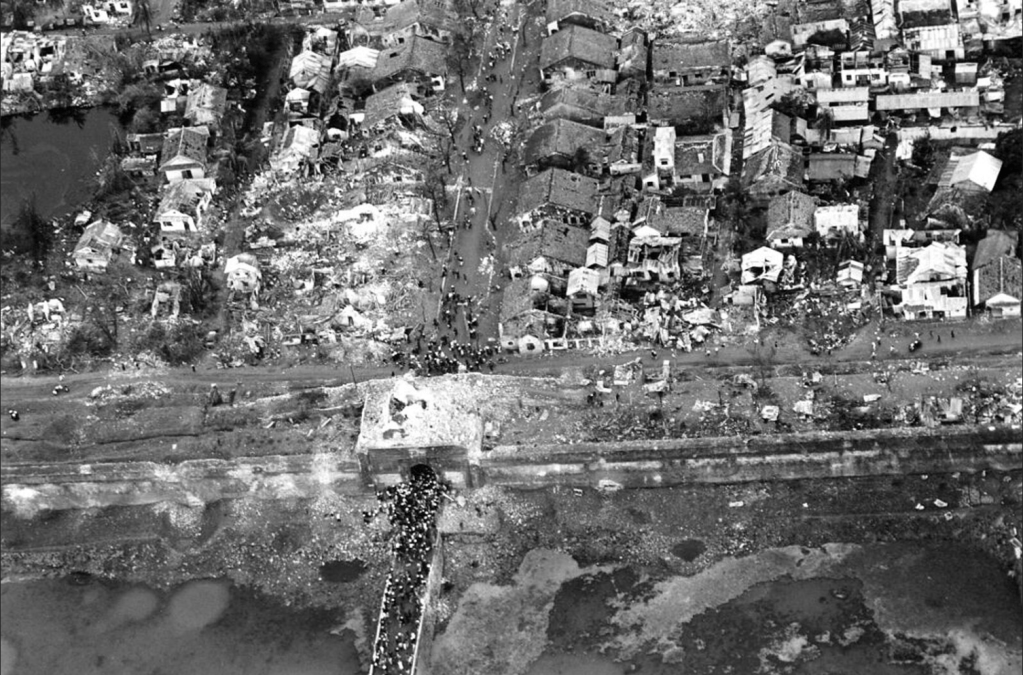
Hue City after Tet
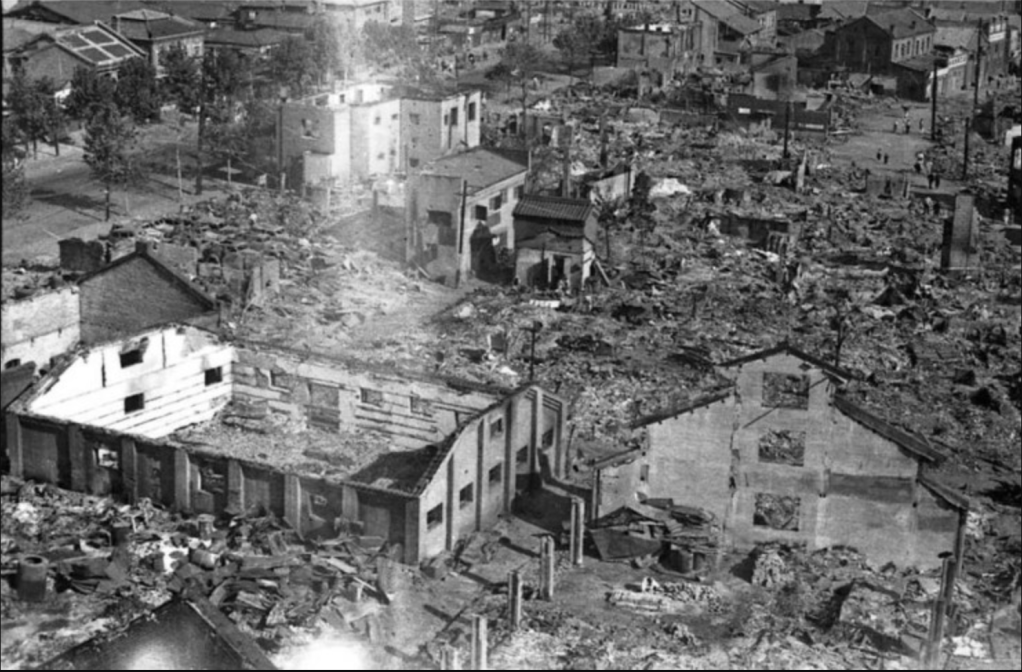
Seoul after its recapture

Mosul, as retaken from ISIS
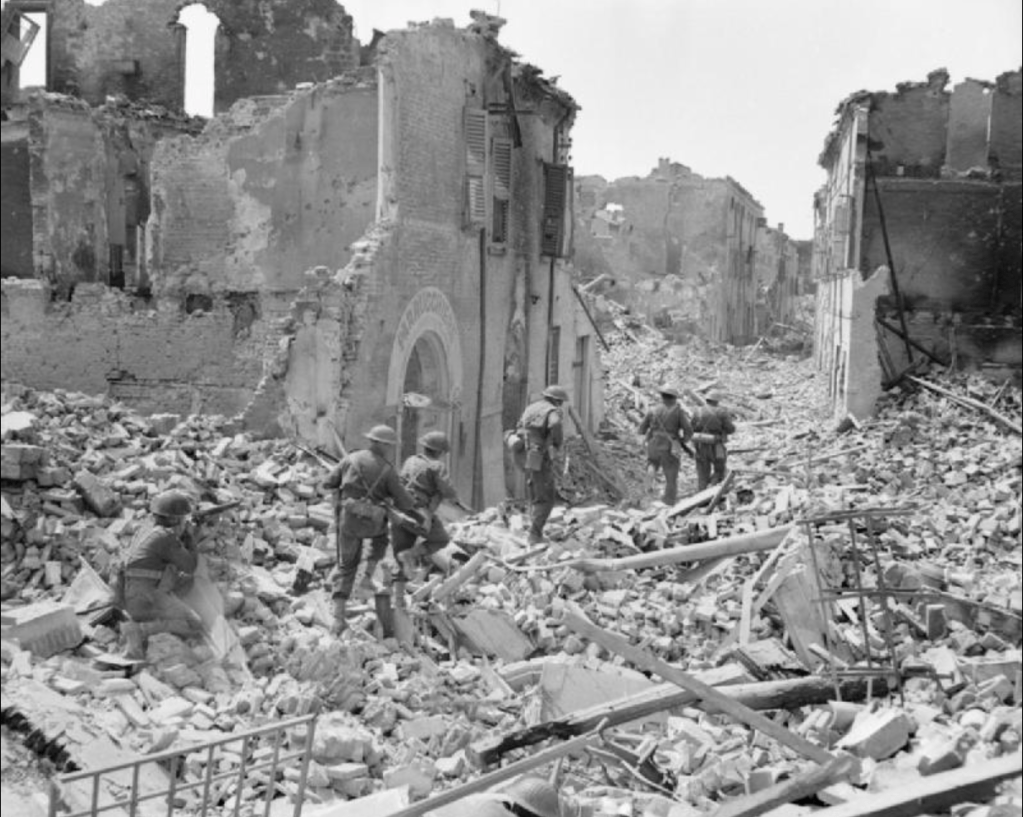
Argenta, Italy, 1945
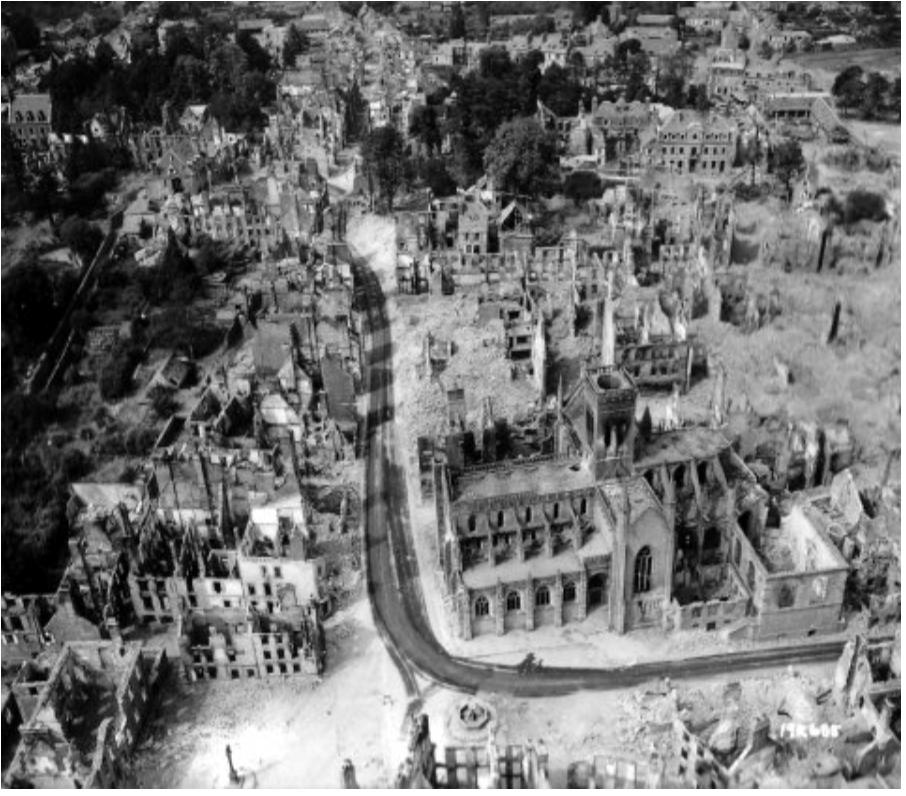
City of Vire, Normandy, 1944, after driving the Germans out
*4,000 of these were executed in purges conducted by the Viet Cong before being driven out in the counterattack, which means the attacking forces, not the Americans, were responsible for a percentage equating to about 25,000 in Gaza; but Hamas has also contributed greatly to Palestinian casualties.
 the needlefish