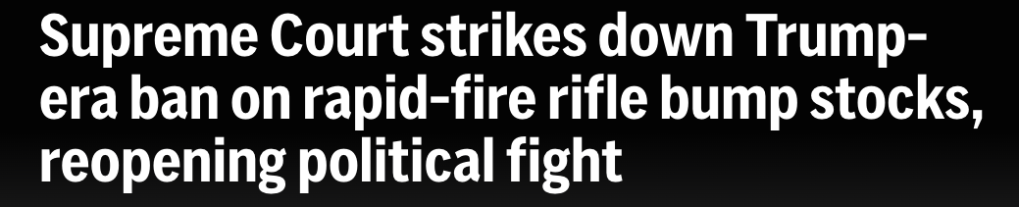
Can you believe these craven A-holes? Look, we’ve all grown inured to the idea that most of the U.S. Supreme Court is composed of religious nut-bar Christo-fascist absolutists, a few of whom are shamelessly on the take and essentially owned by the oligarchs, and all of whom are in the tank for Trump. But this? What’s with the gun fetishism? It can’t be that they’re under the thrall of the NRA, because they don’t need to get re-elected, and anyway the NRA has pronounced itself content with a ban on bump stocks, which was probably a factor in Trump’s decision to go along with it. So what gives?
We’ll get to that presently.
First, though, what’s a bump stock? It’s a sort of spring-loaded device that replaces the conventional stock of a semi-automatic weapon, usually an AR-15, and uses the recoil of the firearm itself to convert the one-trigger-pull-one-shot semi-automatic gun into something virtually indistinguishable from an illegal fully automatic assault weapon. It’s a truly ingenious and thoroughly pernicious work-around designed a few years back to allow regular citizens to, in effect, circumvent the decades-old federal ban on civilians owning machine guns:
This boost in firepower is, of course, pure overkill on a rifle which can already shoot just as fast as you can pull the trigger, which for most people is about 2-3 rounds per second after a little practice, or a theoretical 120-180 rounds per minute (the average clip would be emptied in just a few seconds). With the bump stock, the AR-15, otherwise virtually indistinguishable from the military M-16 derived from it (and thus built for extremely high rates of cyclic firing) becomes capable of an astonishing 400-800 rounds per minute, depending on the model, just as fast as the legendary M-60 machine gun that became every GI’s best friend during the Viet Nam War. There is, obviously, only one purpose for a gun that fires that fast, and it ain’t hunting moose.
The ban on these diabolical things, now struck down by SCOTUS, was instituted in the aftermath of 2017’s horrendous mass killing in Las Vegas, when a 64-year-old Stephen Paddock, motive unknown, perched himself in a 32nd floor suite in the Mandalay Bay hotel, and used several weapons equipped with bump stocks to pour more than a thousand rounds into a dense crowd attending a music festival across the street. In a few brief minutes he killed 60, wounded another 400, and caused a mass panic in which about 400 more were injured. Everyone, even Republicans and their NRA backers, was horrified enough to allow the Trump administration, via ruling of the Bureau of Alcohol, Tobacco, and Firearms, to designate weapons equipped with bump stocks as “machineguns” as defined under the existing ban at 26 USC 5845(b), which reads:
Machinegun
The term “machinegun” means any weapon which shoots, is designed to shoot, or can be readily restored to shoot, automatically more than one shot, without manual reloading, by a single function of the trigger. The term shall also include the frame or receiver of any such weapon, any part designed and intended solely and exclusively, or combination of parts designed and intended, for use in converting a weapon into a machinegun, and any combination of parts from which a machinegun can be assembled if such parts are in the possession or under the control of a person.
When that was drafted, nobody had the imagination to envision something like a bump stock, hence what now turn out to be the fateful words by a single function of the trigger. That’s how an according-to-Hoyle machine gun works. You pull the trigger, hold it, and the gun fires until it empties its magazine (or runs through its belt). That’s not how a bump stock works. When a gun is equipped with a bump stock, the shooter’s finger remains stationary, held in place by a finger rest, and upon the first pull of the trigger the business end of the gun moves back and forth rapidly and continuously, causing the unmoving finger to pull the trigger as the weapon cycles. Arguably, then, that’s not a “single function”, since it involves more than one pull of the trigger, mechanically, even though in both cases the shooter only flexes his trigger finger once, and then the gun does the rest.
Had anyone been able to conceive of such a thing, it certainly would have been included in the definition, since the goal, after all, was not to provide an extra-granular classification system for gun fetishests, but to abolish weapons suitable for mass killing, like the Tommy Guns that the gangsters were then fond of toting, before Congress, appalled at what that particular weapon could do, enacted the ban in 1934. Most models of the Thompson sub-machine gun fired at a rate of about 600 rounds per minute, considerably slower than the maximum of 800 RPM reached by an AR-15 equipped with a bump stock. At that rate, about 13 rounds per second, you’re emptying standard 40-round clips at a prodigious rate, but that needn’t hamper you too much from emulating a belt-fed, crew-served weapon if you have enough clips, and hone your reloading technique. Val Kilmer mastered the moves preparing for the legendary shootout scene in the movie Heat:
Totally bad-ass. I’ve read that even battle-hardened soldiers don’t do it any better than that, so your average crazed mass-shooter likely wouldn’t be so proficient, but you get the idea.
Now, any law student could tell you that a purposive reading of the statute’s definition of “machinegun” could only lead you to conclude that a gun with a bump stock is exactly what the law was meant to prohibit, and would have been included if bump stocks had existed at the time. Considering the importance of the legislative goal, and the ambiguity surrounding the defined term, given that with both categories of weapon in question the shooter flexes his finger only once, the sane thing would be to bring bump-stocks under the ambit of the ban. An interpretation that bump stocks are caught might be reinforced, in this analysis, by noting that the damned things are a deliberate and devious contrivance to evade the law on technical grounds, so that America’s numerous gun-nuts could once again lawfully own fully automatic weapons. But we don’t want them to have fully automatic weapons. Two to three high velocity rounds a second out of their semi-automatics should be plenty. Anything more than that and you’re into military firefight territory, which is, I guess it needs emphasizing, a very bad thing in a civilian environment. It’d be silly to undermine sound public policy aimed at averting mass carnage with an overly restrictive, almost obsessively nit-picky parsing of a defined term, wouldn’t it? We can all agree on that much, at least, right?
So what does Clarence Thomas say, writing for the 6-3 majority in Garland v. Cargill? Get this:
Section 5845(b) defines a “machinegun” as any weapon capable of firing “automatically more than one shot . . . by
a single function of the trigger.” We hold that a semiautomatic rifle equipped with a bump stock is not a “machinegun” because it cannot fire more than one shot “by a single function of the trigger.” And, even if it could, it would
not do so “automatically.” ATF therefore exceeded its statutory authority by issuing a Rule that classifies bump
stocks as machineguns...With or without a bump stock, a shooter must release and reset the trigger between every shot. And, any subsequent shot fired after the trigger has been released and reset is the result of a separate and distinct ‘function of the trigger.’ All that a bump stock does is accelerate the rate of fire by causing these distinct ‘function[s]’ of the trigger to occur in rapid succession.
See? All that a bump stock does is provide the same firepower.
To bolster his ruling, Thomas even included half a dozen diagrams, demonstrating the different ways that automatic weapons and semis with bump stocks accomplish exactly the same thing. I’m not making this up. Thomas is that determined to prove that real automatic weapons are functionally different from the bump stock semis that mimic their performance. This is from the majority judgment:

Now do you understand? Can’t you see? They’re different.
So there you go, all you militiamen and cosplaying Navy Seals! You fire just as many flesh-ripping, bone-pulverizing Mach 3 bullets as you want, just as fast as you can, and good for you if you live in Texas, or one of the 39 other States that don’t ban high capacity magazines, so you can load her up with one of these hundred-round babies and really let her rip:

That ought to cut down on the reloads! Yeeeeeee-hawww! (Remember not to overheat the barrels kids).
Sotomayor, in dissent, practically pops an aneurysm:
Today, the Court puts bump stocks back in civilian hands. To do so, it casts aside Congress’s definition of “machinegun” and seizes upon one that is inconsistent with the ordinary meaning of the statutory text and unsupported by context or purpose. When I see a bird that walks like duck, swims like a duck, and quacks like a duck, I call that bird a duck. A bump-stock-equipped semiautomatic rifle fires “automatically more than one shot, without manual reloading, by a single function of the trigger.” §5845(b). Because I, like Congress, call that a machinegun, I respectfully dissent.
I’m surprised she didn’t put quotes around “respectfully”.
So now to the main question: what’s going on here, really? Why is SCOTUS always so keen to make sure that ordinary citizens can out-gun the cops and have a go at duking it out with the 82nd Airborne? Surprisingly, in this instance it really didn’t have much to do with gun rights, and had nothing at all to do with the Second Amendment. This case wasn’t brought by the NRA. It was brought by a libertarian advocacy group funded by America’s oligarch billionaires. The goal was much bigger than to make sure that any dumbass who can fog up a mirror gets to own a weapon fit for pitched battle against the Russians in Avdiivka. The over-arching purpose of this and many other lawsuits brought over the past few years is to dismantle what the extreme right-wingers and their billionaire pals refer to as “the administrative state”, AKA the “deep state”, or what you and I would call regulatory agencies.
It sounds like a conspiracy theorist’s fever dream, but going back decades, now, the most wealthy of America’s super-rich, the 0.0000001% crowd, have been engineering both the composition of the courts and the cases that go before them, in an effort to change not just the law, but the power of government to enforce it. For several decades, now, right wing lawyers amenable to the oligarch’s goals have been indoctrinated, and then put forward for judicial appointment, and subsequent promotion, by a billionaire-friendly organization called the Federalist Society, masterminded by one Leonard Leo, as supported by a nebulous network of anonymous donors and made-to-order activist groups. When Mitch McConnell was stacking the federal judiciary, he was working from a list of approved candidates supplied by Leo, and so was Trump when he stacked the Supreme Court; all three of his appointees, Kavanaugh, Gorsuch, and Coney Barrett, were picked from a slate supplied by Leo, an astonishing surrender of governmental discretion to private interests that Donald didn’t even try to conceal. He bragged about it. He ran on it.
Leo had a role in the previous appointments of the other three conservative justices too. Meanwhile, the billionaires with whom Leo is chummy have spread money and influence around to make sure that “the right cases get to court”, and get decided their way, through advocacy groups acting either as litigants, or as “friends of the court” furnishing what are known as “amicus briefs”, which make arguments in favour of outcomes in cases in which they aren’t directly involved as parties (stress directly; they always have an interest at stake). The details of how all the networks of donors, litigants, and even lawyers are intertwined are far too complex to set out here – you’d have to write a book – but in the past couple of years this has all been rigorously investigated by journalists (God bless ’em) working for Pro Publica, Rolling Stone, and the major newspapers. You can read more about Leonard Leo, and the company he keeps, in this excellent piece:
https://www.propublica.org/article/we-dont-talk-about-leonard-leo-supreme-court-supermajority
With the jurists in place, the advocacy groups really got down to business with a flurry of litigation that’s had a dramatic impact on the American legal landscape. Particularly active has been an organization calling itself the New Civil Liberties Association, a sort of anti-ACLU funded by all manner of capitalists and industrialists, particularly Koch Industries, the petrochemical giant now run by Charles Koch, following the death of brother David (though people will often still refer to the efforts and interests of the “Koch Brothers”). The NCLA was in effect the plaintiff in the bump stock decision (the named litigant, Cargill, was an NCLA member), and made no bones about being the driving force behind the litigation. These guys see no need to work in the shadows or pull strings from behind the scenes. This is a well publicized crusade. They’re happy to tell you all about it on their website (which for some reason I can’t link, but just type “NCLA” into Google if you want a more detailed look at what they’re up to). This banner headline was posted by the NCLA itself:

The NCLA likewise filed an amicus brief in the case of West Virginia v. EPA, another rote 6-3 decision in which SCOTUS, in the words of Supreme Court watcher and Vox contributor Ian Millhiser, “strikes down a federal environmental regulation of power plants that never took effect, that the Biden administration has no intention of reinstating, and that would have accomplished absolutely nothing even if it had been enforced.” Why bother then? To set a useful precedent of general application, using any pretext possible. In this case, the Court curtailed the EPA’s ability to write regulations to combat greenhouse gas emissions, and in doing so invented out of whole cloth the over-arching “major questions doctrine”, in effect leaving it to SCOTUS to decide whether any federal regulation drafted at the agency level is of such significance that it should have been legislated by Congress, and not delegated to the bureaucrats. Wielding this new tool, SCOTUS can invalidate any regulation it doesn’t like, which is to say, any regulation the billionaires and their advocacy groups tell them they shouldn’t like. Hoping for the same sort of victory, the NCLA launched a new case, Murthy v. Missouri, now under consideration by SCOTUS, which on the surface aims to prohibit the Executive Branch from any attempt to discipline social media outlets in times of dire emergency, using the Biden Administration’s directive to police the spread of lies about Covid-19 as their anvil. They don’t care about social media, or censorship, for that matter. They want the Court’s pronouncement of a general principle that ham-strings the Administration when attempting to use executive power to deal with anything at all.
The end-game is to finally obliterate the “Chevron Doctrine”, named after the 1984 SCOTUS decision in Chevron v. National Resources Defense Council. Chevron is to the oligarchs what Roe v. Wade was to the evangelicals, and they’ve chafed against it with increasing urgency and tenacity ever since it was decided. No wonder; the Chevron Doctrine holds that courts, including SCOTUS, shouldn’t be second-guessing the expert technical judgements of the federal agencies tasked with drafting regulations. Again in the words of Millhiser:
Chevron established that courts ordinarily should defer to policymaking decisions made by federal agencies, such as the Environmental Protection Agency or the Department of Labor, for two reasons: Agencies typically have far greater expertise in the areas they regulate than judges, and thus are more likely to make wise policy decisions. And, while federal judges are largely immune from democratic accountability, federal agencies typically are run by officials who serve at the pleasure of an elected president — and thus have far more democratic legitimacy to make policy choices.
https://www.vox.com/politics/2023/5/2/23706535/supreme-court-chevron-deference-loper-bright-raimondo
The operation of this doctrine has, for four decades, ensured that a federal regulatory agency like the EPA could decide what constitutes a dangerous pollutant, the FDA could decide which drugs are safe, OSHA could determine what constitute unsafe working conditions, the SEC can make the rules on how people can and cannot sell securities – and the ATF can decide what amounts to a machine gun – and there wasn’t a damned thing Koch or any of his billionaire pals could do about it. A robust Chevron Doctrine therefore limits, sometimes severely, their room to maneuver across the entire spectrum of their operations, particularly when it comes to marketing whatever dangerous or fraudulent products they can sell, abusing whichever workers they please, issuing whichever bonds and stocks they want to hawk to anybody they can find, dumping as many toxins into the environment as seems expedient, and so on. Thus the nettlesome doctrine must be destroyed. The “major questions” nonsense got them most of the way there, but that wasn’t enough. They want Chevron gone, utterly and for good.
Well, now, unless I miss my bet, it’s about to be. Currently before SCOTUS, pending a decision likely to be released before the end of session this summer, is Loper Bright Enterprises v. Raimondo, in which the issue, expressly, is whether the Court should overturn Chevron. Guess who’s all over them as the Justices deliberate:

The NCLA isn’t just submitting briefs, it’s actively involved. Ostensibly, the case was brought by a group of commercial fishermen fighting a federal regulation that requires them to pay for third-party monitors, who tag along on their boats, and collect data useful for conservation and pollution control efforts. They are, of course, represented by the NCLA and another conservative advocacy group, along with lawyers from the firm Latham & Watkins, said to be the most profitable law firm in the world, and itself a frequent lobbyist and litigator against, in particular, regulatory efforts to combat climate change. Who do you suppose they’re chummy with?
So brace for it. The case was argued last January, and now we wait for what I assume is a foregone conclusion, and a signal victory for the billionaire industrialist class. Let off the leash by SCOTUS, they’ll now be able to run rampant, any time it’s worth their while to take a regulatory agency to court and get it off their backs.
Congress could step in and pass regulations themselves, you say? Fat chance. They don’t have the expertise, and anyway the GOP will make sure that nothing gets through the Senate, even if the Dems take back the House (it goes without saying, but of course the Republicans will oppose anything that upsets the donor class).
It could get even worse. Another decision still to come by the end of session is whether the President has absolute immunity for criminal acts committed while in office, which I once would have told you they’d laugh out the door in short order. They should, because the entire foundation of American democracy will be undermined if they don’t, but I’m not so sure anymore, because look who’s determined to get Trump re-elected in November:

Trump’s lawyer in the case, John Sauer, was until recently the Solicitor General of Missouri, from which office he filed a motion on behalf of his State, along with five others, to have the Supreme Court toss out the 2020 election results in a number of key swing States (the MAGA crowd failed, for once, praise Jesus). I haven’t mustered the energy to dig deep enough into Sauer’s history to figure out who he sits and eats with, and I can’t really say exactly who’s giving Trump the money to pay him, but you can bet it isn’t Greenpeace or the ACLU. I haven’t been able to turn up any amicus briefs from the NCLA, either, but no doubt the oligarchs are watching this one closely. I’d be gobsmacked if they weren’t actively involved somehow, and they certainly fund the PACs that supply the millions in dark money that Trump uses to cover his bills, when he covers them. To be honest, I’m not sure whether it’s PAC money going to the lawyers, or the millions he’s also grifting out of his small-dollar MAGA disciples; maybe it’s a little of both.
This is a genuinely extraordinary moment in American history. The balance of power between the government and its most wealthy citizens may be in for a radical shift, even as the future of American democracy itself is threatened. All that stands between the rapacious, predatory capitalists and every dirty little thing they’ve ever wanted are some pesky but largely gaslit voters, and a hand-picked collection of corrupt and friendly judges they put there themselves to make good things happen, plying them, when necessary, with what can only be seen as bribes, literally millions-worth in Justice Thomas’s case. It’s borderline unbelievable. The Americans have wound up with a bought and paid for Supreme Court, made up of the Justices appointed, in effect, by the billionaire class. The conservative Justices are deciding cases brought by those same billionaires and their minions, after listening to arguments made by the advocacy groups those billionaires have created and funded, then ruling continually in the billionaires’ favour. It’s all so corrupt you could lose your mind.
Sometimes, I fear that the most we have to hope for is that after they make sure he skates on his crimes and gets elected, Trump turns on the over-monied bastards, and wields what may be an unprecedented expansion of executive power and impunity to screw them over five ways from Sunday. That would be just like Donald, and just what they deserve.
 the needlefish
One comment on “Screw The Deep State! Let’s All Get A Machine Gun!”