So much for the price of groceries. The incoming U.S. President seems to have bigger fish to fry.
Unfortunately for all concerned, Our Donnie, with his repeated expressions of intent to take back the Panama Canal, turn Canada into the 51st State, and either buy or seize Greenland, seems to have come down with an especially feverish bout of Manifest Destiny. Maybe he’s thinking about legacy (Trump expands U.S. territory by largest amount since Louisiana Purchase!), or maybe he just likes the idea of all those resources belonging to America, I don’t know – who knows with Donald? – but regardless, he seems to be veering into just the sort of wild-eyed gonzo policy territory where all of us expected him to take up residence at his first opportunity, which of course he is, generally, except – except – the Trumpian objective that’s typically held up as proof of his craziness, the desire to grab Greenland, isn’t quite so nuts as it seems.
I mean it’s batshit, don’t get me wrong, but not utterly batshit. There are reasons why Trump isn’t the first President to think about acquiring Greenland. The island is of lasting, and these days increasing, geopolitical significance.
In large part, this is because the world doesn’t actually look like this:
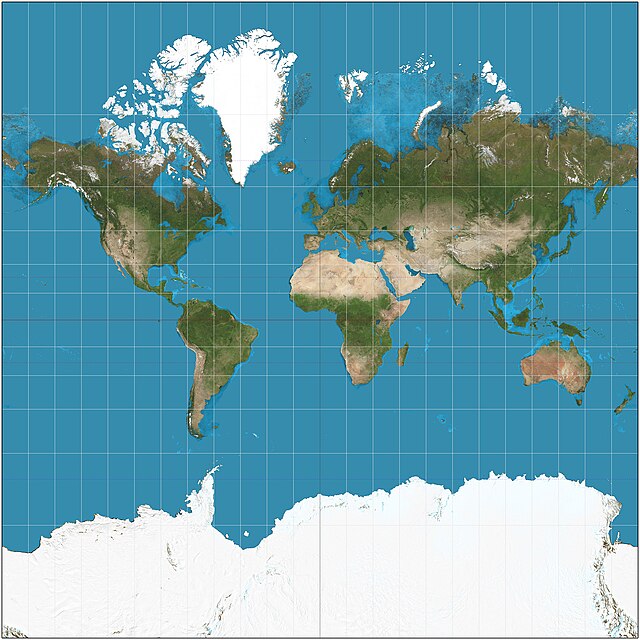
This is, of course, a Mercator projection, the like of which we’ve all seen all our lives, to the point that it’s almost reflexive to conceive of the world’s nations as being laid out flat, as if upon a card table, with us on the left, and Russia, Europe, Asia et al. on the right, or sometimes vice versa. Ask the average schmuck in the street to conjure up a mental image of the continents, and, assuming he can do it at all (i.e., assuming he’s not your average American), he’s almost bound to see Mercator’s famous map in his mind’s eye. I’m sure this is how Trump envisions the world, dimly (though if I’m right he’s being advised by somebody with a more accurate understanding of what the world’s really like). The problem is that this projection of the globe onto a flat surface introduces gross distortions, with the landmasses in the Northern hemisphere appearing disproportionately huge – much much bigger than they really are – while the impression is created that Eurasia is over there somewhere, far removed from us. Yet the Europeans, Russians, Chinese and the rest aren’t over there somewhere, because the world isn’t a flat rectangle. No matter what the burgeoning ranks of the flat-earthers think, it’s a sphere. And, if you looked down on that sphere from above the North Pole, this is what you’d see:
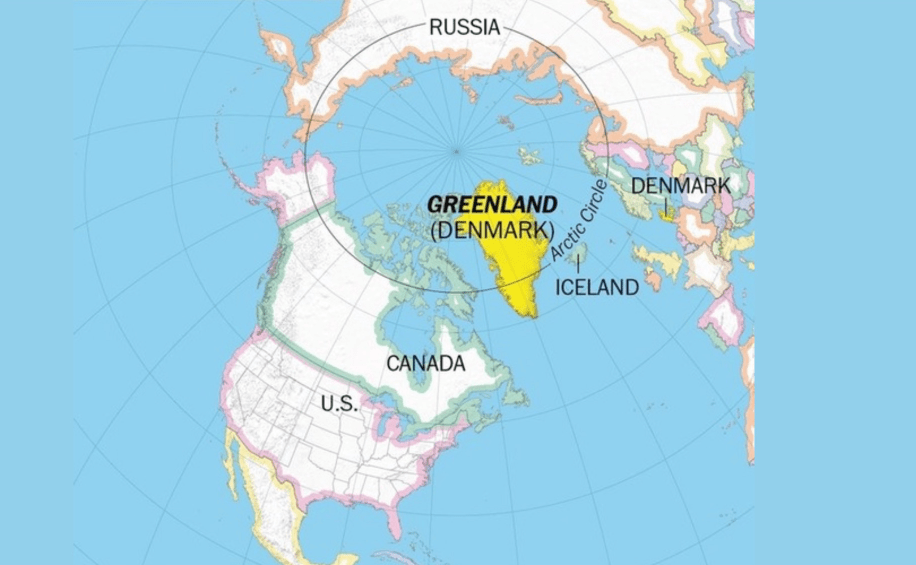
Notice how the northern regions of Canada, Europe, and Russia all butt up against the perimeter of the Arctic Circle, and darned if those pesky Russians aren’t just across the way! And look at Northern Europe! Why, it’s pretty close too! Note, too, the extent to which Greenland sits inside the circle, so close to the pole.
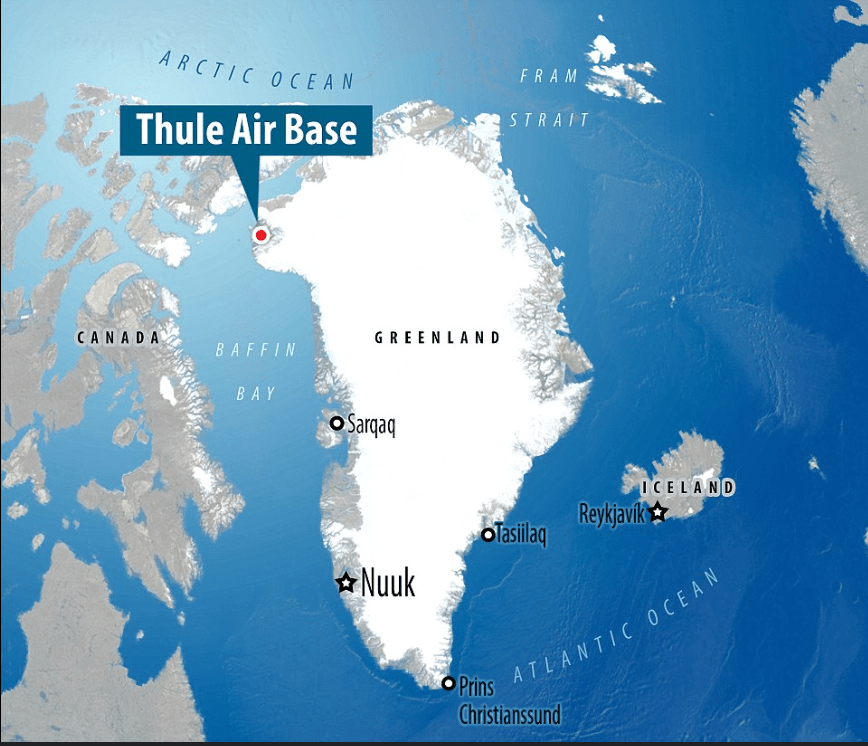
Now, imagine you’re looking at this map at the dawn of the Cold War, and considering what would happen if hostilities between NATO and the Warsaw Pact escalated into global thermonuclear war involving North America. Where would the doomsday attack come from? The answer’s obvious, isn’t it, whether by bomber or ballistic missile: over the pole. This is why the North American Air Defence Command, a joint operation of the U.S. and Canada, came into being, and why the construction of radar facilities throughout the North was an urgent NORAD and NATO priority from the moment our relationship with the Russians went south after WW II. Among the locales for the powerful radars that have kept an eye on northern skies ever since was Greenland, where America constructed, and maintains to this day, extensive facilities at a place once known as Thule, now called Qaanaaq:
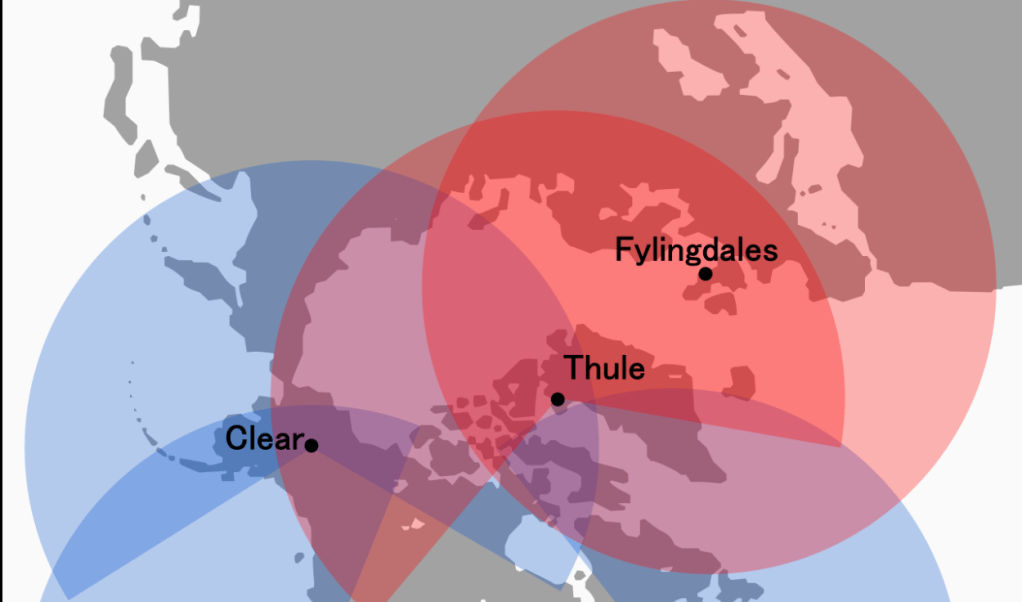
There remains a large U.S. Air Force base at (former) Thule, but even more important was the radar facility that formed a key component of the Ballistic Missile Early Warning System, which also included stations in Alaska and the UK:
While the geopolitical situation has fluctuated following the collapse of the Soviet Union, the surveillance of the air approaches to North America has remained constant. Today, the station at what’s now called Pituffik Space Base looks like this:

That’s the Upgraded Early Warning Radar, a fixed “phased array” that’s incredibly powerful and sensitive, providing not just missile warning and tracking but also the monitoring of about 2,000 Earth-orbiting objects, some as small as 10 centimeters across. Running it costs upwards of $U.S. 100 million per year. There was a while there, after the fall of the Soviets, when the maintenance of this exquisitely keen, unblinking vigil of the northern skies seemed like a vestige of an uglier time, and something which we might, one day, be able to scale back, but that was then. Not anymore. Not with Putin running the show in Russia. So long as the geopolitical climate remains as frosty as it is today, Greenland and the facilities it hosts will remain of the utmost strategic importance.
This, however, might not be the half of it. As somebody in Trump’s inner circle seems to appreciate, Greenland and the waters around it are now poised to assume a greatly increased importance in world affairs, owing, ironically, to a phenomenon the existence of which Donald and his merry band of MAGA maniacs denies: global warming. With climate change, the northern ice packs are receding, and the fabled Northwest Passage, El Dorado to the mariners and explorers of ages past, is now expected to become much more readily available to international shipping. In fact, the process has already begun, with thinning summer ice packs making transit of the passage possible for several months of the year, sometimes with the assistance of ice-breakers, though large ships with strengthened hulls are capable of making it through on their own. Traffic has increased by about 35% since 2012, and is expected to keep growing.
What’s the big deal about sending ships through the Arctic Ocean? Again, it’s necessary to look at the planet as a sphere, rather than a Mercator projection. Viewing the world from a vantage point over the North Pole, it’s immediately apparent that the shortest, fastest route between Asia and both Europe and the American eastern seaboard is the one across the top the world:
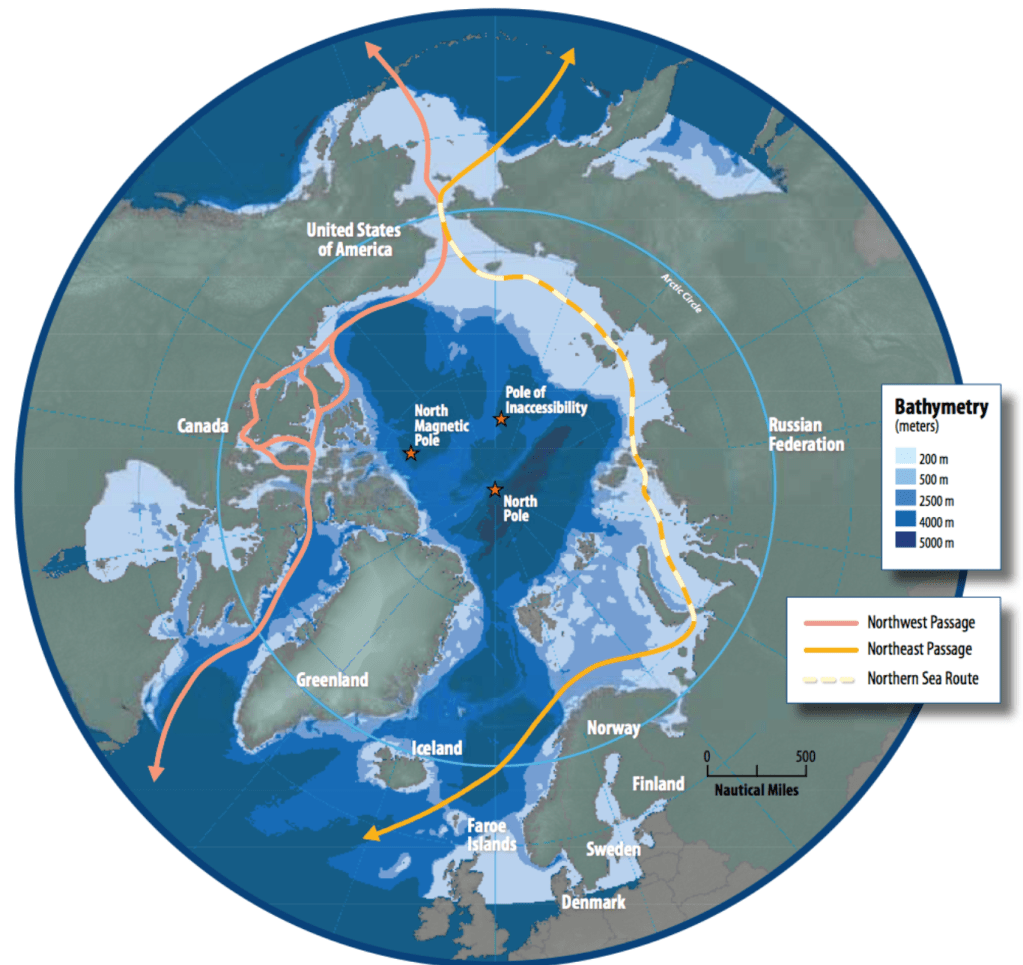
The Passage is also the fastest route between the ports of the American east coast and the oil fields of Alaska. Depending upon the ports of call, use of the Northwest Passage cuts transit time by thousands of kilometers and several days, and time plus distance equals money. Given the potential savings, it’s easy to imagine the Arctic waterways becoming some of the most important trade routes on the planet, and with that will come the usual great power jockeying as nations seek to protect their own shipping and keep the sea lanes open (and perhaps, should push come to shove, deny them to others). In this, both Canada and the United States are coming late to the party; the Russians have for years been dedicating significant resources to the construction of both northern port facilities and the heavy ice-breakers needed to keep them operational, and are well ahead of us on that score. The Chinese, too, are manifesting increased interest in the Arctic, and are themselves constructing heavy ice-breakers, envisioning a time when the volume of Chinese traffic on its way to Europe and the Eastern U.S. increases by orders of magnitude. To date, we North Americans have largely neglected the problem, though both Canada and the U.S. are moving, belatedly, to bolster their ice-breaking capabilities.
Canada has a special interest in all of this, because most of the navigable northern waterways now pass between islands of the Canadian Arctic archipelago, and our position thus far has been that these straits should be considered national waters under Canadian jurisdiction. The Americans don’t agree, stressing, as ever, freedom of navigation, and arguing that the entire Passage should be considered international under the U.N. Law of the Sea, as its straits connect major international bodies of water (a position with which the Needlefish agrees as a matter of general principle). To date, nobody’s been making bellicose noises about the sovereignty question, but it’s obvious this could become a source of increasing friction as the Trump administration seeks to impose its witless will all over the hemisphere.
Mind you, by some accounts any argument about the Canadian archipelago could be rendered moot within the next 10-15 years, if present trends continue. The Arctic ice may become so thin (or even non-existent, God save us) that a direct route, straight through the pole, may become navigable:
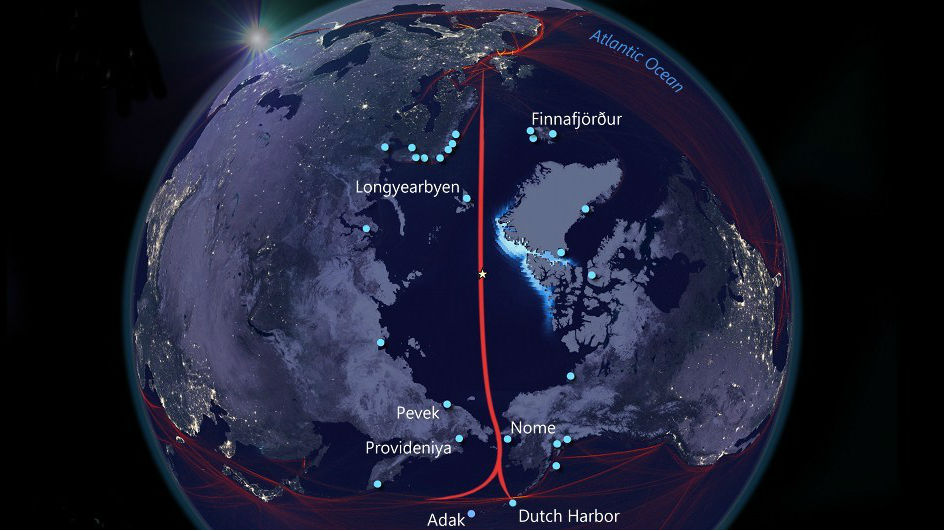
Other things being equal, this would be a boon to international commerce.
There’s more: the retreating ice packs will facilitate oil and gas exploration, which is expected to be fruitful. Now, you and I might think that it’s madness to exploit the effects of dangerous climate change to harvest the raw material needed to promote yet more dangerous climate change, but you know how the world works, right? There are resources, perhaps vast resources, to be plundered, and everybody is going to want a piece of the action, climate be damned. The Arctic Ocean could become the next Saudi Arabia.
The geopolitical utility of Greenland, already home to a major U.S. Air Force Base, and location of the northernmost deep water ports on Earth, thus becomes obvious. From bases on the island American forces could maintain surveillance and effective sea control over most of the newly-opened Arctic, with bases in Alaska picking up the slack at the Pacific end of the Passage.
Even that’s not the end of the story. Greenland is rich in mineral deposits, most importantly in the elements known as the “rare earths”, a group comprising the elements of the lanthanide series on the periodic table. Rare earth elements are key components in many of the electronic devices that have become central to our daily lives, among them cellphones, LCD screens, light emitting diodes, and the batteries for electric vehicles, and also have a variety of industrial applications, from magnets, to jet engines, to lasers, to wind turbines. In the 21st Century, the rare earths have taken on a strategic significance akin to oil’s, and it’s therefore a matter of increasing anxiety that one of the world’s largest suppliers of the elements these days is China, making us vulnerable to the whims of a potentially hostile power. Greenland may offer a remedy. The United States Geological Survey reckons that Greenland has the eighth largest reserves of rare earths in the world, at 1.5 million tonnes, almost as much as the known reserves of the United States; access to Greenland’s minerals could thus go a long way toward depriving China of its leverage over this vital resource, at a time when the geopolitical tensions between China and the United States are rising, and may well explode, depending upon what Xi decides to do about Taiwan and the South China Sea, among other things.
In sum, Trump’s interest in Greenland is by no means misplaced, and if the island was now an abandoned no-man’s land, bereft of facilities and belonging to no one, the urge to grab hold of it before somebody else beats America to the punch would make perfect sense. The thing is, this isn’t the 19th Century, and Greenland isn’t an abandoned wasteland up for grabs in the ongoing Great Power struggle for strategic advantage. Greenland is a semi-autonomous part of Denmark. Denmark is a NATO ally. The Danes, routinely cooperative on such matters, as evidenced by the current American presence on the island, have already indicated their willingness to work with the United States in the pursuit of its national security, which security, after all, is of vital interest to all NATO nations. In other words, what the Americans need now out of Greenland they already have, and if they need more, they can have that too; they can lease new lands upon which to build new facilities, they can buy rare earths and whatever other resources Greenland has to offer fair and square, and they can continue to operate their radars and fly their aircraft as before. There is no more need to bully Denmark over the status of Greenland than there is to have a go at Germany and the U.K., other NATO nations that host a significant U.S. military presence to the satisfaction of all concerned.
If Donald and his cabal of MAGA henchmen were able to think rationally and operate within established international norms, the United States would right now be engaged in multi-lateral discussions within NATO on the growing significance of the Arctic, and the disquieting regional initiatives of the Western World’s geopolitical arch-rivals. There’s no reason to doubt that America’s concerns would be thoroughly addressed within this framework, just as they always have been. The interests of the United States and its NATO allies are as usual broadly aligned, and absent the ham-fistedness of Trump’s approach to foreign policy, Canada and America could surely work out something mutually satisfactory about sovereignty while other parts of the big picture are hashed out.
But no. Trump, egged on by anonymous hawks within his gang of blinkered MAGA hooligans, figures it’s better to push people around until he gets what he wants. That’s what’s batshit about this renewed interest in Greenland. Trump’s expansionist urges make absolutely no sense within the context of the Western alliance system, and indeed threaten to undermine the rules-based international order that the United States has for so long struggled to uphold. What’s the difference between Donald threatening military action to seize Greenland and Putin claiming a right of conquest in Ukraine? One thing springs to mind: prior to the launch of Vlad’s “special military operation” Ukraine wasn’t a stalwart ally, already happily hosting its larger neighbour’s armed forces at a number of a key facilities established to address Russia’s security concerns. War was the only way for Putin to achieve his illegitimate ends. Donald, pursuing interests the legitimacy of which none of his allies would question, needs merely to pick up the phone and start a conversation between friends. That he would even think about threatening friendly, loyal little Denmark, let alone give public voice to his crass, predatory ideas, tells you everything you need to know about what a craven, bullying, authoritarian A-hole he truly is.
Meanwhile, as the climate deniers, urged ever onward by Donald’s continual shouts of “drill baby drill”, continue to set policies that exacerbate global warming, yet another key facet of Greenland’s immense geopolitical potential may come to the fore, this time to our severe and everlasting detriment. On top of its other attributes, the current apple of Donald’s eye is a potentially globe-wrecking bomb with an increasingly sensitive fuse, on account of its rapidly warming ice. The huge glacier that covers most of the island, a holdover from the last ice age, is on average over a mile deep. Locked within is about 7% of the entire global stock of fresh water. If all of that ice was to melt – and the way things are going, that’s not at all out of the question – an infusion of cold water sufficient to raise global sea levels by a staggering 24 feet would result, with dire consequences for everybody, everywhere on Earth. Our civilization could be all but destroyed by an inundation of that scale, depending upon how rapidly it occurs, and whether we have both the time and the means to react sufficiently to save ourselves. Only God knows what would happen to global ocean currents and weather patterns, and which formerly hospitable and densely-populated areas of the planet, even if still above water, would be rendered unfit for agriculture or large-scale settlement. In all, it would be a dystopian nightmare.
At that point, who’ll care about, or even remember, the comparatively trivial concerns that fuelled Trump’s absurd territorial ambitions way back in the Before Time?
 the needlefish