

The Remains of the Ukrainian city of Bakhmut
Look where we are now. Elections have consequences.
Having laid waste to huge swaths of eastern Ukraine, and after God knows how many Ukrainian civilian and military deaths, the Russians are laughing quietly to themselves as Trump swoops in to impose the peace deal he promised, during the election campaign, to deliver on day one of his Presidency. Here’s the Russian “offer”: cede de jure control of all occupied territory, and then some, to Russia; stay out of NATO; disarm. Then, all sanctions imposed by the international community against Russia must be lifted. This isn’t far, sadly, from what we know about Trump’s peace proposal to the Ukrainians, though it isn’t clear yet whether Donald is also pushing for Ukraine’s disarmament. He’s certainly telling President Zelensky that he’s going to have to give up territory, and he told the Press a few days ago that he “thinks Ukraine is ready to give up Crimea”, which is doubtful.
What concessions will the Russians make? “They won’t conquer the rest of Ukraine” says Donald, as if that’s a big giveaway from our good friend Vlad in Moscow. No reparations for the devastation of Ukrainian cities. No withdrawal from any part of the land they’ve stolen. No mention is made, even, of returning the estimated 20,000 children that the Russians kidnapped and took home to raise as their own, a crime against humanity that’s been given far too little attention.
This is not a peace deal. It’s capitulation. It’s intolerable. It’s also almost impossible for Zelensky to accept, legally or politically. Recognizing Russian legal, as opposed to de facto, sovereignty over occupied Ukrainian territory would be off side Ukrainian law, and require a constitutional amendment. Politically, simply giving up the conquered territory would be suicidal, and perhaps even futile; there could well be a popular uprising, and one way or another Zelensky would probably be booted from office, to be replaced, in all likelihood, with a successor who’d repudiate what amounts to an abject surrender.
Yet what choice does Zelensky have? U.S. Secretary of State (and epically spineless Trump bootlicker) Marco Rubio has announced that America’s patience is wearing thin, and that Trump may soon decide to wash his hands of the whole business. If by that he means that America will soon give up on trying to negotiate a just peace with a bad faith actor, and continue to support the Ukrainian war effort, this wouldn’t be a bad thing at all. But that’s not what he seems to mean. The threat all along has been that the Trump administration will simply withdraw all support for Ukraine, which sometimes seems like a bargaining ploy to coerce access to Ukrainian mineral resources on favourable terms, but more often feels like an indication that America has simply switched sides and now favours Russia regardless. This leaves Zelensky in a hellish bind. Depending upon what he’s hearing from the Europeans behind closed doors, he may be driven to conclude that absent American help he can’t possibly hold out in this ugly stalemate with the Russians. Unless the Europeans can credibly commit to filling the void left by American withdrawal, the choice boils down to two options, one terrible, and one that might end up being even worse: a) accept a peace deal now, however odious the terms, and at least preserve, for the time being, the sovereignty of the 80% of Ukraine that remains unconquered, or b) continue the fight with inadequate European assistance, and risk losing the entire country on the battlefield.
That’s already a Hobson’s choice, but it gets even harder, since, though the first option might seem the lesser evil, militating against the acceptance of Russia’s terms is the well-founded belief that Putin’s promises mean nothing, and a peace deal now will do little more than give the Russians a breathing space in which to prepare themselves for another assault in due course. The only way Zelensky could even begin to accept a bargain that leaves Russia in control of a fifth of his country, including Crimea, would be if he obtained Western assistance in arming his nation to the teeth while the Russians pause to lick their wounds, and was allowed to join NATO – or whatever treaty organization replaces it after Trump’s America withdraws from the alliance – which, unsurprisingly, is exactly what the Russians insist he must promise never to do, or it’s no deal. As things stand, Trump offers only vague security guarantees (perhaps involving European peacekeeping forces) of a sort that have proved worthless in the past, as the current situation on the ground attests.
Are there no other possibilities? Couldn’t some sort of mutually acceptable compromise still be negotiated? This can’t be ruled out at this point, but given Russia’s inflexible insistence on its current set of maximalist and entirely unreasonable demands – Putin is playing it as if he actually has no interest in a deal, and won’t accept any compromises – this doesn’t seem terribly likely, especially since Trump appears to believe that the Russians are being generally reasonable, given they “hold all the cards”, and doesn’t seem to be doing anything much to push Putin to give anything up, beyond asking nicely. For Vlad, it’s all carrot and no stick; for Zelensky it’s the opposite.
Dear God in heaven, please take pity on President Zelensky. He has to pick one door or the other, and there’s a tiger behind both of them.
Here’s what’s particularly galling: while Putin carries on as if he doesn’t need a peace deal, and can fight on indefinitely until the inevitable Russian victory, the situation on the ground tells a different story. Yes, the Russians now occupy 20% of Ukraine, including Crimea (which they annexed in 2014) and large parts of the Lukhansk and Donetsk oblasts. Yes, repeated bloody assaults keep affording the Russians small incremental gains all along the eastern front. And yes, on paper, the Russian military can still draw upon a huge pool of manpower, giving them plenty of cannon fodder to feed into the battle.
Yet look at what’s actually going on behind Putin’s smoke screen. The Russians have taken truly terrible punishment. There’s some debate on the figures, but conservative sources put their casualties in the vicinity of 700,000 either killed or too wounded to rejoin the fight. The Ukrainians estimate the number is closer to 950,000, and from what I can glean about Russian tactical prowess on the battlefield, I’m betting that estimate isn’t so far off. At the current loss rate, which is about 1,000-1,400 additional Russian casualties every day, total Russian losses may reach well over a million by the end of 2025, if the fighting continues. Think of it: one million casualties over three years of conflict, all to seize only a fifth of the country they’d planned to steamroll in a cake walk.
Moreover, while it’s true that Putin’s forces can be bolstered from what remains a substantial pool of military-age males, our intelligence indicates that reinforcements are now arriving at the front lacking the necessary combat gear and woefully under-trained, leaving them likely to become casualties themselves within only days of joining the fray. The constant losses can only be made good by the infusion of about 30,000 new recruits per month, and that’s not easy when by Russian law, those conscripted into service can’t be sent to the front, but can only be used to fill gaps at home. This means the Russians have to offer increasingly exorbitant salaries and signing bonuses to fill the ranks with contract soldiers, volunteers, and even at that desperate measures have been necessary, including the hiring of African mercenaries, the emptying of prisons, and the stopping of gaps in the line with whole divisions of North Korean reinforcements, courtesy of Putin’s good buddy and fellow international pariah Kim Jong Un, who no doubt extracted a painful price for his kind assistance.
The loss of soldiers is only half of the problem. The Russians are also running desperately short of equipment. Even the most cautious estimates put their losses at around 10,000 armoured vehicles, roughly 4,000 of them tanks, the balance consisting mostly of the armoured personnel carriers and infantry fighting vehicles that are integral to effective mechanized warfare. The Ukrainians claim the losses are actually far greater. Here are the latest figures reported by the Ukraine General Staff:
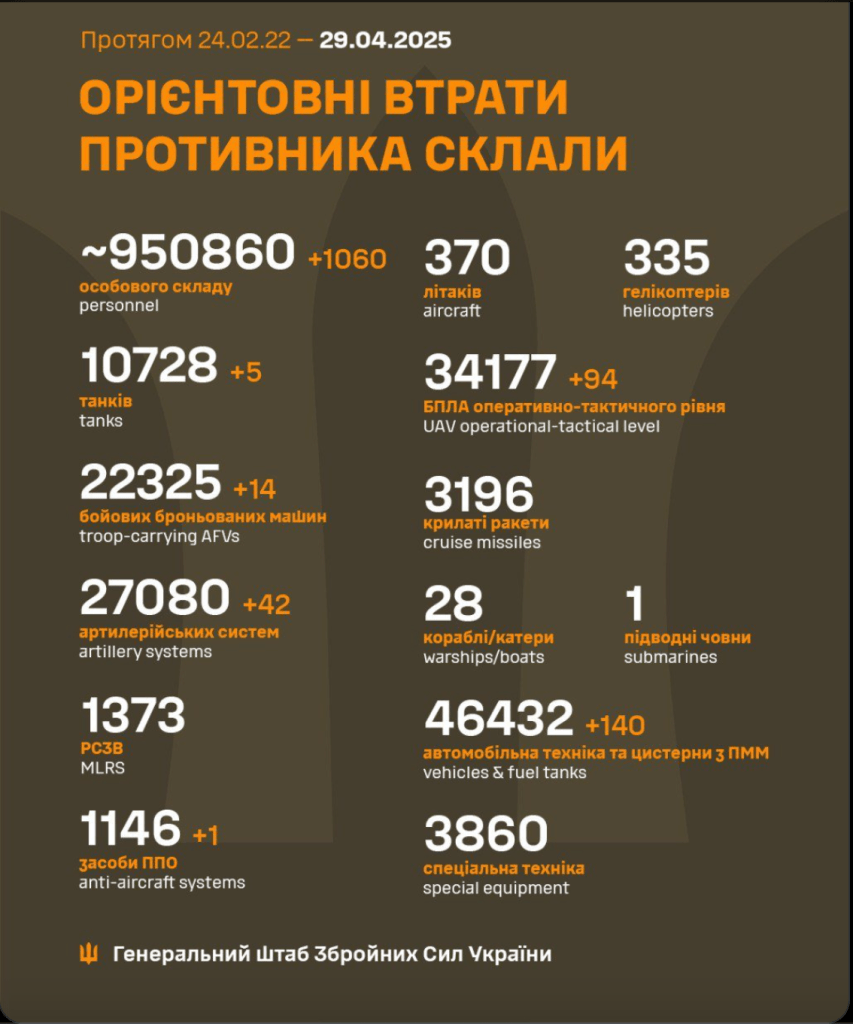
They’re claiming that the Russians have actually lost over 33,000 armoured vehicles of all types, and an almost equally huge number of artillery systems, among similarly catastrophic figures across the whole panoply of equipment needed to maintain and defend an army in the field. Propaganda? Sure, maybe, but when you observe how the Russians persist in conducting operations – using the same old frontal assault meat grinder tactics, the main difference these days being that the unfortunate troops are rushing suicidally toward Ukrainian lines in thin-skinned civilian vans and even on motorcycles, if not on foot, which nobody, not even the Russians, would contemplate if they had an armoured alternative – the Ukrainian claims don’t seem outlandish. Inflated, perhaps, but I’m betting to a much lesser extent than Western intelligence estimates would lead you to believe. Without being privy to classified information there’s no way to be sure, but we civilians do have access to several streams of reliable open source intelligence, “OSINT” in the jargon, including fairly high resolution photographs from civilian satellites. These reveal that the huge open-air storage facilities where the Russians park their strategic reserves, literally thousands of Soviet-era tanks and armoured vehicles, are now all but empty; the Russians haven’t just lost their front line machinery, they’ve all but exhausted their stockpiles of older equipment. Tanks manufactured in the 1950s are now being pulled out of mothballs and thrown into battle, and even these are in short supply at this point. New equipment is still being produced, of course, but Russian industry lacks the capacity to manufacture replacements for anything but a small fraction of what they’re losing. In 2024, for example, fewer than 300 new tanks rolled out of Russian factories, about a tenth of the number the Ukrainians claim to have destroyed that year, and far fewer than the Russians lost no matter whose numbers you endorse.
There’s every reason to believe that the situation is just as dire when it comes to ammunition. We’ve known for some time that artillery shells, in particular, are in increasingly short supply, and reports indicate that the large stock of rounds purchased from North Korea to make up the shortfall are as often as not defective and unusable. At the same time, Ukrainian drone strikes have taken a significant toll on Russian ammunition depots located far behind the front lines, which have been struck repeatedly to significant effect.
The Ukrainians have taken terrible losses too, no doubt. They aren’t reporting any numbers, but Western intelligence reckons that Ukrainian casualties amount to about half of what the Russians have absorbed. That’s an awesome sacrifice for the much smaller nation to have suffered. Still, it looks as if the Ukrainians are in better shape than the Russians, and better able to tough it out, if – oh, if only – American support isn’t withdrawn.
Let’s consider the scenario I wish was likely: suppose that American military and economic support remained unwavering. In that case, the Russians would be hard pressed to carry on, due not just to their unsustainable losses, but also their rock-bottom morale, which results not just from the savagely curtailed life expectancy of the troops, but the endemic corruption and rank incompetence of a generally brutal and often inebriated officer corps. Look at this thread from Twitter (sorry, “X”):
The portrait painted by this ex-storm trooper, and many other Russians who’ve been lucky enough to escape combat as prisoners of war, is one of death, drunkenness, disease, unconscionably inadequate battlefield medicine, and, overall, an army on the brink of collapse. There’s good reason to believe that if Ukraine could maintain the bloody stalemate on its eastern front for the remainder of 2025, the Russian war machine would grind to a halt when its demoralized, under-trained, ill-equipped forces are no longer combat effective, perhaps in as little as another ten to twelve months. Putin seems determined to press the attack for as long as possible, intent as he is upon projecting an image of infinite Russian stamina and inexhaustible reserves of manpower and equipment, but many analysts think he can’t keep this up into 2026 and beyond. With staunch American support a Ukrainian military victory, if by no means assured, is certainly still possible.
It’s just that under Donald, such support now looks to be off the table.
My own fervent wish is that somehow Ukraine could continue to resist even without the Americans, but that comes down to what the rest of us are able and willing to do, and I’m not very optimistic on that score. I very much doubt that the Europeans have the means to fill the void that America seems likely to leave, though I wish to God they’d try, and in fact, I’m not sure they have any choice. Putin cannot be allowed to win this war. The Russians have to be contained now, or somewhere, not very far down the road, we’ll simply be forced to fight them again, as Putin continues his revanchist drive to recreate the old Soviet empire. My emotional response is that all of us, Canada included, should now do everything we can to empower the Ukrainians to keep on fighting, Americans be damned, even if that means boots on the ground. Screw Donald’s one-sided, pro-Russian peace proposals! A million times no to capitulation! The Russians are weaker than they seem. Putin’s army is in a shambles, and close to the breaking point. Now’s not the time to fold, I’m convinced of it. I want to believe that we can still win this thing, if we have the will. No matter what Donald does, maybe we can still win.
On the other hand, maybe an emotional response like mine paves the way to disaster and carnage, including a Russian nuclear response to intervention by Western armies. I doubt I’d be so bold if this was actually my call.
When all this began, I stated in this space that Putin couldn’t win his nasty war of aggression, and after three years of fighting he sure as hell hasn’t, not by a damn sight. Viscerally, I still don’t think he can, unless we let him. My instinct is that Putin wants a deal on favourable terms now because he knows he could well suffer a catastrophic military collapse in a matter of months, and he’d much rather freeze things in place and dance his little victory dance, while glossing over the reality that his army suffered a million casualties over three years to seize 20% of a much weaker country, having botched a campaign in which he was supposed to have conquered all of Ukraine within a matter of weeks, if not days. If he gets to do that, I’ll be beside myself. Yet it’s easy for me, sitting here in my swivel chair in Toronto, to urge Zelensky to carry himself like the reincarnation of Churchill and vow to fight on alone, if need be, no matter the costs. If Ukraine’s beleaguered President decides that the best of the bad set of available choices is to stop the killing now, and hope for the best down the road, nobody could blame him. I just don’t know, all things considered, if that’s even possible, let alone wise. He may just have to fight on, and, quite possibly, lose his country.
All because of Trump.
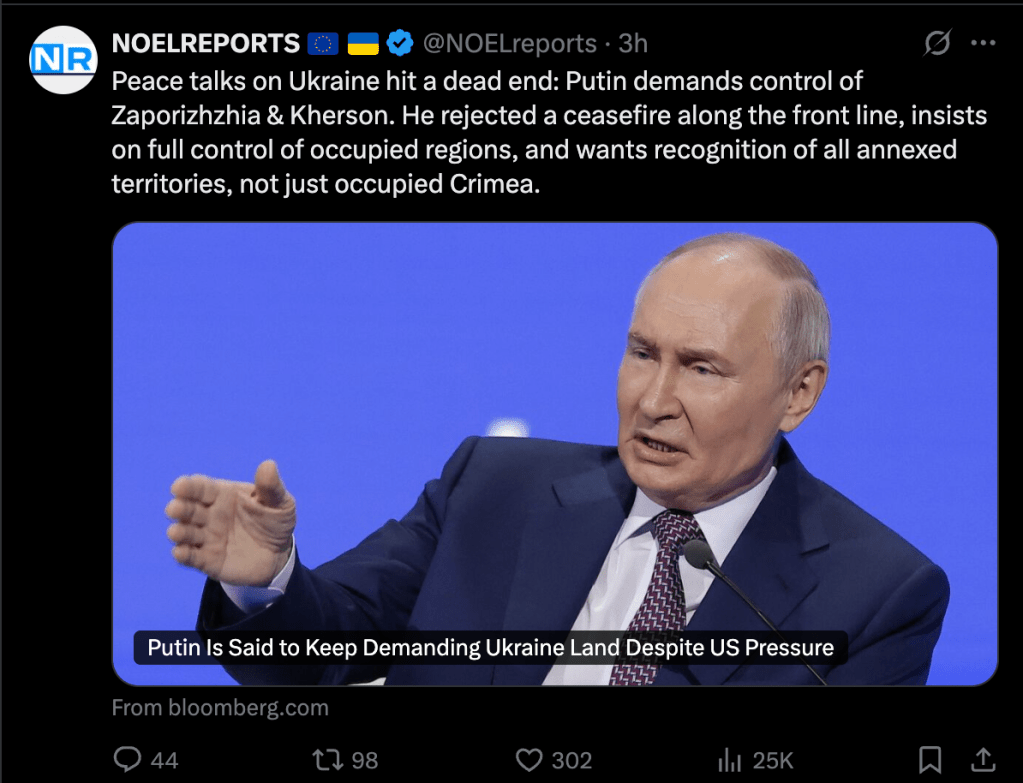
As I write this, here’s the situation:
 the needlefish