So let’s begin by acknowledging that no matter how it’s going, every war looks dire and disastrous when you’re lost in the Clausewitzian fog, especially these days when we’re receiving scant accurate information amid the tidal wave of disinformation, propaganda, AI-generated fake videos, mislabelled imagery, video clips taken from other conflicts going all the way back to the 2003 Iraq war, and hysterical on-line commentary. At this point none of us out here in TV Land has any sort of grasp on the true state of play in the Persian Gulf. Victory for the American-Israeli Axis might still be at hand. You never know, right? This could all be going according to plan, if plan there be (which seems doubtful, actually). Still, from where I sit right now, it’s sure starting to look like Fat Donny really stepped in it this time.
Imperilling the U.S. campaign are a number of readily foreseeable problems which nevertheless seem not to have been anticipated, which I suppose is par for the course with the gob-smackingly incompetent Trump Administration. I’m afraid they could add up to produce a humiliating military reversal for American forces, shattering the mystique of U.S. invincibility, depleting the American armed forces of equipment and materiel at a perilous time for global geopolitics generally, and leaving other theatres of potential combat, especially in the Western Pacific, dangerously exposed to an extent that might entice hostile powers to move on their own longstanding plans of mischief and conquest. I’m also worried that even a military victory in the short run could pave the way towards Iran becoming a failed state and humanitarian disaster as various factions try to carve up the country, supposing the operation leads to the toppling of the current regime.
Let’s go over a few screechingly obvious issues that seem to have eluded the bright lights in Pete Hegsith’s Department of War.
In war, past isn’t always prologue, and your results may vary. Contemplating last June’s 12 Day War (as we’ve come to refer to it), in which the Israelis and Americans absolutely pummelled the Iranians while largely fending off all retaliatory strikes, one might have gathered that the Iranians wouldn’t be able to resist any better this time than last. That’s true, actually, when it comes to defending themselves against the aerial onslaught that has so far pulverized something like 1700 targets throughout Iran; the impression created is that American and Israeli combat aircraft continue to go wherever they want, whenever they like, to do anything they please, and from this distance it seems that nothing can be done to stop them. That’s probably not quite true, but still, I’m not sure I can come up with any other example of such lopsided combat against a nation that purported to have at least some semblance of an air force, and significant anti-aircraft capability (Iran still possessing at least some residue of the extensive, state-of-the-art integrated air defences that were battered last June). As far as I can tell, the Iranians haven’t shot down a single attacking aircraft, in which case even Desert Storm was dicier for the allies than what we’re seeing here. Leaving aside the larger qualms we’ll be getting to in a minute, it really is a magnificent and terrifying thing to behold.
However, the Iranians clearly learned a few things from the general failure of their ballistic missile counter-attacks last time around. Last June they came close, but never quite managed to saturate and overwhelm the missile defence forces arrayed against them. This time, having worked feverishly to construct literally thousands of new ballistic missiles, many, apparently, with improved characteristics, the Iranians seem – stress seem – to be managing better to punch through the defences with attacks that may involve as many as 30 or 40 warheads arriving at once on a given target. From what we can glean now, their missiles seem to be more resistant to shrapnel, faster, and capable of some degree of maneuver in the terminal phase of their attack, vastly complicating the job of the defenders. The clip pasted above illustrates the apparent problem: three Patriot missiles are shot skyward to down an incoming ballistic missile targeted at 5th Fleet headquarters in Bahrain, and they all miss. True, this sort of thing can always happen, it happened last time too, and you’re never going to intercept them all. True too, seeing a few videos of isolated attacks, cherry-picked and posted by who knows whom, can greatly distort one’s perception of the actual big picture – especially when so many of them are faked – so it’s impossible to be sure. We may not have any solid data for weeks. Yet the impression gathered from verifiably genuine video is that Iran’s ballistic missile retaliation is more effective than it was during the 12 Day War, and prior skirmishes.
This is at best anecdotal evidence, but still, the interceptors streak skyward, and many hit the mark, but a distressing number miss.
Just as an aside, I’m assuming I’m not the only one to find these clips horrifying and dystopian.
You shouldn’t start something if you haven’t got the means to carry it through. Put simply, the Americans and Israelis are at risk of running out of some categories of critical advanced munition. In the clips pasted above, defensive interceptors costing anything from four to thirteen million dollars a shot – and even more – are being expended at a prodigious rate. Not only are these things expensive, they’re so mind-bogglingly complicated that they can’t be replaced in a hurry. They’re procured annually by the dozen, not by the hundred, much less by the thousand. The Iranians know this. They know they have a shot at running us out of missiles. They might just do it. The race is now on to destroy the launching systems and storage facilities of the weapons in Iran, depriving them of their stockpile before they can fire them our way and drain our magazines, but that’s not going to be easy. The launchers themselves are mobile and practice “shoot and scoot” tactics, and the stocks of reloads are buried deep under solid rock, just like their nuclear facilities were. The latest claims coming from the American side indicate that the campaign is being won, with Iranian missile launches being cut back by 80% or more in recent days, but I don’t know. My bet is that it’s still going to be a near run thing. [See update below]
The same holds true at sea. The American war effort, as usual, relies in large part upon aircraft carriers heavily defended by guided missile destroyers, but these, too, have finite magazines that can be exhausted by sustained attacks, and, crucially, they can’t be rearmed at sea. They have to put into ports with the proper facilities and stockpiles, and I’m not sure if that’s even possible in theatre; any local capability is in any case bound to be limited and inadequate. Moreover, the available supply of reloads has already been dangerously depleted in prior engagements in the Red Sea, defending against Houthi anti-shipping strikes, and in the 12 Day War, during which U.S. warships contributed significantly to the defence of Israel. The naval weapon of choice, known as the Standard Missile III, costs anywhere from twelve to thirty million dollars a round(!), depending on the variant, and prior to the 12 Day War the entire American stockpile totalled only 400 missiles, of which about 160 were expended.
The same also holds true, to varying degrees, for offensive weapons, like Tomahawk cruise missiles, earth-penetrating “bunker buster” bombs, and so on. For example, in the June attacks on Iran’s nuclear facilities, which, contrary to Trump’s boasts at the time, appear not to have obliterated Iran’s nuclear program, used up a high proportion of the existing stock of 30,000 lb. Massive Ordinance Penetrators. It isn’t public, as far as I can tell, how many were in the inventory, but the urgency with which the Air Force is trying to acquire more (or a successor model) indicates that there are only a few left to strike at Iran’s underground ballistic missile stores. Replacements for those expended against Iran’s nuclear sites aren’t expected to be delivered until some time in 2028.
None of this means that US forces can’t still draw upon a huge store of more conventional ordinance, like the guided bombs known as JDAMS, laser guided bombs, plain old dumb bombs, and the like. The problem is with the higher-end stuff, which is also critical to the defence of US facilities in other theatres.
In planning this war of choice, did nobody warn Trump and his minions that a short war had better succeed, because a long one would involve depleting vital stocks of munitions from strategic locales all over the world, and even at that there might not be enough?
Anybody with the wit God gave geese could have anticipated Iran’s obvious escalatory counter-moves, but I guess that means nobody on the Trump Dream Team. Look, it was plainly obvious that if you went at the mullahs and the IRGC in an attempt to effect regime change, they were going to go absolutely apeshit, and respond with spasmodic attacks on every American ally in the Gulf, and every American facility within reach. In fact, they said as much. Yet the Americans and their Gulf allies seem to have been caught by surprise, and are thus far responding in a piecemeal and uncoordinated fashion, while the Gulf states, too, run down their available stores of interceptor missiles. It’s as if the Kuwaitis, Qataris et al weren’t brought into the loop beforehand, and there doesn’t seem to be proper communication and data sharing between the Gulf states, or with the Americans. The shocking loss of three F-15E Strike Eagles in a “blue on blue” engagement over Kuwait, shot down by a friendly Kuwaiti F-18 Hornet, may be a symptom of this.**
Likewise, it was blindingly obvious that America’s highly important communication and surveillance assets in the area, particularly a huge ballistic missile early warning radar situate in Qatar that cost over a billion dollars, would supply the Iranians with big, fat, juicy targets, the destruction of which would make their own ballistic missile attacks more effective. Shouldn’t this radar in particular, then, have been especially well defended? Yet reports indicate that it’s been hit, probably by slow-flying “Shahed” drones, fairly easily engaged if the right defensive assets are in place, i.e., right on the structure’s roof, or all around the perimeter, at least. I’d have had a standing combat air patrol overhead too. It was a point target, and needed point defences. Admittedly, information is sketchy as to the defences on site, and the weapon used by the Iranians, yet it does seem on the available information that the Americans might have left a crucial facility sitting there with its ass flapping in the breeze.
Equally predictable was the Iranian move to close down the Strait of Hormuz and cut the globe off from 20% of its total oil supply. Every wargame and analysis proceeds from the assumption that this is likely. Yet now that it’s happened, the Americans appear to have been caught off guard, and are scrambling to figure out what to do about it. Really, guys? The thought never occurred? Or did you forget that just by declaring the Strait closed, the Iranians would spook maritime insurers to the point of denying coverage, at which point the traffic would stop whether or not Iran has the military wherewithal to back up its threats with effective action?
Similarly, anybody could have told you that the general ballistic missile bombardment of every frickin’ country in the Middle East would make American citizens keen to go back home, and indeed, they’ve just been instructed to do so by their government. The problem is, now that the shooting’s started, and airports everywhere are coming under attack, all flights are grounded, and it’s hard, if not impossible, to get out. The problem is compounded by the sheer number of Americans in the area, at least half a million, maybe twice that many. It’s fine to issue an edict to vamoose; how exactly? And why, Donald, is the evacuation order given only after the shooting started at the time of your own choosing? Other countries, China prominent among them, ordered their nationals to skedaddle days before the attacks began, and they weren’t even sure when the shit was going to hit the fan. Not America. If the fear was that an order to leave would tip off the Iranians that the ongoing diplomatic effort was yet another sham, and signal that an attack was imminent, they could at least have planned to supply as much airlift as possible to begin evacuating people as soon as the bombs started falling. Nobody gave this any thought?
Don’t expect the enemy to fold, and beware mission creep and a wider war. The whole attack seems to have been premised on the idea that this was going to be easy, that the mullahs and the IRGC would just fold, cede power, hand over the reins to somebody else more agreeable to America, and bing-bang-boom it’s all over just like that, piece of cake. Four days tops. Nobody seems to have worried about what would happen if the uncooperative poor sports didn’t roll over, the war couldn’t be contained, and the Iranians started doing things that made the increasingly messy affair a whole hell of a lot sportier than anybody wanted. Well, now just about everybody’s being drawn in, including Lebanon on top of all of the Gulf states – the Iranians even took a pot shot at Turkey today, according to reports, and have also attacked British assets in Cyprus, way over in the Mediterranean – and all the oil infrastructure in Kuwait, Saudi Arabia, and everywhere else is or likely soon will be under attack. The various countries are defending themselves of course, many of them have their own Patriot batteries, but as noted, like the Americans they’re going through their supply of interceptors at an alarming rate. It clearly wasn’t within the Americans’ contemplation that they might wind up having to deal with the defensive requirements of everybody from Oman to Iraq and all points in between.
Meanwhile, now that the Strait of Hormuz has been closed, Trump is talking about using the Navy to open it back up by escorting tankers in and out of the Gulf. At its narrowest point, the Strait is only 21 miles wide. Sailing back and forth through that sort of danger zone will be extremely risky, even for warships as lavishly equipped and armed as the Burke class destroyers that will end up hauling the mail on the ill-conceived mission, which is why thus far US naval assets have stayed well to the South in the Arabian sea, and avoided the Gulf altogether. The Iranians have extensive shore batteries, comprising both conventional artillery and shore-to-ship missiles, just itching to have a crack at the Americans, and then there’s all the drone swarms, both airborne and floating, that could be sent en masse against US warships, as well as large numbers of manned go-fast boats, known as “Boghammers”, that can race around at 50+ knots while merrily firing small but potentially quite damaging missiles of various types at anything within range. Even a rocket-propelled grenade can do nasty damage to vital stuff, if you can get close enough to use it (which you might, in a coordinated attack involving dozens or hundreds of incoming threats). The Iranians are cracking to have a go at it. They’ve been planning and practising it for decades. They can lay dense fields of sea mines, too, which US forces, believe it or not, are. I’ll-equipped to sweep. Once big, blue water assets like 9,000 ton, two-billion-dollar destroyers start cramming themselves into a chokepoint gauntlet only 21 miles wide, all bets are off. It’s easy to imagine many being hit, and even destroyed. In that case, the next obvious step, if air strikes can’t take out the enemy batteries (and my bet is that they’re all mobile and slippery targets), is to put troops ashore to deal with them, at which point oh boy, you’re off to the races.
But maybe I should relax about all this, because the Navy doesn’t have enough ships to spare for such a mission, and since commercial shipping would still be attacked, escorted or not, insurers still won’t provide coverage, and therefore the tankers still won’t go.
Regime change is hard, if not impossible, to effect just by blowing things up from the air, if that’s even the plan. In fact, what is the plan, Donnie? You can blow up as many Supreme Leaders and senior officials and military commanders as you like, but others will simply slot themselves in and carry on. This we know from hard experience. Or do we? At one point, Donald was carrying on as if once he nailed the Ayatollah and a few other key players, the IRGC would see which way the wind was blowing, either change sides or doff their uniforms and take to the hills, and an uprising of the general population could then occur, leading to new, moderate leadership, and sunshine, and bunnies. But then Pete Hegseth told the press that Hell no, this was no regime change war, we don’t need no stinking regime change. After which Donald said he could imagine somebody better taking over in the aftermath, or somebody worse, maybe, how should he know, that was none of his concern. Also, that at first he’d had some people in mind who could take over, but oooooops, we killed them too. Meanwhile, other rationales have been floated, including the destruction of the nuclear program that was already, we were assured, utterly and permanently obliterated last June. Now there’s talk of the CIA arming Kurdish factions in the region to rush in and, one supposes, boot out the IRGC by force of arms, an idea which doesn’t sound fully baked. So what’s the plan here, Donald? What’s victory look like? What’s the end game? Did these witless bastards pull the lever on setting the whole Middle East on fire without any idea what was supposed to happen next? It sure seems that way. It seems like not only did nobody have any thoughts on a Plan B, they never even had a Plan A.
What do bad actors like China and North Korea do when they realize the Americans have utterly exhausted themselves in a Middle Eastern quagmire, and no longer have the assets or the ammunition to do anything about any moves they might make against Taiwan or South Korea? The mind boggles. Here’s what really scares me. There’s a chance, I don’t think a big one but a chance, that a massed ballistic missile attack might put the carrier Abraham Lincoln, now operating in the Arabian sea, out of action. American supercarriers are almost impossible to sink with conventional weapons, but easy to knock out of the fight with a couple of hits that disable catapults or arresting gear, or blow up fuel and munitions on the flight deck. If the Iranians pull that off, China’s Xi will have his answer to the question we’ve all been wargaming, and, equipped with anti-ship ballistic missiles far more potent than anything the Iranians could launch (a Chinese specialty), he would be confident that the US Navy could be thwarted from intervening in an invasion of Taiwan.
Lots of other countries, especially those in Asia, and especially the Chinese, have a vital interest in keeping the Strait of Hormuz open and the oil flowing. Does that put them on our side, or the Iranians’? Good question! And if other powers start to feel the pain, what are they going to do? I don’t know. Maybe something good. Maybe something bad. In China’s case, the Iranians can keep their ally happy by letting Chinese traffic pass. Nations friendly to the US may figure their national interest requires them to pitch in on the escort mission, supposing they actually attempt such thing. That would be nice. Is anybody talking to, say, the Japanese? Hopefully nobody thinks the best solution is to help Iran win the war (a vain hope, probably, since Russia and China are in Iran’s corner). I certainly don’t expect anybody to try to intervene militarily, not directly anyway (China especially has potentially devastating weapons it could supply to Iran, though that would be extremely risky for all concerned, and I don’t know how they would get there at this point), but affected nations around the globe might resort to diplomatic, economic, and even covert means to make life that much more difficult for Americans, and of course the whole operation only cements the US’s growing reputation as a rogue actor on the world stage, not to be trusted or bargained with, much less granted any special favours. When it involves the Strait of Hormuz, the whole world has skin in the game, and how nations will react is something that merits careful thought, and careful diplomacy. Which I’m guessing hasn’t happened.
Did nobody realize that a war that pisses off almost literally everybody could drive the wedge even deeper between the U.S. and its erstwhile allies? Trump has been ranting that Spain won’t let the US use its air force facilities to support the attack on Iran – impacting resupply and aerial refuelling efforts – and it isn’t clear where the Spanish stand on naval facilities, like the base at Rota, where the US Navy has been allowed to set up shop. The British, who control Diego Garcia, long an important regional base hosting American airpower, have refused to let the Americans use the facilities there to attack Iran. Trump rants about that, too. He’s threatening to cut off all trade with Spain, which I’m sure he has no authority to do, but who cares, he never has legal authority to do anything he does. These disputes and Trumpian hissy fits drive even more nails into NATO’s coffin, already all but sealed by his insane threats to invade Greenland and annex Canada. It doesn’t help either that this idiotic war will be driving up everybody’s energy costs, with all the attendant knock-on effects. Meanwhile, all those friendly nations in the Gulf, suffering the effects of Iran’s retaliation, perhaps won’t be so friendly any more, or quite so eager to host the American military facilities that turn out to be missile magnets.
Hey, what about the economy? Since nobody, apparently, thought about the Iranians maybe shutting down the Strait of Hormuz and choking off 20% of global oil supply, I guess it follows that no one considered what that would do to oil prices, inflation, unemployment, stock markets, consumer confidence and all that. Maybe not the best play in the run-up to the mid-terms, being as it’s all so completely unnecessary.
I guess Ukraine is really screwed then eh? This isn’t an unforeseen problem so much as an agreeable outcome for Trump, but if the Americans need to divert all defence production output to their gambit in the Persian Gulf, there will be nothing left for Ukraine to acquire. Direct support of Ukraine has long since been cut off by Trump, of course, but he was letting the Europeans buy various systems, Patriot, HIMARS etc., and pass them on to Ukraine. That pipeline may well be choked off now. The Europeans can’t easily fill the gap.
So, like I say, this may all work out, but I’m really worried, and inclined to replace the groovy name concocted for the operation by the adolescent morons in Hegsith’s thrall – Operation Epic Fury, can you believe that shit? – with my own Operation Enduring Clusterfuck. I’m not saying I know. I’m just saying this thing could go horribly South in a frightening number of ways, and I’m really, really nervous.
Time for the classic meme from Hunt for Red October:
++++++++++++++++++++++++++++++
**This is the first time, in its many decades of service, that any F-15 has been shot down by another airplane. Of course it wasn’t a real instance of air combat, since, if this was a long range shot, the American pilots would have been unperturbed when their equipment notified them that friendly fighters were painting them with radar – of course they were – and wouldn’t have taken any of the usual defensive steps, at least not until their gear told them they were being locked up (even then maybe not right away, for reasons that are complicated). There’s stuff going around on the internet claiming that this was actually a close range engagement within visual range, using heat-seeking missiles, but that would imply that something nefarious is going on, and again, until the F-18 downed its first target the F-15 crews would not have known or had any reason to suspect anything was amiss. Easy to get the jump on somebody when the target knows nobody around is hostile. Anyway, coming into this, the F-15 was 104-0. Now people will be saying it’s 104-3. No fair! Fratricide doesn’t count!
UPDATE: Figures supplied by the American military, if accurate, support the assertion that the Iranian ballistic missile threat – and to a large extent, the drone threat – is being heavily degraded as air strikes hit Iran’s launchers, storage facilities, and manufacturing plants:
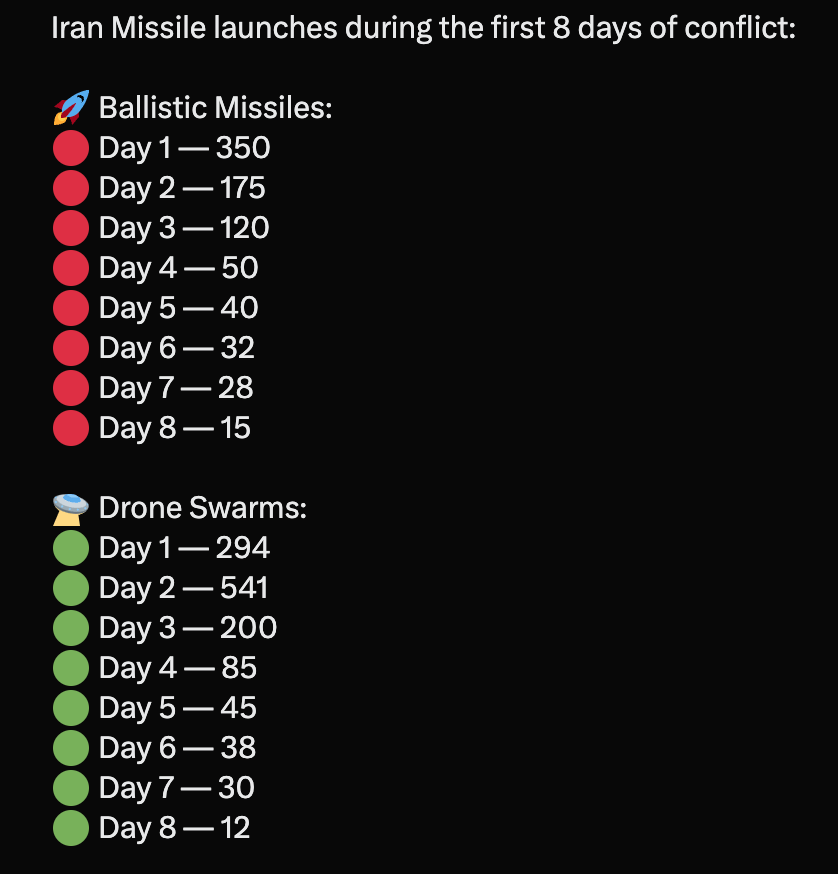
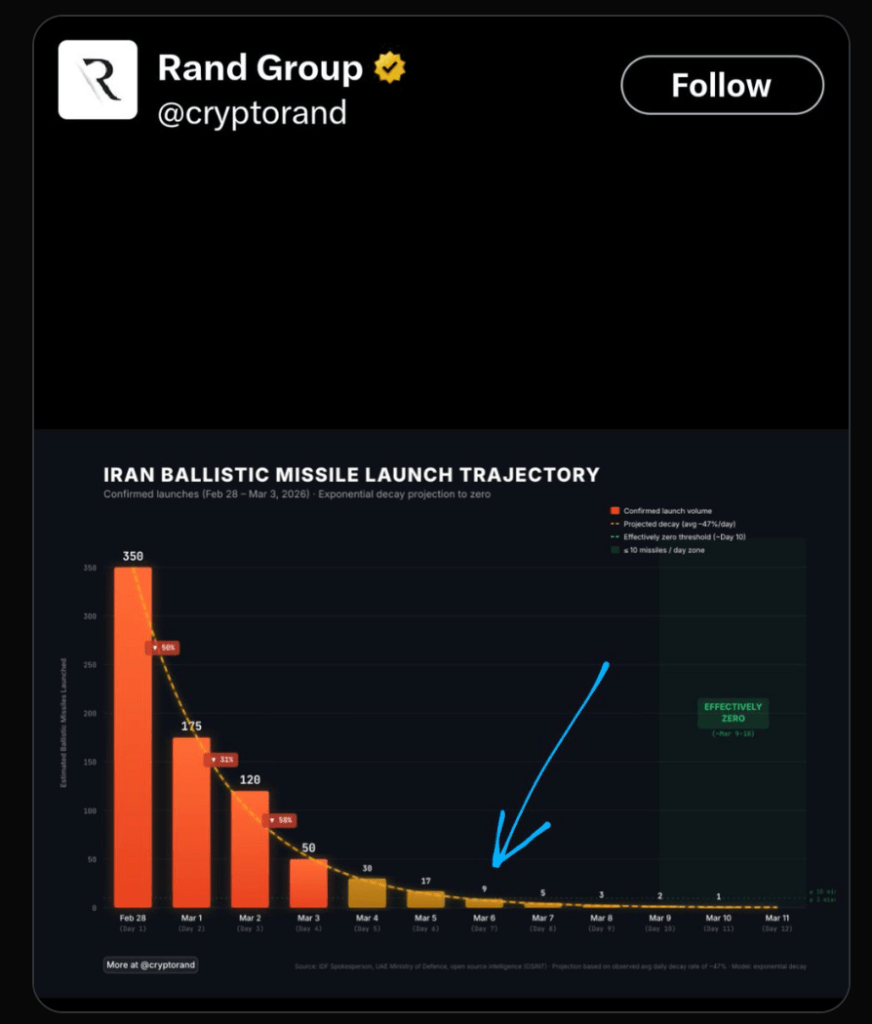
If reliable (and of course I have no idea, especially since you can’t trust anything on line anymore), these figures indicate that the technology of locating and destroying mobile missile launchers has improved by leaps and bounds since “The Great Scud Hunt” of 1991’s Desert Storm, which produced few if any verifiable kills.
The questions now, which may or may not ever be answered in public, are: 1) how many defensive interceptors have been expended, and how close Israel and US forces have come to exhausting the inventory; 2) was the percentage of successful interceptions better or worse than during the 12 Day War; and 3) were the ballistic missiles that made it to target any more accurate or destructive than last time around, given new capabilities like the ability to dispense cluster munitions rather than deliver single “unitary” warheads.
 the needlefish