Now and then you’ll encounter a scene in a movie that strikes you as uncannily real, to a level that most Hollywood productions never attain. Somehow, it won’t appear as if it’s a scripted set piece in which the people on screen are merely acting. You get this feeling that this is what it really looks like. It’s rare, but it happens.
I recall feeling this way several times watching Bullitt, Steve McQueen’s archetypal urban police drama famous these days for its legendary car chase, in which the utmost realism was obviously the primary goal of director Peter Yates. This is obvious in the car chase itself – those late Sixties muscle cars really are going 120 MPH, tear-assing over the hills and narrow streets of San Francisco – and in many other scenes, in which the viewer is presented with authentic police procedures and operational techniques. There was one in particular that really grabbed me, when a gravely wounded witness, gunned down when he about to turn state’s evidence on the Mob, is worked on by a surgical team struggling to save his life. The setting is so authentic, and the behaviour of the surgeon and his OR nurses is so precise, so practiced, and so skillful – it’s a wonder watching the nurses thread needles and snap the required surgical instruments into the doctor’s hand – that you immediately think that’s a real hospital, and that’s a real surgical team. Which it was. Yates reckoned that as long he was filming inside of a real hospital instead of a film stage, he might as well capitalize on the talent at hand. I wish I could find the clip on YouTube, but it seems that most people only want to see that fastback ’68 Mustang in hot pursuit of a souped-up Dodge Charger.
There’s something quite similar at the end of Captain Phillips, director Paul Greengrass’s depiction of a real event that occurred early in Obama’s first term, when pirates off the coast of Somalia were routinely intercepting commercial traffic as it transited to and from the Red Sea, ransoming captured vessels for millions of dollars. In an earlier Greengrass masterpiece, United 93, the director injected unusual realism by enlisting Ben Sliney, the actual Federal Aviation Administration National Operations Manager, the man in the big chair on 9/11 when the shit hit the fan, to play himself, re-enacting the moment in which he made the fateful, unprecedented call to ground all air traffic over the entire United States, and every plane coming or going, thousands of aircraft, at considerable risk and the cost of who knows how many umpteen kabillion dollars. In the film, he says exactly what he really said that day, grasping what others, struggling to understand how so many concurrent plane crashes could be happening on a clear blue day, haven’t yet realized: “Look, we’re at war with somebody.” The viewer really feels the shock of that awful realization.
In Captain Phillips, Greengrass somehow persuaded the Navy to let him use a massive amphibious assault helicopter carrier and real Arleigh Burke class destroyers in several key scenes, including many filmed aboard ship, as the US warships, having rushed to the rescue when the container ship captained by Phillips was hijacked, pressure the Somali pirates to surrender and abandon the modern enclosed lifeboat in which they now hold Phillips hostage. The filming is almost cinéma vérité, escalating from tense to harrowing within the claustrophobic confines of the lifeboat, as the Somalis, one of whom Phillips has come to know quite well, try to negotiate their way back to shore, hostage in hand, growing increasingly frightened and angry as the bargaining drags on. Of course, once the Navy is on scene, and the attention of a superpower is fully focussed on this one narrow problem, the poor Somali bastards, who’re portrayed as desperate and not at all unsympathetic, haven’t got a snowball’s chance. Navy SEALS parachute into the scene, perch themselves on a destroyer’s fantail flight deck, and aim three .50 calibre sniper rifles through the covered life boat’s windows, waiting for the moment when they all simultaneously have their target in the crosshairs. It takes a while, what with it being nighttime, and the lifeboat bobbing erratically in the waves, until it’s almost unbearably tense. Then, the instant all three snipers go “green”, it’s all over in a millisecond, three head shots striking each of the pirates at the same instant, blood, skull fragments, and brain matter spewing all over the confused and terrified Captain Phillips, now the last one standing, blindfolded and disoriented. Watch this:
It reminds me very much of the climactic scene in United 93, when the passengers make their valiant but doomed attempt to seize their plane back from the hijackers, and it’s one of the most fraught and traumatizing things I’ve ever seen on film, the sheer, brutally efficient finality of what amounts to a cold-blooded triple execution. My heart was in my throat throughout. You rarely see filmmaking of this calibre.
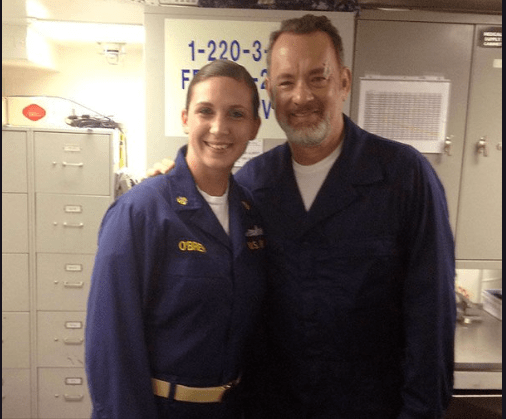
In the aftermath, Phillips, distraught and in shock, is transported to a destroyer for medical treatment. To maximize the authenticity, Greengrass had Tom Hanks, portraying Captain Phillips, taken aboard the USS Truxtun, where he’s shepherded to the sick bay for evaluation and treatment by a real Navy corpsman of the ship’s company, one Danielle Albert, who was under instruction to simply follow the procedures she would if it was all really happening. No lines, no stage direction; just do what you do, and ignore the cameras. At first she was a little star-struck and unable to function, but Hanks managed to calm her down (“Hey, I’m the one supposed to be in shock here”, he joked), and on a subsequent take, entirely improvised by both Hanks and Albert, she methodically tends to the traumatized Captain’s wounds while uttering the soothing things medics say when they’re they’re trying to calm you down. It’s quite the display of acting chops, how convincingly Hanks portrays a man scared out of his wits and fully in shock; the story goes that the Truxtun’s captain, on site to watch the filming, was moved to tears, telling the director that “I’ve seen trauma, and that’s what it looks like.” Meanwhile, Corpsman Albert behaves just as she would with a real casualty. Hanks, his voice quavering, offers that he thinks he’s OK, but looking at him as he sits there trembling, wide-eyed and covered in blood, she responds “You’re OK? You don’t look OK”, while cutting off his shirt and tending to his injuries, calmly dictating to her assistant the location and nature of his various scrapes and lacerations. Throughout she exudes an aura of complete professionalism, total competence, and within that, no small amount of compassion and empathy. The captain, we realize, is now in very good hands. It’s more than poignant when she asks Phillips to tell her where he’s wounded, and where all the blood and guts that cover him have come from, and Hanks responds, tears in his eyes, reliving the awful moment, that “it’s not all mine…not all of it…”. He says it as if he can’t quite grasp the horror.
At the end, she lays him down, assuring him that he’s safe now, as he thanks her repeatedly, and she repeatedly responds “you’re welcome”. It’s all incredibly powerful, and elevates the film to a new level. I doubt anybody who sees it can ever forget it.
 the needlefish