No one would have believed in the last years of the nineteenth century that this world was being watched keenly and closely by intelligences greater than man’s and yet as mortal as his own; that as men busied themselves about their various concerns they were scrutinised and studied, perhaps almost as narrowly as a man with a microscope might scrutinize the transient creatures that swarm and multiply in a drop of water. With infinite complacency men went to and fro over this globe about their little affairs, serene in their assurance of their empire over matter. It is possible that the infusoria under the microscope do the same. No one gave a thought to the older worlds of space as sources of human danger, or thought of them only to dismiss the idea of life upon them as impossible or improbable. It is curious to recall some of the mental habits of those departed days. At most terrestrial men fancied there might be other men upon Mars, perhaps inferior to themselves and ready to welcome a missionary enterprise. Yet across the gulf of space, minds that are to our minds as ours are to those of the beasts that perish, intellects vast and cool and unsympathetic, regarded this earth with envious eyes, and slowly and surely drew their plans against us.
The opening paragraph of H.G. Wells’s War of the Worlds, read aloud in voice-over at the beginning of the 1953 film.
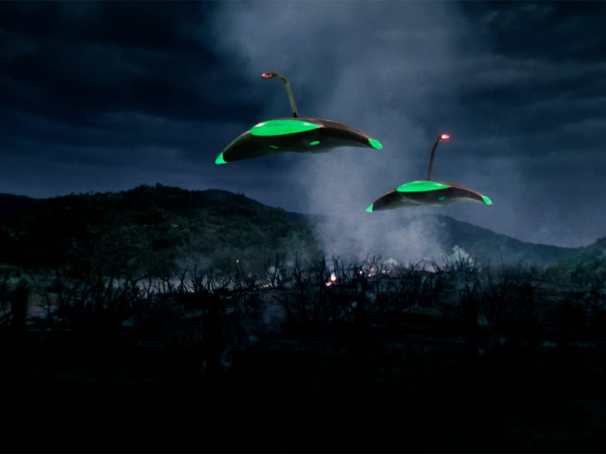
In this time of senseless war and apocalyptic Trumpian threats to end civilizations, it seemed somehow appropriate to recall a great old film made, unbelievably, way back in 1953, which presented the scenario of all of human civilization being wiped off the face of the Earth by an implacable alien army. Director George Pal’s reimagination of the great granddaddy of all alien invasion stories, H.G. Wells’s War of the Worlds, was an incredible technical achievement for its time, and to this day retains its power, even when set beside Steven Spielberg’s 2005 remake (a terrific and under-appreciated film in its own right). I first saw it as a child, when I was I don’t know how many years old, fewer than ten I think. Back then it played fairly regularly on TV, especially on Saturday and Sunday afternoons if memory serves. Every showing was an event, and even in black and white, with the crappy sound issuing from the single little mono speaker of our small-tubed wooden console TV, it always scared me out of pre-adolescent wits. The whole concept was at that point novel and creepy AF, but above all it was those terrifying Martian machines, emerging by threes from their landing vehicles – always, with these Martians, things come in threes – their brushed metal, manta-like fuselages, their nasty sensor/weapon probes, looking like flexible antennas, or bendy periscopes with eerie, menacingly pulsing red lights at the business ends, the way the damnable things hovered there legless, it was all utterly alien and unnerving. One look at those floating, hissing, pulsing, chirping, positively demonic Martian weapons systems, and you knew, you just felt in your bones, that nothing on Earth could stand against them.
It was the first of the attached scenes that almost had me pissing my pyjama pants. Three locals have been left to keep an eye on what’s presumed to be a novel sort of meteorite. It’s still red-hot from its descent through the atmosphere, and our guys are watchmen, posted there to make sure it doesn’t start any fires as it cools down, when all of a sudden the damnedest thing starts to happen. A circular, threaded hatch on the object starts to unscrew. From the inside. Huh? Holy crap! Wait, what’s inside of there, waiting to exit out of that unscrewing hatch? Then, God help us, out pops the glowing sensor/weapons combo at the end of one of those long flexible periscopes, and no two ways about it, the frigging thing is looking around, emitting pulsed sounds reminiscent of sonar, taking the lay of the land and scanning for prey. Out here in the audience, we’re hollering Run!! Run for your lives ya frickin’ idiots!!, but no, two of the three sentries want to approach this frightening piece of unearthly technology and make friends – even though they’ve already figured out that they must be dealing with alien life forms – and they reckon they’ll be fine so long as they walk forward waving a white flag. Everybody knows what a white flag means, right? The little hispanic guy, God bless him, isn’t so sanguine, and offers some words to live by, which I’ve never forgotten: Don’t fool around with something when you don’t know what it is. Amen to that, brother! But they talk him out of his reluctance, approach the alien device bidding peaceful greetings, whereupon, naturally, the three of them end up as piles of disintegrated ash. That’s what the next people on scene discover in the beam of their flashlight: three pitiful human-shaped mounds of grey powder.
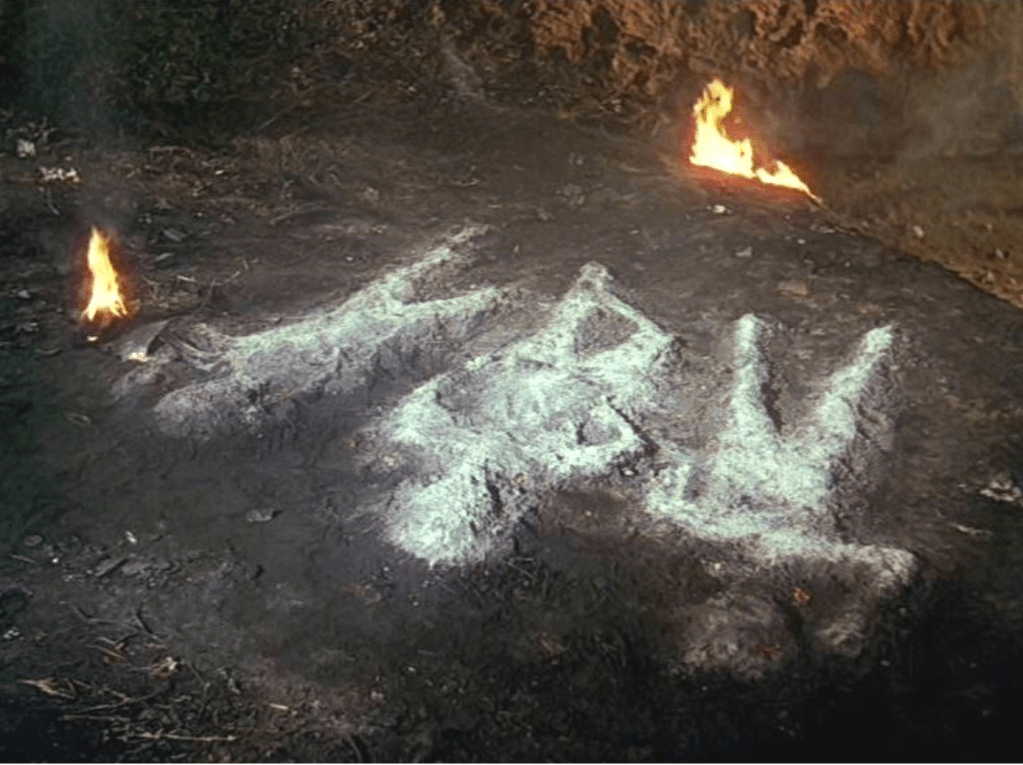
At which point ten-year-old me is frantically assembling a fort out of the sofa cushions.
A fascinating aspect of the first use of the Martian heat ray weapon is the depiction, in a subsequent scene, of what we’d identify today as the effects of an electromagnetic pulse. Simultaneously with the poor watchmen getting theirs, the lights go out in town, the phones go dead, and even wristwatches stop, their casings rendered magnetic. EMP is a side effect of nuclear explosions, and as near as I can tell was first identified years after the film was made. I looked it up, and this is what Google gave me:
The first major, observable discovery of nuclear electromagnetic pulse (EMP) occurred during the US Starfish Prime high-altitude nuclear test on July 9, 1962. Detonated 250 miles (400 km) above the Pacific, the 1.44-megaton blast produced an unexpectedly large EMP that damaged electronics 900 miles away in Hawaii, including 300 streetlights and telephone systems.
Somehow, the filmmakers intuited the real-world impact of a high energy atmospheric discharge akin to an atomic blast.
The next attachment is the first big battle between the Martians and the military. Formidable forces have been assembled to contain the aliens, whose intentions are by now all too clear. Tanks, artillery, and infantry well supplied with mortars, bazookas, and heavy machine guns, all hunker down in their entrenchments, waiting to unleash holy hell, and perhaps we’re supposed to feel a renewed optimism. Sure, we’ve seen what their heat ray can do, but we’ve got some surprises for them too, yes? Wait ’till those off-planet bastards get a load of hot lead and high explosives coming their way at Mach 3, by God, they’ll wish their alien fathers had never met their Martian mothers. Yeah. The thing is, what we haven’t yet seen is that the overwhelmingly high-tech Martians also have another, even nastier type of energy weapon, one which employs not heat, but some sort of electromagnetic death ray that literally disassembles atoms, and even worse, they’ve got deflector shields. Deflector shields, for rice cakes, also apparently running on magnetism. Shells, bombs and bullets bounce off with no effect, while the three Martian war wagons proceed to mop the floor with the best that the US Army can throw at them. It’s a massacre. People and machines don’t just burn, either, they glow green and evaporate, leaving only greasy stains behind. It’s horrifying.
The special effects are extraordinary for 1953, truly ground-breaking, and they’re attended by some amazing Foley work; remember, this was 1953, and they didn’t have synthesizers and computerized gizmos to produce all those otherworldly noises pouring out of the Martian killing machines. The sound engineers had to do it all the hard way with a purely analog and truly ingenious bag of tricks, making it up as they went. According to my brief research, the whining sound of the heat rays was produced by layered electric guitars played backwards on tape; other incidental sounds were an amalgam of feedback from electric guitars recorded on top of harps; the strange pulsing noises associated with the green, atom-smashing death rays were the product of striking high tension steel cables, like the guy-wires that hold up radio masts, with something heavy like a monkey wrench (an effect reused 15 years later for the photon torpedoes of the Starship Enterprise, and later still for the blasters in Star Wars).
After that first battle it looks pretty grim, and it only gets worse from there, as the Air Force takes its best shot and fails miserably (“I watched the jets go in” reports the General to high command, “but none of them came out”), and even an H-Bomb dropped from a futuristic YB-49 “Flying Wing” (courtesy of a Northrop promotional reel) comes to naught. All seems lost, and the script doesn’t pull its punches to the extent contemporary viewers might have expected. Our downfall as rendered on screen isn’t pretty. The chaos and ugly societal collapse depicted in the final scenes, as the Martians lay waste to Los Angeles while its citizens panic and turn on each other like animals, made a particularly unsettling impression, as did the shots of huddled survivors taking their last refuge in houses of worship, singing hymns and praying for deliverance as the sound of the death rays grows nearer.
It’s over. Humanity hasn’t a hope. And then…
As I write this, War of the Worlds is now 73 years old, and it’s about 55 years since I first saw it. It still knocks my socks off. In an era when sci-fi horror was apt to involve giant insects and marauding fire-breathing dinosaurs, along came this intelligent, well-crafted, altogether harrowing depiction of what it must have felt like to be the Aztecs when the Spanish first planted their big Conquistador boots in the New World. There’s nothing like that feeling of atavistic dread when the Martians first reveal themselves, or the horror of realizing, as the invaders burn humans down to ash and make fast work of our most powerful military machines, that this isn’t going to be a war so much as an extermination, and that to them, all of us count for about as much as the bugs we crush casually underfoot, or, as Wells put it, the transient creatures that swarm and multiply in a drop of water.
 the needlefish