Song of the Day: The Kinks – Waterloo Sunset (January 24, 2020)
Almost lost amid the psychedelic explosion that followed in the wake of Sgt. Pepper, the Kinks’ more conventional 1967 album Something Else included many of the best songs Ray Davies was ever to compose, none better than his masterpiece, Waterloo Sunset. There may be nothing else in all of popular music quite so wistfully evocative as this poignant, eligiac, and characteristically nostalgic paean to the famous neighbourhood of central London, over which Ray saw many a sunset as he looked out the window of his room in St. Thomas hospital as a very ill young boy. The beautiful melody came to him in a dream, like Yesterday‘s did for McCartney, and Ray at first thought the title should be “Liverpool sunset”, but he knew and loved London better, and the now familiar lyrics flowed readily as childhood memories of his view over Waterloo washed over him. There’s a curiously moving, philosophical, and almost olympian quality to the narrator’s depiction, as he gazes out over the city, with its bright lights and bustling people, content to stay at home all by himself. It’s chilly outside, but he’s safe, warm, and happy in his solitude, taking satisfaction in the lovely view, while the sun goes down and the Thames keeps rolling as it has through thousands of years of the old city’s history.
Every day I look at the world from my window
But chilly, chilly is the evening time
Waterloo sunset’s fine…
Terry meets Julie, Waterloo Station, every Friday night
But I am so lazy, don’t want to wander, I stay at home at night
But I don’t feel afraid
As long as I gaze on Waterloo sunset, I am in paradise
Millions of people swarming like flies ’round Waterloo underground
But Terry and Julie cross over the river where they feel safe and sound
And they don’t need no friends
As long as they gaze on Waterloo sunset they are in paradise
The Terry and Julie characters are often said to be Terrance Stamp and Julie Christie, at that time the “it” couple of Swinging London, but Ray was actually thinking of family, saying in one interview “I think the characters have to do with the aspirations of my elder sisters, who grew up during the Second World War and missed out on the 60s. I was thinking of the world I wanted them to have.” One can’t help but hear an underlying tinge of sadness upon learning that the eldest of his six sisters, Rene, died when Ray was just 13, the very day she’d bought him his first guitar as a birthday present, and the listener’s mood grows more somber knowing that two others who served as Ray’s muses, Joyce and Rosie, died within three weeks of each other in 2014. Yet Waterloo Sunset remains an uplifting celebration of life, and of the soothing, heart-warming beauty of everyday, ordinary things as taken in from a certain remove. Ray once described himself as living with “an abiding sense of apartness”, and that inherently melancholy point of view is certainly evident here, but Waterloo Sunset is written from the perspective of a moment at which the sadness has all been boxed away, and everything is, after all, still right with the world, or at least as right as it’s ever going to be, which might, in a naturally sad person’s reckoning, be one definition of paradise.
The story goes that upon finishing the recording session, Ray had his wife drive him down to stand for a while on Waterloo bridge; he wanted to soak it all in and be sure he’d gotten it right. Looking around, contemplating the nighttime scene, he decided that he had.
Song of the Day: Jackson Browne – For a Dancer (January 26, 2020)
There’s a mother lode of memorable thoughts and imagery packed into the suite of beautifully intertwined piano ballads of Jackson Browne’s landmark 1974 album, Late for the Sky. One remembers with almost cinematic clarity the metaphorical picture, conjured by The Late Show, of the narrator parked outside a mournful girl’s house in his early model Chevrolet, her standing in the window, him mentally urging her to bundle up her sadness, leave it at the curb, and just get in the car so they can go far away from whatever it is that’s breaking her heart. There’s the photo of a former lover he finds in a drawer in Fountain of Sorrow, so clear in the mind’s eye; she’s turning around to see who’s behind her, unaware that her picture’s being taken, and thus caught off guard betrays her true feelings with the unmasked sorrow in her eyes. There’s the open road, stretching on forever like the highways do in places like Arizona and Utah, which I always see when I listen to Farther On. There are frank, rueful sentiments, like maybe people only ask you how you’re doin’ cuz that’s easier than lettin’ on how little they could care. Every song is a finely wrought study of loss, regret, doubt, and a steadfast refusal to give up, but the finest has to be For A Dancer, which showcases Browne’s rare capacity to mix profound sadness with a clear-eyed, rational hopefulness that acknowledges all the mishaps, mistakes and misfortunes that drag down our spirits, tells itself no lies, harbours no illusions, yet refuses to accept that our lives must be futile, no matter how much it may seem that way. Written in memory of a friend who died pointlessly in a house fire, For a Dancer is poignant, philosophical, and steeped in almost unbearable emotional honesty, confronting head-on the terrible, unfathomable reality of death.
I don’t know what happens when people die
can’t seem to grasp it as hard as I try
it’s like a song I can hear
playing right in my ear
and I can’t sing it
but I can’t help listening
What can anything mean when you can be alive one minute and permanently gone the next, when somebody you know can simply vanish, and all the things that were unique and endearing about a friend can be rubbed out like they never existed in the first place? Why maintain the forward momentum when all paths lead us over the edge of an abyss? Once we’re gone, will it matter at all that we were here for just a little while?
The special grace of For A Dancer lies in Browne’s admission that he just doesn’t know, but he’s not going to let that stop him from squeezing as much out of his time among the living as he can. You never know what will be coming down, and if you don’t know what it’s all about, and can admit of the possibility that it might not be about anything at all, you also have to accept the flip side, and allow that after all, our seemingly inconsequential lives might form a part of something larger and mysteriously, perhaps unknowably, meaningful. It might not be the answer we’re hoping for, but maybe we can still take solace in realizing that the doubt cuts both ways.
Don’t let the uncertainty turn you around
(The world keeps turning around and around)
Go on and make a joyful sound
Into a dancer you have grown
from a seed somebody else has thrown
Go on ahead and throw some seeds of your own
and somewhere between the time you arrive
and the time you go
may lie a reason you were alive
that you’ll never know
Somehow, the closing lines of For A Dancer always manage to break my heart and mend it at the same time. I know of nothing else in popular music that offers such an honest and unblinking rationale for continuing to hope against hope. Maybe our lives don’t matter. Maybe they’re too meaningless to justify the pain. Maybe, though, there’s a reason that we’ll never know.
Words to live by.
Song of the Day: ABBA – Dancing Queen (February 3, 2020)
No, I’m not kidding. And no, this isn’t Bizarroworld Songs of the Day. Listen to this with an open mind and it’s immediately obvious why this unlikely crew burst out of Scandinavia to take the world by storm.
What it comes down to is this: you never know where you’re going to find a great pop song, and there’s nothing but snobbery in giving short shrift to a tune just because of who performs it. Yes, ABBA was often very sugary, very Europop, and way too calculated. Yes, a lot of their biggest hits (think Fernando, Mama Mia, or Take a Chance on Me) put one cringingly in mind of feathered Farrah-dos, bell bottoms, and disco balls, while tending, as some wag of a reviewer whose name escapes me once wrote, to promote both mindless toe-tapping and tooth decay. It was all very slick and prefabricated, no doubt, but boy, the formula – smooth, soaring harmonies, classic pop chord shifts, lilting melodies, and layered production that owed everything to Phil Spector – gelled perfectly in Dancing Queen, producing something that was at once a danceable earworm and something a little more. Maybe a lot more – I don’t care what anybody says, this is transcendent pop, and not at all as shallow as ABBA’s reputation would lead you to expect. To my ears there’s a positively wistful quality to the chorus; I always imagine it sung from the perspective of an older woman, watching the seventeen-year-old having the time of her life, and remembering, with a hint of sad nostalgia but no trace of regret, that lost, ephemeral moment of her own youth, when the world was full of possibilities, and none of those choices that set one’s path in life had yet been made.
Go on and dance, young lady, they seem to be singing. You owe it to yourself to revel in your youthful vitality, and make as many joyful memories as you can while the making’s good.
Song of the Day: Blondie – Dreaming (February 3, 2020)
Look, I rail against the horror of Seventies music all the time, but the decade certainly had its highlights, especially along the roads less travelled by. As the decade closed, though, few would deny that an appalling ennui had overtaken the zeitgeist, with West Coast singer-songwriters vying for chart position against guys shrieking 4/4 Disco (with rhythms so simple even white people could find them) in manic falsetto, while John Travolta strutted around in white suits across illuminated dance floors. It got so bad that rock ‘n roll became ripe to breed its own counterculture – and then, all too briefly, something wonderful happened.
For a few years there, until the likes of Lionel Ritchie, Phil Collins and Huey Lewis imposed a new, bland consensus on the Eighties, there was a tremendous burst of energy and creativity. In England, as the shock of the Sex Pistols played itself out and faded away, bands like XTC and Squeeze were cranking out first order British pop that hearkened back to the best days of the Who and the Kinks – some thought even the Beatles. A Buddy Holly-looking dude named Elvis Costello was cutting high energy discs. A fantastically rebellious outfit calling themselves The Clash, supposed punks who weren’t punks at all, being politically engaged, talented, and passionate, rather than nihilistic and deliberately ham-fisted, were beginning to make a name for themselves. Back in CBGBs in New York, the Ramones were tearing the cosmos a new one, the Talking Heads were introducing pop music to an exotically rhythmic form of art rock that fairly boggled the mind, and a gorgeous blonde named Deborah Harry came out of nowhere, fronting a band called Blondie, and proceeded to blow the doors off the whole bloated pop radio edifice.
Everybody remembers Heart of Glass, and The Tide is High, but those eminently catchy tunes were mediocrities next to Dreaming, which fired on all twelve supercharged cylinders, combining the melodicism of traditional pop with the ferocious energy of punk to create a level of excitement that still stirs the blood over 40 years later. Propelled along by drumming reminiscent of Keith Moon at his peak, and accentuated by ripping guitars and soaring synthesizers, Dreaming is made whole by the sheer power of Harry’s piercing, unwavering vocal. An audience long since stunned into decadent, ambient passivity by the metronomic thump of songs like Do The Hustle and Shake Your Booty, and the empty pop stylings of Captain and Tennille and The Starlight Vocal Band, was jolted abruptly into full consciousness. All of a sudden it wasn’t Muskrat Love and Midnight at the Oasis. The DJs might just as well have announced “we interrupt our regularly scheduled programming to bring you this special report”, while the dashboard radio started screaming at us: Wake up, numb-nuts!! Something is happening!!
It couldn’t last, of course. All too soon it was Duran Duran, Culture Club, Bananrama, and the Spice Girls. As the Eighties wore on, there were, again, highlights, especially on the roads less travelled by. But for just a couple of years there, the airplay was going to the most energizing stuff any of us had heard for years, and popular music seemed set on a trajectory that would take us back to the exhilarating heights we’d thought we’d never revisit.
Song of the Day: Crowded House – Recurring Dream (February 14, 2020)
Within myself, there are a million things spilling over…
A sweet little symphony of harmonious chord shifts swirling around a sinuous, rolling lead guitar line, Recurring Dream showcases Neil Finn’s expert grasp of tight, disciplined, melodic pop songwriting. For decades now, whether on his own, with his brother Tim, or fronting the bands Split Enz and Crowded House, Finn has regularly supplied discerning listeners with many of the greatest musical pleasures of the post-Beatles era, enjoying significant yet entirely insufficient commercial success along the way. In pessimistic moments it’s easy to imagine that Neil’s compositional style has gone out of fashion, with all the chart action these days going to rhythmic shouting, tuneless moaning, and formulaic dance tunes sounding like they were written by algorithms. Yet surely there’ll always be an audience for the genuine article, for songs which, however different they may seem on the surface, share DNA with a long line of compact masterpieces stretching back decades, through Lennon-McCartney, Bacharach, Wilson, Holland-Dozier-Holland, Goffin-King, and the rest of the pantheon all the way through to Rodgers, Gershwin, Porter, and Berlin.
Great songs, whatever the style, share a common set of virtues; there’s a sort of master tunesmith’s toolkit of chords, keys, rhythms and melodies that all the greats employ, discernible whether you’re listening to God Only Knows or My Funny Valentine, Here There and Everywhere or Someone To Watch Over Me. It’s there in Wouldn’t it be Nice just as surely as in Night and Day. I wish I had the background and the training to properly explain it, and I suppose, given my rank ignorance of music theory, it’s possible that I’m full of old rope, yet I swear I can hear it, there’s a difference to really fine songs that’s as plain as the distinction between stilted prose and beautiful writing, even if I can no more account for it than I can tell you why, exactly, There once was a man from Nantucket / who kept all his cash in a bucket just isn’t the same thing as I should have been a pair of ragged claws / scuttling across the floors of silent seas. Some songs, most really, belong in the Dirty Limericks League, while a few, hardly any in the scheme of things, are more like Prufrock. Have a listen not just to Recurring Dream, but Fall At Your Feet, You Better Be Home Soon, Angel’s Heap, Don’t Dream It’s Over, She Will Have Her Way, or Twice if You’re Lucky, just to suggest a sampling, and see if you agree that Neil’s best stand among the few.
Song of the Day: John Darnielle – Surrounded (March 18, 2020)
I was just sitting here up in my third floor office, the “tree house”, keeping my extreme social distance (even Kathy is two floors away!), staying something similar to calm, as my life’s savings literally evaporate before my eyes, by playing with my very expensive audio toys – what could be more soothing than watching the reels spin on an Akai GX-77, I ask you – and being thus comforted put me in mind of this song.
I discovered Darnielle because he shared the stage in the song writers’ forum Ships and Dip, from which I once supplied a clip for One Great City, the wonderful ballad to frozen Winnipeg performed by John K Samson. Darnielle fronts a band called the Mountain Goats, an “indie” outfit that often releases its music in penny packets of a thousand units or so. Surrounded is from a “concept” album and proposed rock opera about, get this, a government-run organ harvesting conspiracy being perpetrated in secret facilities on the Moon. The clip starts with Darnielle explaining the underlying concept, and you’ll probably share the reaction of the guy sitting next to him.
Yet this a powerful song, which to me has always seemed quite Townshend-esque. Here we have a rock opera with a wild and out there story line, and a ferocious acoustic number that features almost frantic strumming of the sort heard in Flamenco music. Doesn’t this bring to mind the story of a deaf dumb and blind kid named Tommy, the subject of a similarly strummed little number called Pinball Wizard?
Anyway, how could I resist a song that portrays a character who doesn’t mind being separated from the general population, so long as he has his 96 inch widescreen to keep him company?
I’m just fine. I’ve got my friends here with me.

Song of the Day: Sophie B Hawkins – Damn, I Wish I Was Your Lover (March 18, 2020)
Damn.
Totally, immediately immersive. Two seconds in, and you’re underwater.
Maybe there’s a torch song somewhere out there more feverishly evocative of pure, desperately unrequited feminine lust as felt in the lonely dead of night, but if so, probably best to just leave it well enough alone. Hard to believe, now, that this thing was melting the grilles off of boom boxes way back in 1992, sharing space on the charts with the likes of relics like Baby Got Back and Whitney Houston’s crooning of I Will Always Love You, the hit that launched a thousand bellowing Divas. This isn’t a song that belongs to an era. It doesn’t share a “sound”, or any particular place or time. It just is, all hot and bothered and fit to burst. They say it’s about lesbian longing, which I don’t know, maybe it is, but one things’s for sure, somebody else is dominating the one she wants, and she’d lie, cheat, steal and probably murder if it’d get her love object to kick that other worthless bastard to the curb. You can feel her frustration boiling over into something close to hatred:
That old dog has chained you up alright
Give you everything you need to live inside a twisted cage
Sleep beside an empty rage
I had a dream I was your hero
This is white hot. This is twelve million candlepower incandescent desire. You don’t play this in the morning. You don’t play it when you’re sober. You don’t play it in polite company. You don’t play it above ground, either – darkened basements only, preferably after midnight, and then you play it loud.
Maybe get a doctor’s note first.
Song of the Day: Matthew Sweet – Get Older (March 21, 2020)
Matthew Sweet is another one of those songwriters who ought to be a hell of a lot more popular than he is. His stuff, which often sounds like a tuneful cross between the Byrds and the Rolling Stones, just soars. Get Older is the purest power pop, typical Sweet, and bounces along with such energy that you might not notice the sadness, not at first. Listen, though, to the poignant counterpoint of the repeated high-pitched piano chord being struck in the background (almost like the flutes in Penny Lane), and the words that accompany the descending melody. Written as if speaking to his younger self (that’s him in the headphones), this is the essence of everything you wish you knew when you were a kid, the advice you never got and wouldn’t have had the sense to follow if you had. Who cares if they don’t think you’re cool? Who cares if you don’t know what you want? One day, child, when you get older, you might wish you’d had the sense to be happy when you could have been, instead of worrying yourself sick about what all of those cool kids, every one of them peaking early and destined for a soul-destroying career in middle management, thought about your hair style and footwear.
You’ll get older, faster than you can imagine. For now, you’re too young to fret over their cliquish rules. This will pass. Resist.
No kid mired in adolescent angst and the agony of not fitting in could ever really adopt such an olympian perspective, of course. God knows I didn’t, and these days, so I gather, it’s even worse than it was when I went through it. It seems like they’re ahead of the game if they can tough it out without being taunted and bullied literally to death via social media. All those gawky, uncomfortable, anxious kids wondering where it is they’ll ever be able to go where they aren’t humiliated and embarrassed just to walk the halls. Kids, perhaps, just like the ten-year-old pictured on the album cover.
This one’s for them.
Song of the Day: Bonzo Dog Band – Death Cab For Cutie (March 31, 2020)
Anybody need a yuk or two?
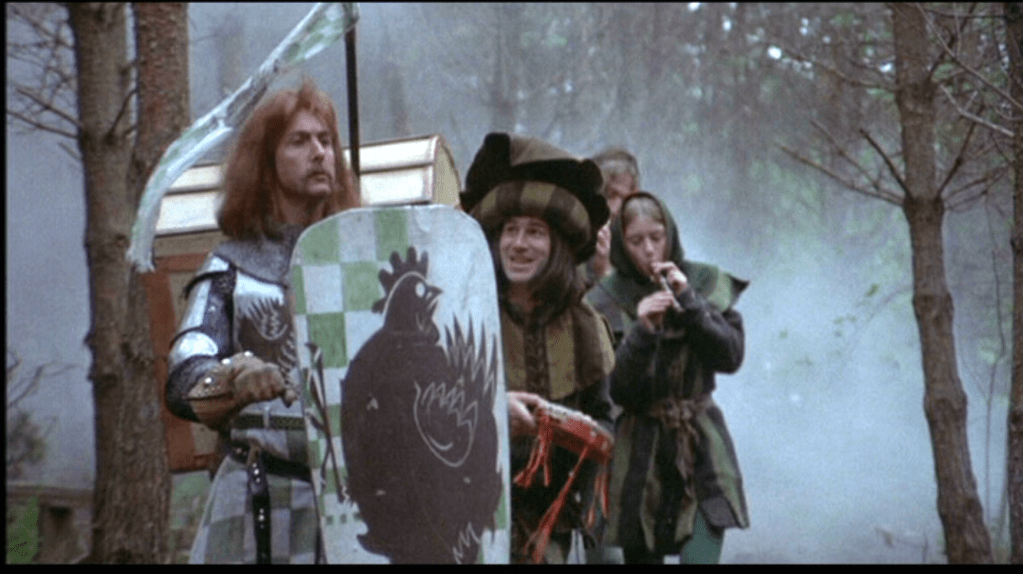
The Bonzos, A.K.A. the Bonzo Dog Doo-Dah Band, were an oddball group of former art students who happened to be quite talented musicians, a comedy troupe of a sort who hung around with the Monty Python crew and participated with Python alumni in various side projects, including the proto-Python series Do Not Adjust Your Set. Formed initially by Vivian Stanshall, who played tuba (!) and Rodney Slater, the outfit came to include a whole host of multi-talented members, among them the great Neil Innes, who can be seen playing Sir Robin the Chicken Heart’s travelling minstrel in Monty Python and the Holy Grail (for which he wrote the immortal songs Robin the Brave and Knights of the Round Table), and was one of the members of Eric Idle’s satirical take on Beatlemania, The Rutles.
The Bonzos, steeped in the traditions of the English music hall, which they fused into a bizarre but effective combination of rock, jazz, and oom-pah music, put out a number of albums that enjoy cult status today, and gave us such charming, quirky numbers as Mr. Slater’s Parrot, My Brother Makes the Noises for the Talkies, Tubas in the Moonlight, and the hilarious The Intro and the Outro. Their truncated version of I Left My Heart in San Francisco belongs in the Smithsonian, or some sort of hall of fame. They weren’t huge, exactly, but they’ve always had a devoted following, and even had a top 5 hit in England with I’m the Urban Spaceman, a record produced by some guy named Paul McCartney.
Death Cab for Cutie, the title of which was pilfered for the name of late-nineties alt-rock band, is a not-so-gently mocking slice of faux Elvis, with the singer sneering and Southern-drawling his way through the tale of a shameless two-timing girl who steps out on her boyfriend, but winds up getting hers. You can practically see Stanshall’s hips wriggling as the teen tragedy à la Teen Angel, The Last Kiss and Tell Laura I Love Her plays out to its gruesome car crash conclusion. She’s such a hottie, you see, that the cab driver can’t take his eyes off her in the rearview mirror – and, well, baby don’t you know that curves can kill?
Song of the Day: Kelly Clarkson – Since U Been Gone (April 1, 2020)
Believe it or not, the professional songwriters who penned this one, Max Martin and Lukasz Gottwald, had to shop it around a bit. For some reason Pink didn’t like it, and Hillary Duff, bless her heart, couldn’t sing it – the high notes were beyond her – so lucky for us, it wound up with American Idol victor Kelly Clarkson, who manifestly and most emphatically could hit the high notes, and then some. This is a great pop tune, and likely would have been a hit no matter who sang it, but Clarkson makes it her own with what has to be one of the standout vocal performances of the modern era, spanning the melody’s two octaves, climaxing on a high G, not merely with ease, but outright ferocity. My God, it sounds like she could shatter plate glass at 200 paces if she felt like it, and her impeccable musical phrasing, her sense of of the song’s inherent drama, captures perfectly the enraged essence of this anthem of a woman who’s just as relieved as she is angry to have finally been scorned by her worthless louse of an insensitive boyfriend. Screw him. Up his with a wire brush. Free at last!
It’s said that when the demo made its way to her, Clarkson didn’t much care for it, finding the arrangement bland and a bit generic. She wanted to punch it up, big time. She wanted a faster tempo. She wanted lots of howling guitars, with a bitchin’ solo in the middle. She didn’t want a power ballad – she wanted balls-to-the-wall rock ‘n roll, goddammit. So she did the same thing with the raw material that George Martin did to Please Please Me, changing it from a good song with potential into a guaranteed chart-topper that nobody – not even the hipsters and skeptics whose instinct was to scoff at anybody who arrived by way of frigging American Idol – could possibly resist.
It’s powerful, defiant, righteous, and royally pissed off. A triumph.
 the needlefish