A lovely performance of a lovely song, beautifully recorded a few years ago on the Australian iteration of the Idol franchise, at the conclusion of Lauper’s appearance as a guest judge.* There’s something especially magical about the complete sympathy that can develop between musicians, and one of the great pleasures of this rendition is watching Cyndi and her unnamed co-performer reach something akin to symbiosis, his work on the acoustic serving as a sort of combined lead and bass guitar compliment to Cyndi’s rhythm chords on the Appalachian dulcimer, her latter-day signature instrument. I’ve been searching the internet all day, trying to find out who he is, and whether, as it seems here, he and Lauper were longtime collaborators.
Time after Time was co-written with Rob Hyman for her spectacular 1983 debut album, She’s So Unusual, which sold umpteen millions during its 96 week run on the charts (65 0f them in the top 40), and included six different songs that made it on to the Hot 100, including this one, which became her first Billboard number 1. She never burned quite so brightly again, but over the decades her reputation has soared, and Time After Time in particular has come to be regarded as one of the modern era’s great love ballads, amassing a remarkable breadth of accolades, which you can read about here:
https://en.wikipedia.org/wiki/Time_After_Time_(Cyndi_Lauper_song)#Critical_reception
Still, whenever Lauper comes up, the conversation seems to turn to the supposed mystery of why she never made it as big as Madonna, who appeared at around the same time, and looked at the outset to be the inferior talent. Well, not a lot of performers were ever as big as Madonna, but it’s hardly as if Cyndi was a failure, not with 50 million album sales and an awards cabinet that displays not just a couple of Grammys, but an Emmy and a Tony as well. The odd thing about her was that all appearances to the contrary, Lauper was a serious musician who wanted to make music for its own sake, prevailing trends be damned, and she wasn’t all that concerned with mega-stardom, or willing to do the things women have to do if they want to reach the sort of heights to which the almost pathologically driven Madonna manifestly aspired from the outset (and that’s no knock against Madonna, whose sheer drive and enormous talent have for decades been a thing to behold). Anyway, so what? I find the whole discussion irritating – does anybody ever look at the career of, say, Randy Newman, and say “yeah, but he was never as big as Springsteen”?
Have another listen to Time After Time. Cyndi accomplished plenty, and surely that’s enough.
*There was a lot of commentary in the local press about Cyndi’s apparent dismay with the regular judges; bless her heart, she thought they were harsh to the point of cruelty, and kept jumping in to contradict their criticisms and offer encouragement to the poor saps on stage.
Song of the Day: Gerry Rafferty – Baker Street (June 5, 2021)
Who hasn’t dragged their tired soul home after long days of pounding the pavement in pursuit of some dream; when everything has been tried, everyone talked to, everything possible done, your very best, most complete shots taken… yet still there are no takers? Such moments can be incredibly discouraging and depressing. They can also be cathartic.
Nancy Wilson, discussing the emotions stirred by Gerry Rafferty’s Baker Street, 2018
The greatest riff in pop music history might not be Keith Richards’s guitar part from Satisfaction, and might not even be a guitar part at all, whichever your nominee might be. There’s a good argument that it’s actually the instantly captivating, infinitely memorable, and manifestly immortal saxophone line performed on Gerry Rafferty’s 1978 mega-hit Baker Street by little-known (and wonderfully named) session player Raphael Ravenscroft, who claimed to have composed it himself (early demos prove him wrong on that score), said he was paid for his efforts with a union scale 27 pound cheque that bounced (dubious), and always insisted rather sourly in public that it was almost unlistenable, telling one interviewer I’m irritated because it’s out of tune. Yeah, it’s flat. By enough of a degree that it irritates me at best. According to most knowledgable sources it’s neither terribly inventive nor especially difficult for any competent saxophonist to play, and evidence suggests that anyway Rafferty might have nicked it, from an earlier 1968 Jazz/Rock fusion recording called Half a Heart, performed in 1968 by virtual unknown Steve Marcus. The theft allegation is made plausible by the eerie similarity between the two, yet rendered equally implausible by the near certainty that UK resident Rafferty could never have heard the obscure American record, which moved maybe 1,000 copies in its own market, wasn’t sold at all in Great Britain, received absolutely no airplay anywhere, and wasn’t noticed by anybody until well after Baker Street emerged. Have a listen:
Songwriting credit for Half a Heart is widely attributed to vibraphonist and sometime composer Gary Burton, who’s gone back and forth on whether the resemblance between the two riffs could be pure coincidence, sometimes saying yes, because the older record was so obscure, sometimes thinking no, because they’re so similar, while also wondering why anybody’s asking him about it, seeing as he certainly wasn’t the composer. He’d remember something like that, right? So a bit of a mystery endures, and remains a lively topic of discussion on the internet among those (mostly pedants like me!) who like to discuss such things. You can read all about it here in this article in the Atlantic:
Whatever. Maybe it’s simple, technically unimpressive, and even plagiarized – there’s still something about it, isn’t there? I’ve never known anybody who doesn’t respond to it. Whatever the context, Baker Street cuts right through the background noise. People always want you to turn it up.
I’ve always found it odd that what strikes me as a rather moody, dark, and bluesy number, one boasting some scorching guitar work to boot, is universally classified as a “soft rock classic”, or, as they refer to the genre these days, “yacht rock”. Really? It doesn’t sound all that soft and yacht-worthy to me, not musically, and certainly not lyrically either, being, as it is, an account of a stumbling drunk’s depressed late night ramble down London’s legendary street, feeling beaten, directionless, and uncomfortably self-aware:
Winding your way down on Baker Street
Light in your head and dead on your feet
Well, another crazy day
You’ll drink the night away
And forget about ev’rything
This city desert makes you feel so cold
It’s got so many people, but it’s got no soul
And it’s taken you so long
To find out you were wrong
When you thought it held everything
You used to think that it was so easy
You used to say that it was so easy
But you’re tryin’, you’re tryin’ now
Another year and then you’d be happy
Just one more year and then you’d be happy
But you’re cryin’, you’re cryin’ now
I don’t know about you, but I’m not up for lumping that in with Margaritaville and the Pina Colada Song, neither of which would in any case be getting much play on my yacht, even if I owned the sort of vessel a more benevolent Cosmos would have long since gifted a deservingly agreeable fellow like me.
Baker Street is purely autobiographical. Rafferty, always notoriously dismayed by the cutthroat aspects of the music business, was embroiled at the time in legal battles over contractual recording obligations (a hangover from his stint as frontman of the group Stealer’s Wheel, whose hit Stuck in the Middle With You was one of the musical highlights of a generally lacklustre 1973), feeling angry, depressed, and drinking heavily. The song recounts the aftermath of one of his many visits to London to meet with the bloody lawyers, and his subsequent visit to an old buddy’s flat, where he could take a little break for a while, have a few laughs, and try to focus on something else. This is from the website Songfacts:
The song was the Scottish singer’s first release after the resolution of legal problems surrounding the acrimonious breakup of his band Stealers Wheel in 1975. In the intervening three years, Rafferty had been unable to release any material due to disputes about the band’s remaining contractual recording obligations, and his friend’s Baker Street flat was a convenient place to stay as he tried to extricate himself from his Stealers Wheel contracts. Rafferty explained to Martin Chilton at the Daily Telegraph: “Everybody was suing each other, so I spent a lot of time on the overnight train from Glasgow to London for meetings with lawyers. I knew a guy who lived in a little flat off Baker Street. We’d sit and chat or play guitar there through the night.”
https://www.songfacts.com/facts/gerry-rafferty/baker-street
The legal problems were eventually resolved, but the drinking and depression remained, and I’m sorry to report that Rafferty died relatively young in 2011, aged only 63 (which no longer sounds anywhere near as ancient as I’d like), his liver and kidneys both shot from decades of boozing. He’d long since given up on making music or capitalizing on his earlier successes, and didn’t seem to give a rat’s ass, having even, at one point, turned down a chance to tour with Paul McCartney. He didn’t die a pauper, if that’s any comfort; right to the end, Baker Street was earning him a nice pension of about 80,000 pounds a year (approx. $US 125,000), and must still be raking in the royalties for somebody, one hopes his ex-wife Carla, who finally couldn’t live with him any longer, as his demons overtook him and his behaviour turned disturbing and erratic, but by all accounts never stopped caring. “There was no hope”, she said later. “I would never have left him if there’d been a glimmer of a chance of him recovering”. Listen to Baker Street, and you can hear it all coming.
Yacht rock, my big squishy backside.
Song of the Day: Marc Cohn – Walking in Memphis (June 6, 2021)
As long as we’re talking about great riffs that weren’t played on guitars, how about the piano work in Walking in Memphis, which lent the song a distinctive sort of Bruce Springsteen-meets-Bruce Hornsby feel when it was released, and thirty years on still sounds a little different from anything else on the radio. It was the standout cut on Cohn’s eponymous 1991 debut album (which won him a Best New Artist Grammy), and told the true story of a journey taken years earlier to the city that was one of the wellsprings of the Delta Blues, as well as the home of the legendary Sun Studio, which Cohn aimed to visit along with other real yet mythical locales like Graceland, the tacky mansion where Elvis lived out his fantasies, and Beale Street, immortalized in the blues classic by the legendary W.C. Handy – the sort of trip that for many American musicians would amount to a religious pilgrimage. There was a little actual religion, too; Cohn also made a point of visiting the church where soul singer Al Green had taken up preaching as a Reverend, and took in a sermon.
Later, after walking the streets for a while, Beale Street especially, he headed home, up Highway 61 and into Mississippi, where he had the encounter that inspired him to compose the song, in a little roadside diner/cafe that caught his eye called Hollywood, of all the things to name an utterly unglamorous little joint sitting in the middle of the impoverished boondocks of pretty much the poorest state in the Union. Inside, an aged black piano player named Muriel Wilkins, who’d obviously been a regular at the place for years, was performing spirituals and old standards, and there was something about her – maybe Cohn simply admired the skill of a fellow musician, but you get the sense that it was something else, that he felt drawn to her at some sub-conscious level. When she took a break between sets, he approached her to strike up a conversation, and they hit it off. He wound up telling the sympathetic 70 year-old the bulk of his life story, really spilling his guts about how he was a struggling performer, how he lost his parents young, his Dad when he was 12, his Mom at only 2, and bless her heart, Muriel listened – really listened. As Cohn told Q magazine in 1992:
She was real curious, she seemed to have some kind of intuition about me, and I ended up telling her about my family, my parents, how I was a musician looking for a record deal, the whole thing. Then, it must have been about two in the morning, she asks me up to sing with her and we do about an hour, me and this lady I’d never met before, hardly a song I knew, so she’s yelling the words at me. Then at the end, as the applause is rising up, she leans over and whispers in my ear, she’s whispering, “You’ve got to let go of your mother, child, she didn’t mean to die, she’s where she’s got to be and you’re where you have to be, child, it’s time to move on.”
https://www.songfacts.com/facts/marc-cohn/walking-in-memphis
In the song, she asks him if he’s a Christian child, and he answers “Ma’am, I am tonight”.
Now that’s a hell of nice story, isn’t it? Heck, it’s downright inspirational, and steeped in the sort of mythical quality one expects from tales about finding your muse along the dusty roads of the Old South (plus it’s way more uplifting than the one in which Robert Johnson sold his soul to Satan at the crossroads).
Cohn kept in touch with Muriel, and she attended his wedding before she passed on, about a year before Walking in Memphis was released. You can’t help but wish she’d lived to hear it.
Walking in Memphis wasn’t the only good thing on the album – I’m a big fan of Ghost Train, the very next track on Side 1 – and two others, Silver Thunderbird and True Companion, made it on to the charts. Unfortunately, with that, Cohn peaked commercially, but he’s kept on making records, and I’m thinking I should check them out, and for that matter, revisit his debut.
The Hollywood, named not after Tinsel Town but Hollywood, Mississippi, still stands, and is, it turns out, a legendary place, which you can read about here if you’re interested:
Hollywood Cafe


Song of the Day: Jennifer Warnes – It Goes Like It Goes (June 10, 2021)
This beautiful, extraordinarily delicate little piece, voiced by the great Jennifer Warnes, played in its entirety over the opening credits of Norma Rae, which dramatized the struggles of labour amid the appalling working conditions in the old textile mills of the American South. It always sounded to me more like something composed by Stephen Foster than anything on the charts in 1979, and my first impression was that it had to be the work of Randy Newman – who but he could conjure something so mournfully evocative, echoing the musical traditions of another era? – but it was actually written by David Shire, a prominent film composer of the day, with an assist from lyricist Norman Gimbel. The song’s simple message, that there’s nothing special about the average person’s story, you’re born is all, then you work hard all your life until you grow old, wasn’t calculated to put a goofy smile on your face and a spring in your step, but then, neither was the movie, based on the true story of Crystal Lee Sutton, a textile worker who led union organizing efforts in one of the mills in Roanoke Rapids, North Carolina. The famous scene that everybody remembers, in which Norma Rae defiantly makes her stand on a worktable in the middle of the shop, wasn’t Hollywood fiction. That’s exactly what Sutton did, and it went down just as portrayed in the film. These are Sutton’s own words:
I took a piece of cardboard and wrote the word UNION on it in big letters, got up on my work table, and slowly turned it around. The workers started cutting their machines off and giving me the victory sign. All of a sudden the plant was very quiet…
https://en.wikipedia.org/wiki/Crystal_Lee_Sutton
Then, just like in the movie, the cops came to drag her away in handcuffs.
The battle was won, the plant got its union, and things got better for a while, but then the jobs started to move off shore. The J.P. Stevens factory where Sutton worked closed in 2003, and so have hundreds of others, all over the Carolinas and throughout the United States. While the domestic manufacture of textiles has rebounded a bit in recent years, this hasn’t meant much for the labour force; these days the robots do the work, and at last count only about half a million people are employed in the entire industry. The jobs aren’t ever coming back.
It’s not entirely clear how we should feel about that. Those mill jobs were terrible, dehumanizing, and never paid all that much, unions or not. Yet people need to put food on the table, and hustling around while a computer cracks the whip in the Amazon warehouse – sorry, fulfillment center – isn’t a whole hell of a lot better. One way or another, seems like, the rich keep getting richer, and the ordinary folk keep working their lives away for wages that barely make ends meet, always one paycheque away from being out on the street, without even a couple of hundred bucks in the bank in case the tired old car blows a gasket, or, God forbid, somebody needs to go to the doctor. It goes like it goes, and people hang on by their fingernails, maybe believing, like the song says, that you never know, some things along the way might get a little bit better.
Maybe so, if somebody can get get that sumbitch Joe Manchin on board.
It Goes Like it Goes won the Oscar for best song, and Sally Field won for Best Actress.

Song of the Day: Chris Collingwood – You Can Come Round if You Want To (June 15, 2021)
Just a sweet, tuneful, gentle little song by the other half of my beloved Fountains of Wayne songwriting team. After the break-up, Collingwood recorded the solo record Look Park, named after a favourite public green space back in his home town of Northampton, Massachusetts, on which You Can Come Round If You Want To was one of he highlights. It has a wistful, innocent quality that leads one to imagine the narrator as a not very successful, not terribly ambitious, but compassionate and utterly guileless sort of fellow, maybe a little lonely, but determined to deal with it all as best as he can, and mindful of what he’s got, when so many have so much less. Yeah, he’s just barely getting by, with the bank on the phone to remind him that he doesn’t really own anything he thinks he owns – So many bills to pay, so many bills, he sings – but hey, it’s OK:
And when the power goes out or the cable is broken
I’ll tell you every story I know
How we complain and find fault where there ain’t none
When some people got nowhere to go
Maybe he can’t scrape enough together this month to pay the cable bill, but it could be worse, right?
A little company would be nice, though.
Song of the Day: Jimi Hendrix – Are You Experienced? (July 20, 2021)
He made the electric guitar beautiful. It had always been dangerous, it had always been able to evoke anger. If you go right back to the beginning of it, John Lee Hooker shoving a microphone into his guitar back in the 1940s, it made his guitar sound angry, impetuous, and dangerous. The guitar players who worked through the Fifties and with the early rock artists — James Burton, who worked with Ricky Nelson and the Everly Brothers, Steve Cropper with Booker T. — these Nashville-influenced players had a steely, flick-knife sound, really kind of spiky compared to the beautiful sound of the six-string acoustic being played in the background. In those great early Elvis songs, you hear Elvis himself playing guitar on songs like “Hound Dog,” and then you hear an electric guitar come in, and it’s not a pleasant sound. Early blues players, too — Muddy Waters, Buddy Guy, Albert King — they did it to hurt your ears. Jimi made it beautiful and made it OK to make it beautiful.
Pete Townshend
Pete Townshend, one of the greatest ever to wield a guitar, had this reaction upon first seeing Jimi Hendrix play in a London nightclub called Blazes, back in 1966: I need to find something else to do for a living. Later, at the legendary Bag O’Nails club, Hendrix insinuated himself on stage to out-do Eric Clapton, then playing with the “super-group” Cream, who was taken aback – shocked and frightened, truth to tell – by the American’s supernatural talent. Graffiti all over London attested that Clapton was God, so what did that make Hendrix? Everybody flocked to see him, the entire pantheon, Keith Richards, Mick Jagger, Brian Jones, Jeff Beck, Paul McCartney, Eric Burdon, John Mayall, and of course Pete, all of whom quickly came to the settled conclusion, from which none of them ever wavered, that Hendrix was the greatest guitar player who ever lived, or ever would live. It wasn’t just the raw skill, it was the sinuous assuredness of his artistry, the obvious joy he took in the performance, the way he could do things holding the thing behind his head that nobody else could do no matter how carefully they cradled the damned guitar, all of it without seeming to boast or show off in any way. It was just what he did, which doing had a way of making everybody else in the trade feel like a bit of poser, to the point that it left those who’d built their fame on their reputations as guitar maestros not merely rattled, but almost abashed. At the famous Monterey festival in 1967, Townshend was desperate that the Who not follow Hendrix, since you simply couldn’t follow Hendrix, and according to legend the matter was decided by a coin toss, which Pete won (many years later, Jerry Garcia of the Grateful dead said that either way, this left him in the most unenviable position in concert history, having to appear between the Who and Hendrix, Townshend and the boys smashing their instruments like madmen, Hendrix later setting fire to his guitar, “and in the middle there’s us going ‘pling pling pling'”). End of the day, though, maybe it wasn’t so great to precede Hendrix either.
He only had time to record three albums in his all too brief career, Are You Experienced, Axis: Bold as Love, and Electric Ladyland. The first of these might just be the greatest debut album in pop music history, presenting an artist fully formed and capable of extraordinary feats of both playing and composition, and its title track remains one of the most powerful and musically sophisticated artifacts of the psychedelic era. This is from Wikipedia:
Hendrix historians Harry Shapiro and Caesar Glebbeek have praised “Are You Experienced?” as “a majestic setpiece of declamatory anthem rock”:
Mitch [Mitchell]’s military snare raps out behind the startlingly contemporary hip-hop scratch sound-effects of tapes running backwards punctuating Jimi’s condition for being your guide (‘If you can get your mind together’). To what? Sexual ecstasy? Altered states of consciousness? Or just finding yourself, taking time out to view what you’re doing from the outside, ‘from the bottom of the sea’, letting go of the daily grind of the ‘measly world’. It is all there for the taking. The secret is being at peace with yourself – ‘not necessarily stoned, but beautiful’.
https://en.wikipedia.org/wiki/Are_You_Experienced%3F_(song)
The overall effect was fantastic, though, one feels almost churlish in noting, the track is obviously the product of some very attentive listening to contemporary tracks by the Beatles, in particular Rain, I’m Only Sleeping, Tomorrow Never Knows, and Strawberry Fields Forever, in which can be heard virtually every musical device incorporated by Hendrix, including the martial snare drumming, the backwards guitar solos, the “scratch sound effects”, and the false ending. Even the insistent hammering on a single piano note has an echo in the coda to Strawberry Fields. What remains obvious is that Hendrix, in adopting these devices, was no mere imitator, and Are You Experienced is certainly no mere Beatles knock-off (in fact, so vast was Jimi’s talent, and so respected was he among his peers, that Lennon and McCartney were probably chuffed at the compliment; Paul, certainly, has always delighted in telling the story of going to see Hendrix and hearing him play the title track from Sgt. Pepper just a few days after it was released). Among all the amazing recordings he produced in the short time he was with us, from his apocalyptic take on Dylan’s All Along the Watchtower, to the frantic, heavier-than-heavy-metal grind of Crosstown Traffic, to the beautifully nuanced and laid back artistry of The Wind Cries Mary, nothing else displays quite the level of artistic confidence, or has quite the emotional impact, of Are You Experienced? It still feels visionary.
Have you ever been experienced? Well, I have. There’s something about the way he sings those lines, sounding both sly and playful, yet also in genuine possession of some profound knowledge that eludes the listener. He’s just talking about being high on whatever it is the drug-addled lunatics are ingesting these days, scoffed the establishment, and they were probably at least partly right. At the height of the Sixties, a lot of people believed that substances like LSD were opening their minds in a host of positive ways, leading them not into a false and dangerous world of incoherent and meaningless hallucination, but to an exalted plateau of cosmic truth. Maybe Hendrix did too. Yet, falling under the sway of the music, it’s hard not to feel that he’s getting at something else, like he really did know something we didn’t, something about how to see the beauty of it all without needing the chemical assistance.
Whatever that may have been, it seems not to have been enough. Maybe it was just a stupid miscalculation, maybe something else, but by 1970, when he was just 27, he was gone, the victim of barbiturates, having decided to swallow 18 times the recommended dose of the sleeping pills that had been prescribed for girlfriend Monika Dannemann. The sheer, pointless waste of it, and of the lives of so many others like him, provokes a sort of bewildered, disappointed anger. He wasn’t finished. He’d barely begun. Didn’t he understand? Wasn’t it obvious that he was supposed to stick around? So often, it seems, we’re left with the same baffled questions, the what-ifs, and the thoughts of what could have been, if only.
Song of the Day: Kathleen Edwards – Westby (July 23, 2021)
This is from her debut album, Failer, released in 2003 (she’d previously made a six song EP that was pressed to to the tune of about 500 copies). The record established her as one of the most authentically earthy writers on the scene, penning astute and insightful little short stories and character studies wrapped in catchy tunes that beguile to the point that you almost miss the acid sentiments in the lyrics. She’s never one to apply the sugarcoating, and a lot of her songs convey a sort of school-of-hard-knocks sensibility, hinting, perhaps, at the clinical depression that’s sometimes knocked her back on her heels. After a painful break-up in 2012, she quit making music for a while, and opened up a coffee shop called Quitters in the little town of Stittsville, just outside Ottawa. Now and then, a customer from out of town would wander in to tell her that her music had helped her through hard times, or changed his life, and eventually, lucky for us, the urge to get back to playing and composing returned. Her latest album, Total Freedom, was released last year to strong reviews. She still owns Quitters, though (always a good idea to have a fallback), and during the pandemic she and her band used it as a recording studio.
Westby is about a young woman losing her virginity to an older (one senses much older) man in a cheap motel, and she feels neither proud nor dirty, it just is what it is. She muses that if he wasn’t so old, she might even keep him, might even introduce him to all her friends, but here’s the thing:
I don’t think your wife would like my friends.
After he falls asleep, she channel surfs for a while, then steals his watch on the way out. Here, There, and Everywhere, this ain’t.
If Westby is your cup of tea, you’re bound to like Six O’Clock News, another standout track from Failer:
Just another happy-go-lucky number, this time about a loser gunned down in the street in front of his pregnant girlfriend. My kind of tune! Enjoy!
https://www.facebook.com/QuittersCoffee/
/https://www.thestar.com/content/dam/thestar/entertainment/music/2014/11/29/kathleen_edwards_calls_it_quits_opens_quitters_coffee/edwards.jpg)
Song of the Day: Dusty Springfield – Son of a Preacher Man (August 3, 2021)
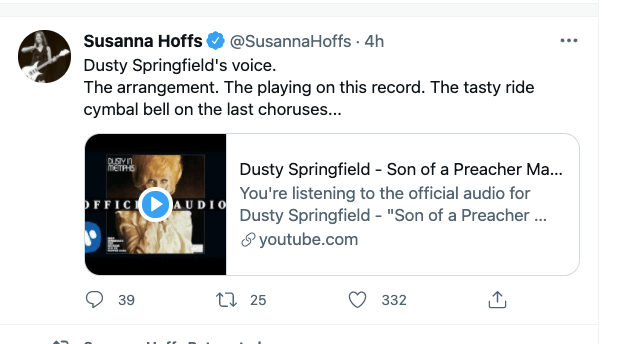
Amen, Ms. Hoffs.
Dusty may not have invented “blue-eyed soul”, a term coined by a Philadelphia DJ to describe the Righteous Brothers, but with Dusty in Memphis, an album that invariably lands itself on critics’ Best of All Time lists, she sure as hell perfected it. After a career singing straightforward pop tunes, including such hits as Bacharach/David’s catchy (but in hindsight rather chauvanist) Wishin’ & Hopin’, Dusty landed herself a contract with Atlantic Records, then one of America’s leading R&B labels, and found herself in a recording studio in Tennessee, surrounded by some of the best session players and most highly sought-after back-up vocalists in the business, including a female vocal quartet out of New York, the Sweet Inspirations, founded by Cissy Houston, Whitney’s mother. Magic ensued. The resulting album didn’t do all that well, actually (shades of Pet Sounds), but Son of a Preacher Man cracked the Top 10, before vanishing for a while from the public consciousness. I remember liking it a lot when I was a kid, back in 1969, but had forgotten all about it until it was used by Quentin Tarentino in Pulp Fiction, as the soundtrack to the quirky scene in which Travolta’s character first encounters Uma Thurman as a disembodied voice speaking at him over the intercom, before the hysterical events of their highly eventful night out kick off. Everybody’s reaction upon viewing that scene was pretty much the same: oh, yeah, Son of a Preacher Man, cool, I remember that one…damn, it’s good, isn’t it? The Pulp Fiction soundtrack sold several million copies, and Dusty had a lot to do with that.
Lots of people have recorded covers of the tune, including the great Aretha Franklin (herself the daughter of a preacher), for whom it was originally composed by songwriters John Hurley and Ronnie Wilkins, but who turned it down as “disrespectful”, likely having intuited what it was, exactly, that only the preacher’s boy was able to do for the narrator (you get right down to it, this song is, well, kind of filthy – sly about it, but delightfully, joyously, downright dirty by the standards of the day). Not even Aretha, though, can outshine Dusty, not on this one. Don’t take my word for it. Ask Susanna.
Song of the Day: John Mellencamp – Key West Intermezzo (August 10, 2021)
Seems to me that Mellencamp never quite got his due, though he had a great deal of commercial success in the eighties and nineties. Maybe it’s because he started out as “Johnny Cougar” (hey, at least it wasn’t Little Johnny Cougar), and transitioned through being John Cougar Mellencamp before the branding exercise ended with the simple use of his real name, making him seem a bit inauthentic. Maybe it’s because he was always being compared, unfairly and usually unfavourably, to Springsteen. Maybe it’s on account of his early songs seeming a little facile (though be honest, who doesn’t like Jack and Diane, however guilty the pleasure?). Damn, though, he could write a song when he put his mind to it, and as the years went on, and he suffered through a heart attack at only age 42, he changed, matured, stopped swinging for the fences with big, arena-friendly anthems, and started writing interesting little stories and character studies. Key West Intermezzo, an extremely well played, tightly constructed, deftly arranged, and beautifully produced little gem about nothing more grandiose than a couple of buddies out on the town on a hot summer night, strikes me as his best. Mellencamp and co-writer George Green supply the quirky little details with a light, wryly perceptive touch: the loud Cuban band at the Flamingo, “crucifying John Lennon”; the inevitable gorgeous girl spotted across the bar, stirring the ice in her drink “with an elegant finger”, while the narrator looks balefully at her well-heeled boyfriend and thinks man, what’s she doin’ with him; his buddy, Gypsy Scotty, spinning a yarn about some girl he knew back in Kentucky, but c’mon, he just made that story up – there ain’t no girl like that; the wan sunlight of an early Florida morning making for “a bone-coloured dawn”; there’s a cinematic feel to it. You feel like you know these guys, like you’ve hung out with guys just like them your whole life.
It’s a good feeling, even acknowledging the rueful observation that yeah, she might have caught your eye first, but you can’t just call dibs on the attentions of that girl over there, the one everybody’s noticed by now, who’s surely going to come and go having never looked your way at all. Nothing for it, I guess, but to lean on your buddies and push on ‘til dawn.
Song of the Day: Unkle – Heaven (August 14, 2021)
For some reason I have a weakness for hypnotic techno-pop, which maybe you don’t share, on top of which a video of a bunch of scruffy skateboarders doing their thing in slow motion might not seem, at first blush, worth much of your time, but wait for it; this was directed by the great Spike Jonze, whose work over the years on music videos has been fascinating, funny, innovative, and sometimes downright ground-breakingly visionary. This one takes a turn when, after a bunch of the usual stunts, nothing new or shocking (though executed brilliantly), dude skates his ass straight through what seems to be a concrete wall, and it gets more, er, explosive from there. The juxtaposition of the rhythmically low-key, trance-like audio with the pyrotechnics as these professional boarders seem to be close to getting themselves killed amid action movie-style blasts of fire and shrapnel is really quite jarring, and thoroughly fascinating – in a way, the movement of these guys through the slow motion explosions is just as mesmerizing as the music.
Musically, this reminds me a bit of U2’s Bad, off Unforgettable Fire.
The footage is distilled from the movie Fully Flared, also directed by Jonze (in collaboration withTy Evans), documenting the unparalleled prowess of the Lakai skateboarding team.
Song of the Day: The Breeders – Cannonball (august 16, 2021)
Oh what fun!
For just a moment there in the early 1990s, the Breeders, formed in 1989 by Kim Deal, the bassist for The Pixies, and Tanya Donelly, singer-guitarist for Throwing Muses, were everybody’s indie rock darlings. Their album Last Splash went platinum, propelled along by Cannonball, which somehow only made it to number 44 on the Billboard Hot 100, but was featured in heavy rotation on MTV and VH1 in the quirky, joyous garage band video attached above, co-directed by Spike Jonze. This left a vivid impression, on both the critics and the slice of the demographic that really loves tight, energetic pop music, that still lingers. Has there ever been a more infectious groove? It just rolls along with authority, don’t it? The lyrics, meanwhile, are deliberately and playfully silly, in the finest rock & roll tradition:
I know you, little libertine
I know you’re a cannonball
I’ll be your whatever you want
The bong in this reggae song
…the reference to reggae arising from Kim Deal’s sense that she’d written something that crossed Caribbean rhythms with grunge music, to which she applied the provisional title Grunggae, imagining it to be an oddity with limited commercial appeal. Interviewed in Mojo in 2013, she said “Did we record a song that opened with me saying, ‘Check 1-2,’ and then loads of vocal feedback from my brother’s harmonica mike, and think, ‘This is destined for radio?’ That was the sort of thing that didn’t get you played on the radio then. We thought no one would play it.” Geez, really Kim? To my ears, from the very start, with drummer Jim McPherson tapping out a clever rhythm on the cymbal stand just before the bass kicks in, this thing had “winner” written all over it. The way it alternates between the mellower, harmonious verses and the raucous chorus, that irresistible hey now, the bass work, the urgent drumming, the sudden, decisive ending, wrapping it all up before you’ve had enough – that, folks, is how you do that. It’s actually incomprehensible how it only made it to #44 – what the hell do people want out of a pop tune, anyway, if this isn’t it? – and I wonder how many of the songs above it on the charts rate any mention today.
Oh, and you’re right if you think the woman behind Kim on guitar looks confusingly similar. It’s not a CGI trick or anything. That’s twin sister Kelly.
 the needlefish