Song of the Day: Neil Young – Heart of Gold (August 19, 2021)
At top, another terrific concert video from BBC 4, bless ’em. Somebody should put together a collection. I’d buy it!
The songs for Young’s Harvest, his 1972 breakthrough album, were written when Neil was in a downbeat and contemplative frame of mind, recovering from a back injury that made it hard for him to do anything much except sit still and play his acoustic guitar. He literally was unable to stand bearing the weight of his favoured Les Paul electric. So, very well, sitting quietly was the order of the day, and songs that reflected his unusually subdued circumstances flowed naturally. “I didn’t know what else to do”, he said, as if his sort of creative process was simply an inevitable product of boredom. In the result he wound up with the raw material for what became the highest-selling album of 1972 (beating out stiff competition from, among others, the Stones’ Exile on Main Street, Bowie’s Ziggy Stardust, and Simon and Garfunkle’s Greatest Hits ), and his first and thus far only Number 1 single, today’s selection.
Harvest also included the classics Old Man and Needle and the Damage Done, which, along with Heart of Gold, were premiered for a wildly enthusiastic audience at Toronto’s Massey Hall in 1971, in a concert that lives on in rock music legend. A little while later, Young found himself in Nashville, recording a segment for the Johnny Cash Show, on which, as luck would have it, a couple of up-and-comers named Linda Ronstadt and James Taylor were also scheduled to appear. Hey, that’s Nashville for you; you’re bound to run into legendary performers, and those destined to be legends.
Local producer Elliot Mazur got wind of Young’s presence and invited him to record at his newly opened Quadrafonic Sound Studios, which despite its grand, high-tech sounding name was really just a rustic old house rigged up for recording, with the drums set up in the kitchen and the control room on the porch, a venue that suited Young right down to the ground. Asked to assemble his own band out of whoever was available, Neil corralled a local session group billed as the Stray Gators, and snagged both Ronstadt and Taylor, still in town, to sing back-up. Both were in the studio for Heart of Gold, and while I can’t claim to discern much from Taylor in the mix, Ronstadt’s unmistakable voice rings out clear as a bell, as usual, especially at the end. This is Mazur on how the session went, taken from Guitar magazine:
Mazer later told TapeOp.com, “Neil was very specific about what he wanted. When Neil Young plays a song, his body language dictates everything about the arrangement. Neil sat in the control room of Quadrafonic and played Heart Of Gold. Kenny [Buttrey, drums] and I looked at each other, and we both knew it was a number one record. We heard the song and all we had to do was move Neil into the studio and get the band out there, start the machine and make it sound good. It was incredible!
“At one point [on Out On The Weekend], Neil said to Kenny that his hi-hat was too busy, so Kenny said, ‘Fine. I’ll sit on my right hand.’ He played the whole take sitting on his right hand.” By only three days in, Young had already cut the versions of Old Man and Heart Of Gold to be released. “Neil and the band played live,” said Mazer, “same as every song on Harvest.”
https://guitar.com/review/album/the-genius-of-harvest-by-neil-young/
At the time, anybody playing thoughtful acoustic ballads while accompanying himself on harmonica was apt to be compared to Bob Dylan, and Dylan himself thought Heart of Gold sounded eerily like something he should have performed:
The only time it bothered me that someone sounded like me was when I was living in Phoenix, Arizona, in about ’72 and the big song at the time was “Heart of Gold”. I used to hate it when it came on the radio. I always liked Neil Young, but it bothered me every time I listened to “Heart of Gold.” I think it was up at number one for a long time, and I’d say, “Shit, that’s me. If it sounds like me, it should as well be me.
Sour grapes, perhaps, but I doubt very much Dylan viewed Young as a rank imitator, and I’d bet he was more angry at himself for not being the one to have written the big hit.
The final mixing of the studio release occurred at Young’s Broken Arrow ranch in Northern California, a process out of which arose one of the best stories you’re ever going to hear about the recording business. This is Graham Nash, excerpted in this case from the same article in Guitar Magazine, recounting an oft-repeated tale that’s become central to Young’s enduring mystique:
So it was that Graham Nash visited Broken Arrow, expecting to hear the album from the comfort of Young’s makeshift home studio. “That’s not what Neil had in mind. He said get into the rowboat,” recounted Nash to NPR. “I said, ‘get into the rowboat?’ He said, ‘yeah, we’re going to go out into the middle of the lake’. Now, I think he’s got a little cassette player with him or a little, you know, early digital format player. So I’m thinking I’m going to wear headphones and listen in the relative peace in the middle of Neil’s lake.
“Oh, no. He has his entire house as the left speaker and his entire barn as the right speaker. And I heard Harvest coming out of these two incredibly large loudspeakers, louder than hell. It was unbelievable. Elliot Mazer came down to the shore of the lake and he shouted out to Neil: ‘How was that, Neil?’ And I swear to God, Neil Young shouted back: ‘More barn!’”
According to the article, a fansite was selling More Barn!! T-shirts back in the nineties. I might just check on Amazon, see if anybody’s selling one.
Song of the Day: Tragically Hip – My Music at Work (August 20, 2021)
Everything is bleak
It’s the middle of the night
You’re all alone
And the dummies might be right
You feel like a jerk
My music at work
My music at work
Ah, truer words. Truer words, folks.
This one is personal. This one stings. This one, I lived myself.
You see, I used to be a lawyer, and my initial years in the profession were spent at a Bay Street law firm that was as much cult as place of business, full to bursting with the same sort of self-satisfied, privileged, upper class, clever-clever Caucasion pricks on wheels that we saw not so long ago acting as both witness and Republican interlocutor in the hearings to appoint self-satisfied misogynist prep. school shit-heel Brett Kavanaugh to the US Supreme Court. Down there at King and Bay, you worked yourself nearly to death helping the wealthy avoid paying their fair share of taxes, hoping to one day win the prize, while they kept moving the goalposts. Nights and weekends, nights and weekends, you know the drill, asshole. We will not be the ones to blame for the inevitable delay in closing. Keep those billable hours coming. Now, drop and give me fifty, maggot. For years and years, there I was at my desk, struggling to understand the arcana in the absence of any sort of guidance, when everything was indeed bleak in the middle of the night, and I felt like a jerk.
Here, Gord Downie portrays more of a low-level corporate grunt than aspiring master of the Universe, but the manic, meaningless, claustrophobic choreography of the dark, regimented office space is just the same. The night so long it hurts.
Song of the Day: Outkast – Hey Ya (august 22, 2021)
Just when you’re about to lose all hope in popular music, along comes the almost unbelievably charming Andre 3000 of Outcast, delivering this clever, cheeky, compulsively danceable pop tune with a video that has him playing all the members of the fictional group The Love Below, driving the girls bonkers as if they’re the Beatles on a British version of Ed Sullivan. I think Andre may have the most captivating smile in showbiz. I just love how the manager harangues them at the start, to get out there and act like they got some sense, since he didn’t fly all the way overseas in the middle seat so they could fuck it up. They have to make some dough over here, just to fly back home – remember, dude, Greyhound don’t float on water. That, the brilliant green outfits, the Love Haters decked out like jockeys, buddy on keyboards in the beret quietly smiling to himself, “Shake it like a Polaroid picture!”, and “Give me some sugar! I am your neighbour!”
Best thing to come along in years and years.
Song of the Day: The Rolling Stones – Tumbling Dice (August 24, 2021)
As much as Jagger’s lyrics or Richards’ riffs, Watts’ timekeeping on key Stones songs made them key Stones songs. The loose, almost jazzy feel on “19th Nervous Breakdown,” his groove lock with Richards on “Beast of Burden,” his extraordinary control with a very odd rhythm on “Get Off of My Cloud,” the bounce of “Jumpin’ Jack Flash,” his ice-cold snare on “Gimme Shelter” — all of these are masterclasses in serving the song and shaping it at the same time.
Rolling Stone, August 24, 2021
“Got to roll me” sings Mick, and Charlie lays ’em flat in the aisles.
From the Rolling Stone record guide
You turn around twice, and the drummer for the Rolling Stones has died, aged 80, and there ain’t a lot scarier than that.
The above-quoted Rolling Stone Record Guide, in one or another of its editions, the red one I think, once declared Charlie Watts and bassist Bill Wyman to be the “most existentially funky rhythm section in all of Rock & Roll”, and it was certainly true that the two of them seemed to stand calmly apart from the boys up front, like the guys in the engine room, making everything work without drawing much attention to themselves while Mick preened and posed and shook his money-maker for the crowd. It was like it was just a job, you know, his deadpan affect making it seem as if he’d rather be playing real music in a jazz combo that could make proper use of his extraordinary talents, but you can’t eat integrity, and if the yobbos wanted to make him a millionaire for supplying the backbone to Paint it Black, Under My Thumb, Satisfaction and all the rest, well, easy money was easy money. Not to say he was phoning it in – not at all – it’s just that he could do that shit standing on his head, and nothing that the Glimmer Twins over there demanded of him was about to make him break a sweat. Was he even enjoying himself, a little? It was hard to say. It didn’t seem like it. As he sat back there maintaining the most preternaturally locked-in backbeat in the business, you wouldn’t have been surprised to learn that he was thinking about the plumbing in his East Sussex cottage, or considering a change in his investment managers.
He was quiet, and he was cool.
Today’s retrospective on the Rolling Stone website, quoted above, mentions a number of standout performances, but for me Charlie was at his most sublime for Tumbling Dice, one the best songs on one of the six or eight greatest albums ever made, 1972’s Exile on Main Street; listen especially for the fills he supplies at the climax. The accelerated rhythm kind of slides in, takes over centre stage, and like the man wrote, Charlie lays ’em flat in the aisles.
I’m hoping they don’t try to tour without him. You can’t have the Stones without Charlie. You just can’t.

Songs of the Day: The Everly Brothers – Crying in the Rain; Bowling Green; Cathy’s Clown
For a while there, Phil and Don Everly were almost the biggest thing going, rivalling Elvis with a string of hits beginning in 1957 with Bye Bye Love, and continuing into the early Sixties, with 1960’s Cathy’s Clown, their first Number 1 under a new relationship with Warner Records, being their biggest hit. During their run at the top they taught a whole generation of performers to come about intricate harmony and lilting melody, and were an incalculable influence on everybody from the Beach Boys and the Beatles to Neil Young and Paul Simon. Indeed Lennon and McCartney, early on, aspired to be the “British Everlys”, and their first Number1, Please Please Me, owed much to the American Duo, featuring the same sort of harmonization that was the Everlys’ trademark. Keith Richards thought Don was one of the greatest rhythm guitar players who ever cut a record, and Bob Dylan said “we owe those guys everything”. They had taste, and serious vocal and instrumental chops. Their songs, whether self-written or not, avoided the kitsch and phoney sentimentality that characterized so much of the output of their 1950s peers, and drew heavily on the country and Appalachian folk music on which they were raised in home state Kentucky. A striking, rather moving vein of heartbreak and melancholy runs through their hits, and even the most upbeat numbers, like Wake Up Little Susie, were less about happy romance than they were about stress, mistakes, and facing the unpleasant music.
Yet good as they were, and despite the boundless respect of the industry, their star faded with startling rapidity after around 1962. It’s hard to understand; there was nothing inherently obsolete or less sophisticated about their style than most Sixties acts, and they should have been able to make a go of it. Instead they became a nostalgia act, and bickered back and forth, pursuing solo careers from the mid Seventies to the mid Eighties, until launching a minor comeback as a duo, propelled along by one Paul McCartney, who gifted them probably the best thing he ever wrote for a third party, the sublime On the Wings of a Nightingale, a song of the day way back when:
Song of the Day: Paul McCartney, On the Wings of a Nightingale
The middle selection above, Bowling Green, might seem an odd choice from a catalogue that contains much more prominent and popular numbers, but it’s a sentimental favourite. Way back, I think the late Sixties, the Everlys had what was then known as a “summer replacement series”, new programming the networks broadcast rather than play reruns of Gunsmoke or Bonanza. It was my first exposure to the duo. They closed every show with a brief rendition of Bowling Green, and it really put the hook in me, especially that one delicious musical phrase, a man in Kentucky sure is lucky.
Phil died in 2014 of COPD, brought on by years of smoking, and Don left us just last week, his passing obscured by the almost contemporaneous death of Charlie Watts, a figure who these days looms much larger in the public consciousness. Charlie would have told you, though, just like all the greats would tell you, that Phil and Don Everly were the real deal, and earned their place in the pantheon.
Song of the Day: The Temptations – Papa Was a Rollin’ Stone (August 28, 2021)
Fatherless siblings hear the nasty talk going around on the street, and ask Mama some pointed questions she was hoping she’d never have to answer. She isn’t going to lie. It’s true. Papa was good for nothing, and when he died, all he left us was alone. This is pure urban grit, the sound of streetlights reflecting off the surfaces of dark, rain-soaked streets, steam rising from subway grates, and big old Cadillacs splashing through the potholes, while over there, down that dark alley…well, shit, you don’t even want to know what’s goin’ on in there. Written by the immortal Norman Whitfield and Barrett Strong, Papa Was a Rollin’ Stone was first recorded by the almost forgotten Undisputed Truth, who never got any higher with it than #63 on Billboard, before the Temptations got ahold of it, turned into an epic twelve minute statement piece (later edited down to about seven minutes for the single release) and took it right to the top in September 1972, winning three Grammys in the process.
It’s undoubtedly a great vocal performance all around, but that ain’t the half of it. Crucial, impeccably moody backup is provided by the Funk Brothers, Motown’s legendary in-house ensemble of master musicians, with Maurice Davis on trumpet, Melvin “Wah-wah Watson” Ragin on guitar, and Bob Babbitt on bass, everybody doing their thing at such a high level that the backing track, without vocals, was chosen for side B of the single, and it won a Grammy for Best R&B Instrumental. The mood they create is so immersively, evocatively atmospheric that in its full-length version, with almost the first four minutes being exclusively Funk Brothers with no vocals at all, Papa Was a Rollin Stone isn’t so much a song as history’s funkiest film score. Indeed, the music for 1971’s Shaft was a major influence on arranger Paul Riser Sr., whose idea it was to add a frosty string section to ratchet up the drama. It’s practically impossible to listen to it now without thinking Seventies urban crime drama.
Amazingly, the group was reluctant to record it. The story goes that the guys were growing weary of the “psychedelic soul” label affixed to them since their smash hit “Cloud Nine”, and wanted to go back to romantic ballads, like My Girl, and Since I Lost My Baby; writer/producer Whitfield also seemed just as interested in the instrumental backing as the vocals, which wasn’t an attitude likely to win over a vocal group, but surely suited this particular number to a “T”. There was also friction between various band members and Whitfield, especially when it came to frontman Dennis Edwards, who was irritated at being commanded to keep redoing his vocal until it had just the right tone of pained weariness, dread, and uncertainty. There were dozens upon dozens of takes. Edwards wanted to emote. Whitfield wanted him to sound more matter of fact, almost flat, like you would when you knew you weren’t going to like the answer, but reckoned you needed to ask anyway. Later, basking in the glory of the band’s last Number 1 hit, the singer had a change of heart, saying in an interview with the Detroit Free Press that “I wanted to put more on it. I didn’t want it to be so bland. But Whitfield actually wanted it bland. Every time I would try to over-sing it, he would change it. He would make me mad…I did not appreciate it until I heard the record. And I said, ‘Wow.’ What he was doing, he was getting me into a certain mood.” He was, and did it ever work. There’s nothing in pop quite like the intonation of those opening lines:
It was the third of September
That day I’ll always remember, yes I will
‘Cause that was the day that my daddy died
I never got a chance to see him
Never heard nothing but bad things about him
Mama, I’m depending on you to tell me the truth
It sounds so emotionally authentic that for years the story has circulated that the pain was real, because Edwards’s father actually did die on September 3, which seems not to be true, at least according to the Wikipedia article**, but sure sounds as if it ought to be – too good to fact-check, in the words of author, screenwriter, and old newspaperman David Simon.
If ever there was a song that better earns the old “they don’t make ’em like that anymore” label, I’ve yet to hear it. They really don’t. Back then we didn’t realize, of course, that we were feasting on the last great songs of a golden age in popular music. In 1972, it still felt like the Sixties (which anyway hadn’t really begun until February 1964 over here), and Papa Was a Rollin’ Stone seemed to be setting the standard for another decade of terrific hit music. Nope. Of course, there was great music in the Seventies, but generally it wasn’t the zeitgeist. Times were changing, and the era of big radio hits being not merely the most popular, but also the very finest, compositions of the day was drawing to a close. In just a couple of years, it was all Disco Duck, Convoy, Theme From the Poseidon Adventure, and Billy Don’t Be a Hero. Meanwhile, Barry Gordy wrapped up the operation at the famous “Hitsville USA” house/recording studio in Detroit, moved Motown Records to L.A., and made a go of it for a while, but the magic was lost, and the label was eventually sold and then re-sold to and among various international conglomerates. Look at it this way: it was a miracle in the first place, and miracles don’t last forever.
Both the single and extended album cut versions are attached above.

**https://en.wikipedia.org/wiki/Papa_Was_a_Rollin%27_Stone
Song of the Day: Paul McCartney – Find My Way (August 30, 2021)
I mean I’m in awe of McCartney. He’s about the only one that I am in awe of. But I’m in awe of him. He can do it all and he’s never let up, you know. He’s got the gift for melody, he’s got the rhythm. He can play any instrument. He can scream and shout as good as anybody and he can sing the ballad as good as anybody, you know so… And his melodies are, you know, effortless. That’s what you have to be in awe of… I’m in awe of him maybe just because he’s just so damn effortless. I mean I just wish he’d quit, you know. [laughs] Just everything and anything that comes out of his mouth is framed in a melody, you know.
Bob Dylan.
Recorded during the pandemic for what became McCartney III, the third career solo outing since 1970 in which he plays all the instruments, Find My Way showcases Paul in fine form, continuing with a career renaissance that began with his excellent Chaos and Creation in the Backyard in 2005. Recent years have seen both robust chart performance and a dramatic critical reappraisal of both Paul’s solo career and his overall contribution to the Beatles, as people generally have come to recognize and value a talent that’s gifted them an ungodly motherlode of songs the non-existence of which is practically unimaginable to anybody who loves good pop music. I remember once, some music critic in the Toronto Star writing about his attendance at a McCartney concert and describing, as if he’d just come to appreciate it, “the terrifying depth of his catalogue”. Paul wasn’t saving the fan favourites for the end, the guy noted, because they’re all fan favourites. I’ve seen it myself; the concert I attended in Halifax a few years back went for over three hours, and he never got around to playing anything that anybody among the assembled 60,000 didn’t know by heart. My brother and I later engaged in an exercise of trying to figure out how long he could play before he did have to resort to something relatively obscure, and the answer, we figured, conservatively, was something like ten hours. Think of that: ten hours, probably, of three and four minute songs before he had to resort to playing a song that perhaps wouldn’t be instantly recognizable to everybody there within the first couple of notes.
Nobody else can say that. Nobody, ever.
The recent fantasy film Yesterday imagined a world in which a struggling singer/songwriter awakes one day in a world in which the Beatles had never existed, and he’s the only one who remembers them. It was purely a fanboy exercise, of course, not bad, not great I guess, but it had some lovely moments, including this one, in which Ed Sheeran, playing himself and being an incredibly good sport for the sake of the film, challenges the only guy who remembers the Fab Four – and who has now become an international sensation, claiming their whole catalogue as his own original compositions – to an impromptu songwriting contest:
Here’s the thing: imagine how many McCartney-penned Beatles classics they had to choose from to be the one that blows poor Ed Sheeran out of the water, and leaves him feeling like Salieri to the newcomer’s Mozart (even though Sheeran’s song, I thought, is quite nice in its own right, which perhaps is the whole point). The title track was disqualified, because they’d already used it:
So they were down to, I dunno, about 30 others, maybe, that fit the mood? I might have decided to make short work of Sheeran with something even more formally perfect, For No One, say, or Here There and Everywhere, She’s Leaving Home, Blackbird, Mother Nature’s Son, or Eleanor Rigby, or maybe gone for the pure overkill of Golden Slumbers, Let it Be, You Never Give Me Your Money, or even, God help him, Hey Jude. Or maybe just murder him outright with Penny Lane. That’s just a sampling, assuming we don’t want to change the tempo with something like Get Back, Lady Madonna, We Can Work it Out, With a Little Help From My Friends, Paperback Writer, or …well, pick one. The point of today’s column, however, is to argue that they needn’t have limited themselves to a pre-1970 timeline, if the premise is that nobody ever heard of this guy McCartney, or anything he ever wrote. One could choose from a whole slew of terrific songs composed by Paul in his solo career, a lot of which, if that’s the test, would have slotted in to Beatles’ releases without anybody noticing anything amiss. Take this little gem, which one can easily imagine appearing on the White Album:
It was something his Dad used to say to offer support to him when he was down; he’d hold out his hand and say “put it there”.
I expect Sheeran would have been equally cowed by the exquisite and exquisitely Beatlesque Maybe I’m Amazed:
Likewise the gentle, unassuming, almost painfully delicate Junk would strike most people as better than Ed’s nice little song:
Or how about jump forward a few decades, to My Valentine, written in 2012 to fill out an album of covers of old classics, titled KIsses On the Bottom, extracted from the Great American Songbook, all of them songs to which Paul’s musician father exposed him as a kid?
Nobody, not Gershwin, not Rodgers, not Porter, not Berlin, ever wrote one better – indeed, this one, written in C minor, seems quite deliberately to be channeling the great Richard Rodgers, once described by musicologist Dominic Pedler, in his book Songwriting Secrets of the Beatles, as the only other popular composer who ever rivalled McCartney’s “leap in the dark” gift for melody. It’s simply sublime, this one. Hey, don’t take my word for it. This is from American Songwriter magazine:
Writing a good love song, one that will bring tears to a woman’s eyes quicker than a dozen roses (or in the case of a man’s eyes, maybe quicker than tickets to a NASCAR race), is one of the hardest things any writer can do. Paul McCartney’s written a few that are part of pop music history. But maybe none of them have been as genuine, or sound as effortless, as “My Valentine.”…The song was as effective and timeless as any of the other great songs written by the masters he covered on Kisses On The Bottom, putting him squarely in their ranks. Nobody but McCartney could combine those lines with a killer melody in a minor key, of all things. Trying to write a love song in a minor key is automatically asking for trouble, as minor keys typically don’t lend themselves to positive, uplifting thoughts and feelings. But McCartney, being McCartney, got away with doing this song in C minor and including various minor chords in the changes as well.
Or how about this genuine piece of art rock:
At The Mercy would have been right at home within another iteration of Abbey Road’s “long medley”; Lord, that wonderful orchestral moment after the lyric “we can watch the universe explode”…the ringing guitars…the icy, foreboding strings…
Or how about How Kind of You, which is beautiful and dazzlingly sophisticated from the first note. It’s simply a superior exercise in music composition, and just listen to the extended coda, and how he wraps it up. It’s a McCartney hallmark, the ineffably elegant ending:
Then there’s this exhilarating rave-up, a live version of a track completed, from start to finish, in just a few hours for release under the pseudonymous group name The Firemen, in response to a challenge to compose, arrange, and produce/record a song in the span of a single working day:
It takes the like of Bono, Thom Yorke, and Noel Gallagher months to come up with something like that.
This is one, I’m convinced, that John would have liked a lot:
That’s Abbey Road Studio 2, by the way, and the kid at the recording console is Giles Martin, son of George. Try to keep track of all the mega-celebrities who jumped at the chance to be in a video with Sir Paul. This one rocks. Especially impressive is the dreamy interlude of the bridge, it was scary, but I did it, and I’m coming back for more.
I guarantee you, George Martin would have spoken warmly about this:
The sheer power of this one:
That’s one of the standout tracks from Ram, an album that was so reviled upon its release that you would have thought Paul had committed war crimes while making it. Honestly, critical reception was insanely hostile, and I do mean insanely, given that this is the present popular and critical consensus:
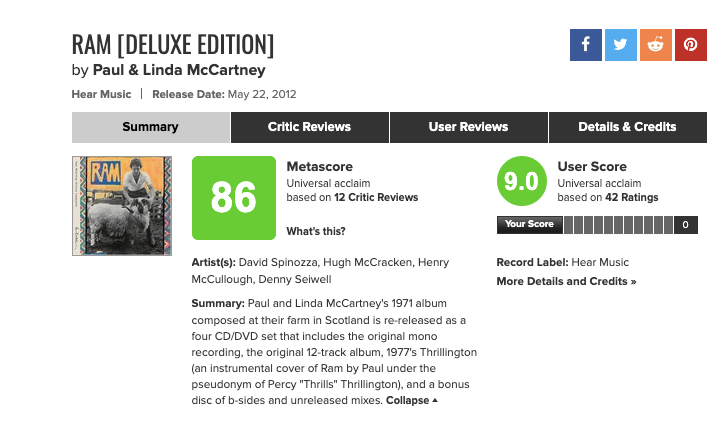
“Universal acclaim”. Hunh.
Which brings us to Find My Way. In a way, it’s just a good-timey number typical of its composer, but it’s also stuffed with the whole suite of subtle McCartney touches, beginning with the opening chords on electric harpsichord, and continuing through layer upon layer of expert instrumental ornamentation. It reminds me a bit of another sure-fire hit he wrote around 1968, which ended up being handed to Badfinger, Come And Get It, though it’s a great deal more complex, especially in the finale, another extended coda in which so many different instrumental lines are piled, each new one atop the last, that the complexity is essentially symphonic.
Look, I know that anybody who might still be out there reading my posts, supposing there actually is anybody, will be weary of my endless, tireless, interminable advocacy for Paul McCartney. Yeah, I hear you, but I’m on a mission, O.K? It’s because I came of age in the Seventies, when the man was generally reviled in the (essentially childish) rock press on a number of spurious grounds, among them his unforgivable tendency to not be angry at the world, and his heinous wish to write songs that made people feel good (and admittedly, his veering into some rather lightweight territory there for a while). I was myself apt to fall prey to the party line, and the Lennon hagiography, yet as I immersed myself in the Beatles catalogue, it became clear to me that the majority – I’d argue the vast majority – of the compositions that live on indelibly in the popular consciousness, and which will still be on the lips of ordinary folk centuries from now, are Paul’s. I really don’t think there’s any doubt about this. Plus, since my teen years, I’ve watched as nobody noticed that even the solo albums roundly condemned as dreck always included a couple of classics, and I’ve taken heart in his continuing popularity, as he keeps on making albums that hit the top of the charts. McCartney III debuted at #2, just a whisker behind Taylor Swift’s latest, and the previous album, Egypt Station, opened up at Number 1. Sometimes, some things are just as they should be.
Sorry to be grandiose, but hear this: McCartney will inevitably be recognized as the greatest songwriter in history. There will be arguments, of course. But the benchmark will be Paul, and not just for his work with the Beatles. To quote John Lennon from a different argument, in which I think it’s fair at this point to say he wasn’t as far off the mark as so many claimed at the time, I am right, and will be proved right.
See also:
Here, too, when you have the time, have a watch of this marvellous documentary from Britain’s ITV, and take note of the songs that made it to #1, and remain the popular favourites:
 the needlefish