Pink: Who Knew? (January 13, 2024)
This marks the third Song of the Day appearance for a composition by veritable Swedish hit machine and possible computer algorithm Max Martin, the others being Kelly Clarkson’s version of Since U Been Gone, and I Want it That Way, as performed by the Backstreet Boys. Curiously, and ill-advisedly, Pink had passed on Since U Been Gone, before Clarkson jumped all over it and made it one of the most memorable power pop hits of the early 2000s. Given the chance to record the structurally similar Who Knew?, she didn’t make the same mistake. She really sank her teeth into it, and had an up-tempo power pop hit of her own (though it took a while to catch on, and peaked at #9 on the Billboard Hot 100 – go figure). That Max Martin, boy howdy, he really can crank out an irresistible ear worm, can’t he? Pink got a co-writing credit on this one, and certainly deserves tons of praise for her performance, but musically, at least, Who Knew? has Martin’s golden fingerprints all over it.
I like Pink, more as a person than a performer. She’s got her wits about her. Her head’s screwed on right. She’s been through some things, taken her share of hard knocks, and knows the score. I remember being struck years ago by an interview she gave to Vogue, or Vanity Fair, or some such glossy magazine, in which she offered one of the best pieces of advice I’ve ever heard; I can’t find it any more, so I can’t give it to you verbatim, but it went like this: Always have your walking-away money. Earn that first, and put it aside. Never allow yourself to wind up in a position where you can’t just tell everybody to go f#@k themselves, and quit for good. Damn, girl. I mean, damn. Absolutely goddam right. Words to live by, if you can. She could, and plainly was. You knew she was. Pink wasn’t here to mess around.
Besides which, she doesn’t just look like she could kick the living crap out of you, she actually could. She’d punch your lights out, buddy, but good. That woman could drop a six-and-a-half-foot longshoreman in his tracks, and he’d wake up whimpering for his mother.
Lyrically, Who Knew? isn’t just another gripe from a woman scorned, though that’s how it might sound at first blush (I wonder if Pink earned her co-writing credit by authoring the words?). It’s obviously about romance gone sour, but I’ve always felt it might just as well be describing the fragility of all relationships, including the friendships you once assumed to be everlasting, and how even the most powerful connections between people, romantic or not, can vanish overnight, or fade quietly away over time while you’re not paying attention. One day, you’re taken aback to realize you’re all alone. It’s nothing you saw coming. You’d have said it wasn’t possible. But here you are.
When someone said count your blessings now
‘Fore they’re long gone
I guess I just didn’t know how
I was all wrong
But they knew better, still you said forever, and ever
Who knew?
She’s not angry, not really. She’s brought up short, bitterly disappointed, and terribly sad, and that’s really quite poignant, isn’t it? Who Knew? may come off to some like a glossy, slickly-produced slice of carefully calibrated chart bait, but not to me. Underneath all that, it’s got soul, and boy, does Pink ever bring it out.

Paul Simon: Me and Julio Down by the Schoolyard (January 19, 2024)
In an interview he gave about five or six years ago, Paul Simon provided his opinion on the hierarchy of history’s greatest popular songwriters, which caused a bit of a stir, because, of course, everybody has highly emotional opinions on such things, despite most having no particular insight into the form, or any appreciation of the relevant criteria. Simon’s assessment – which, I think we can stipulate, is infinitely more valuable than anything liable to be posted by this or that random idiot on social media – was that of a purist, concerned only with the classic virtues of superior music composition, with no regard for the more superficial aspects of any songwriter’s popular appeal. Guaranteed, in other words, to piss everybody off.
A very select group, in his view, belonged in the most exclusive rank of the pantheon, and he wasn’t one of them. Tier 1 comprised George Gershwin, Irving Berlin, Richard Rodgers, Paul McCartney, and, surprisingly to some, Hank Williams. The second tier, by no means anybody’s idea of a collection of abject mediocrities, was populated by Bob Dylan, John Lennon, Stephen Sondheim, and, he hoped he could say without seeming to brag, himself.
Cue the indignant howls of self-styled musicologists all over the world, most of them nothing more than “I don’t have any particular credentials but I know what I like” ignoramuses, but many others with thoughtful arguments about, for example, the relative importance of melody vs. lyrics, whether a gift for chord progressions was as special as a genius for melody, and so on. Many suggested names that Simon hadn’t included, like Cole Porter, Brian Wilson, Ray Davies, and Pete Townshend, which was perfectly reasonable. One might also have queried the absence of Holland-Dozier-Holland, say, or Difford and Tilbrook. There’s so much to argue about, especially if you’re convinced that everything, when it comes to art, is subjective, and nobody’s opinion matters more than anybody else’s.
What interested me most was that Simon didn’t think he belonged in the topmost rank, and in that I don’t think he was affecting false modesty; I think he was quite sincere.
Was he short-changing himself? Maybe, yeah. Reasonable people can disagree, and I don’t suppose today’s offering, which lacks the enormous gravitas of masterworks like Homeward Bound, America, and Bridge Over Troubled Water, not to mention a score of latter day solo works like, say, African Skies, Darling Lorraine, or Obvious Child, could be cited as a reason to elevate Simon to the level of Gershwin et al. But damn, it sure is catchy, isn’t it? It sure does bring a smile to your face, right? Can anybody in a right frame of mind be wholly immune to its charms?
Not everything an artist produces is going to be One For The Ages, but there’s more than a little to be said for a tune that acts as an elixir to counteract gloomy thoughts and negative emotions, especially these days. I don’t see how it’s possible for anyone, no matter how miserably wallowing in the dumps – at least not anyone more or less free of crippling mental illness – to listen to Me and Julio Down by the Schoolyard and remain every bit as dejected and grumpy as before. Nope. Nobody is that much of a sourpuss. The song’s just got to do something for you, even if the effect is only temporary. It’s the musical equivalent of watching a bunch of otters at play, or kittens wrestling with big balls of yarn. It’s like a measured dose of warm sunshine in a bottle marked with a label that says To be opened during periods of protracted gloom. It never gets old, and never sounds dated, even if it is about previously taboo behaviour that wouldn’t raise an eyebrow today. There’s always something that the self-designated upright folk are going to feel obligated to condemn, and that’s why this unassuming little gem will always feel relevant.
Besides which, just the whistling part in the middle eight could probably be proved to be more clinically effective than Prozac. Everybody should have a dose handy, just in case.
Which, I’d argue, qualifies it as One For The Ages after all.
Billy Bragg: Tank Park Salute (January 22, 2024)
Since I offered up an extraordinarily happy song last time, Paul Simon’s irrepressible Me and Julio Down by the Schoolyard, it became necessary to restore balance to the Cosmos, and there are few songs occupying the other end of the emotional spectrum that are anywhere near so genuine, and moving in their sadness, as today’s selection.
Tank Park Salute is about losing a loved one when you’re far too young to be prepared for it, in this case a father. It’s always been my impression that he was killed in a war, I suppose because of the title, but apparently that’s not the case; when Billy was just 18, his dad died of lung cancer, and the song is about Bragg’s own struggle, still ongoing, to grapple with the loss.
The narrative structure of Tank Park Salute is both clever and moving, as Billy relates his feelings from three different perspectives, all his, but from where he stood at different stages of his life. First he relives the emotions of feeling safe and loved when he was just a little boy, his dad tucking him in to bed, and leaving the light on at the top of the stairs to fend off his childish fear of the dark. Then he adopts the perspective of his teenaged self, when his father’s death robbed him of that warm, secure feeling, as if that comforting nightlight had gone out, and wouldn’t ever shine again; now it’s dark at the top of those stairs (a metaphor I’m sure needs no explaining). Finally, he’s in the present, and after all the years that have passed, and all he’s been through, he still can’t come to terms with the permanence of a loved one’s passing, or the certainty that one day, sooner or later, his own time will come. Daddy is it true that we all have to die? he sings, perhaps remembering a time when he posed that question as a kid, or perhaps posing it now.
Why is it a “tank park salute” that he offers in tribute? It turns out that while Billy’s father didn’t die in a war, he did fight in one, and served as a tank crewman in World War II. I’ve always imagined that Billy was moved upon visiting a memorial of a sort that you see in most of the countries that fought on the Allied side during the war, featuring a tank mounted on a plinth. Or maybe Billy was visiting a museum – pretty much the best tank collection in the world can be found at Bovington, a literal tank park located in Dorset. Maybe Billy paid a visit to see an example of the tank his father used to drive? In any case, a smart military salute is a gesture that his dad would have greatly appreciated. I’m reminded of that famous shot from JFK’s funeral procession, in which little John John was captured at the moment he saluted his father’s casket as it rolled by on a gun carriage.
Perhaps death and dying is something that can never be fully comprehended, no matter how many years you’ve had to think about it, years that keep scrolling by without conferring any special insight, while pushing you ever closer to the time when it’s your turn. You might not understand it, but you know it’s coming, and honestly, it’s not easy keeping a truth like that at the back of your mind. As Billy puts it, in hauntingly poetic fashion:
Like a pale moon in a sunny sky
Death gazes down as I pass by
To remind me that I’m but my father’s son


Buddy Holly: Not Fade Away; Words of Love (February 3, 2024)
There are a lot of “what ifs” in popular music, just like everything else I guess; the career of the Beatles is full of them, like, what if young Ivan Vaughn hadn’t introduced Paul McCartney to John Lennon at the Woolton church fete in July, 1957? What if they’d never met artsy bohemians Astrid Kercher and Klaus Voormann in Hamburg? What if tough-as-nails bouncer Horst Fascher hadn’t taken a liking to them, to the point that he made it clear to all the hard cases and petty criminals on the seedy Reeperbahn that the skinny kids from England were with him, and it was hands off? What if Pete Sutcliffe had lived? What if Brian Epstein had never developed the curiosity to go see this new group playing at the Cavern? What if producer George Martin hadn’t sensed something about the lads during their last chance, not very impressive audition at Parlophone? What if Brian had lived?
I suppose you could play this game with just about any group you liked, listing off the chance encounters, missed opportunities, happy coincidences, and accidents of fate that made or broke them – a hearse with Ontario plates spotted in the midst of a Sunset Boulevard traffic jam comes to mind – and none of it would matter much to anybody outside of the true fans (and everybody, it seems, has at least a few true fans, as hard as that is to believe sometimes, see: Insane Clown Posse and Rammstein). Sometimes, though, it’s more than trivia. Sometimes it’s epochal. For me, about the biggest, and surely the saddest, arose from a plane crash on February 3, 1959, 65 years ago today. What if Buddy Holly hadn’t died that day?
It’s hard to believe, given the success he’d already achieved, and the growing maturity of his many well-known compositions, that he was only 22 years old. His catalogue is stuffed so full of memorable songs that you can pretty much select a few of his album tracks at random, slap them together on a compilation, and call it his Greatest Hits. We lost so very much on what’s been referred to ever since as “the day the music died”. Only 22! What would he have done?
He burned so brightly that the short time he was with us was still long enough for his work to become an almost incalculable influence on all who came after him. The Wikipedia article sums it up pretty well:
He is often regarded as the artist who defined the traditional rock-and-roll lineup of two guitars, bass, and drums. Holly was a major influence on later popular music artists, including Bob Dylan, the Beatles, the Rolling Stones, Eric Clapton, the Hollies, Elvis Costello, Dave Edmunds, Marshall Crenshaw, and Elton John. Holly was among the first artists inducted into the Rock and Roll Hall of Fame, in 1986. Rolling Stone magazine ranked him number 13 in its list of “100 Greatest Artists” in 2010.
https://en.wikipedia.org/wiki/Buddy_Holly
Attached above are a couple of my own favourites, and if they aren’t the ones you’d have picked, just go to YouTube and plug his name into the search engine. Up pops a cornucopia. Not Fade Away, later covered by the Rolling Stones, perhaps proves John Lennon’s quip that all songwriting has an element of theft to it, as it’s based on the seminal “Bo Diddley Beat”, toned down a bit and made more friendly (let’s not call it “copying”, and instead think of it as an homage). I sometimes think that half of rock n’ roll would never have happened but for this:
Nobody did it like Bo, but Holly made a pretty good go of it.
Words of Love is simple, but lovely. You can sense its DNA in a lot of McCartney’s most pleasing ballads. Obviously, Holly was a huge influence on the Beatles (even their name, according to the conventional wisdom, was a tribute to Holly’s “Crickets”), and you can sense the Fab Four’s respect for him in their pitch-perfect version of Words of Love, also attached above, as well as the extent to which many “Beatlesque” harmonies have ancestors in Holly’s work (ditto the Everly Brothers). Not for nothing is the attached Tweet, commemorating the anniversary of the plane crash that changed everything, extracted from a Beatles fan feed. Maybe there really is something akin to balance in the Universe; a chance encounter in 1957 ensured that there’d be someone to pick up the baton after that awful accident of 1959. That doesn’t make it all right, but it helps.
Martha and the Muffins: Women Around the World at Work (February 19, 2024)
Blast from the past! One of the quintessential Toronto bands of the Canadian New Wave, circa 1980, Martha and the Muffins weren’t half-bad in retrospect, not bad at all, despite being what we all used to refer to derisively as “CanCon”. Their signature tune, and perhaps the ultimate evocation of 1980s Toronto, was Echo Beach, which bopped along just fine, but didn’t rock quite as hard as this one, with its bitchin’ guitar solo and obligatory saxophone interludes (it was the Eighties, after all). Plus, it was about the first thing to hit the charts since the execrable I Am Woman to put out an unabashedly feminist message, which seemed sort of novel at the time. Now, I suppose, the male backlash crowd would complain that Women Around the World at Work is just so nauseatingly woke, egads, and why does everything have to be about how lousy men are anyway?
Well, because men generally are pretty lousy, and the only thing holding anything together on this dirtball is the tireless work of billions of women, the bulk of whom get sexually harassed and shat upon for their trouble, while living in fear of being sexually assaulted, which about one in four of them will be, right here in woke North America. So shut up and listen.
Besides, it’s a rockin’ little number, isn’t it? The sound benefitted from the great Daniel Lanois, making his debut as a producer, who’d soon achieve fame working with U2, Bob Dylan, and other such luminaries. It peaked at a disappointing #24 on the Canadian charts, about 20 spots behind the theme from the movie Arthur, which from where I sit tells you everything you need to know about the music-buying public.
What the heck, here’s Echo Beach, now indeed far away in time.
Randy Newman: Louisiana, 1927 (February 25, 2024)
A reprint, as I just discovered that somehow, the original post has vanished. From December, 2018:
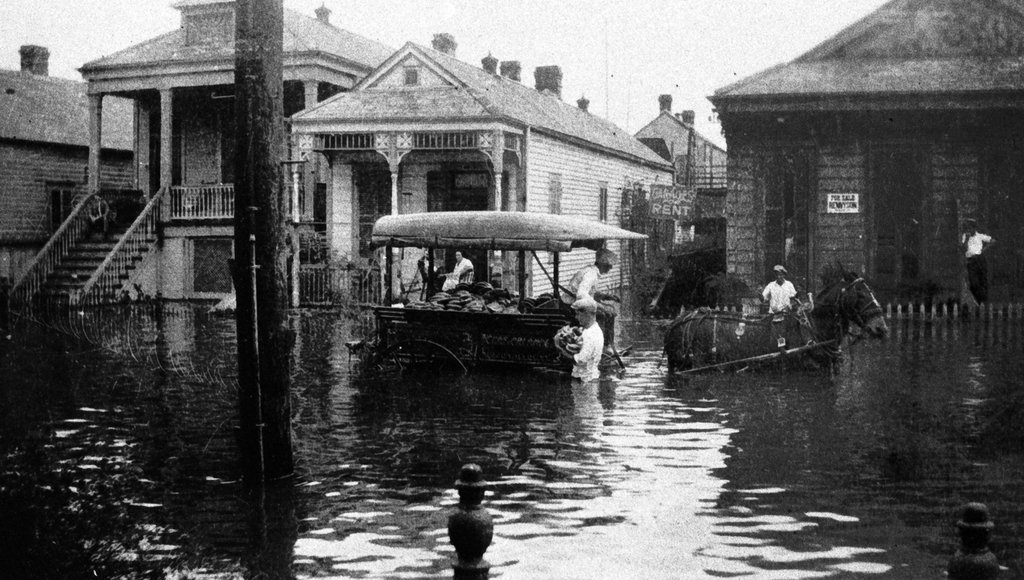
In 1927 a horrible flood of the Mississippi, the product of almost Biblical sustained rainfall, drove over 700,000 people out of their homes in Louisiana. Newman commemorated the event as part of a song cycle of the South called Good Old Boys, which was released in 1974. I discovered it around 1980 or so, and it quickly became, and has remained, my favourite of all of his songs – and he’s written some incredible songs.
The tragedy is narrated in a dry, fatalistic fashion that only adds to the poignancy: Some people got lost in the flood. Some people got away all right. That’s just how luck breaks, you know? Its mournful refrain, “They’re tryin’ to wash us away”, evokes that very human intuition that a calamity of this size can’t just be the product of dumb luck, no, it must be part of some deliberate plan to wipe you off the face of the earth; this just has to be somebody’s doing, there just has to be someone to blame. And indeed, to a certain extent for some, yes, because some of the flooding was the result of dynamiting levees, in order to relieve the pressure and spare New Orleans, deliberately sacrificing smaller communities upstream. It didn’t help.
In the wake of Hurricane Katrina, this song seemed almost prophetic. When George Bush flew over to observe the devastation from the comfort of Air Force One, you can bet the lines about the President’s visit in 1927 leapt to mind.
This was, almost inevitably, the first song performed at the 2005 benefit concert for the victims of Katrina, and it’s since become a sort of anthem to memorialize that eerily similar fiasco. It was a powerful thing even before the levees broke and the Lower Ninth all but vanished underwater. These days, I’ve read, it brings crowds down there to tears.
I recently discovered this chorale, which gives more overt expression to the song’s underlying emotions:
The Kinks: Come Dancing (March 15, 2024)
An unexpected comeback hit for the Kinks in 1983, the success of which was greatly assisted by the charming video directed by documentarian Julien Temple (whose film The Filth and the Fury, chronicling the rise and fall of the Sex Pistols, is a classic of its kind). Come Dancing, like so much of Ray Davies’s work, is imbued with yearning nostalgia for the England of yesteryear, when there were rules to be followed and traditions to be honoured, especially, if by no means exclusively, when it came to the rituals of courtship. Come dancing, that’s how they did it when I was just a kid. The music is upbeat, but the listener might sense a certain sadness in this fond remembrance of things past, now that so much has changed:
They put a parking lot on a piece of land
Where the supermarket used to stand
Before that they put up a bowling alley
On the site that used to be the local Palais
A lousy parking lot where there used to be live music, dancing, and anxious kids out on dates and hoping to get as lucky as decency allowed. All that energy, colour, and vibrancy replaced, ultimately, by a featureless, monochrome concrete square. Note the depiction of steady, relentless decline: first came a bowling alley, not half as much fun, but still a place where people could get together for a little R&R, and then a supermarket, no fun at all, but catering, at least, to human needs. Now it’s just an empty space for bloody cars to sit idle.
That’s the way the whole world seemed to Ray, when you got right down to it. Everything was in decline. You can hear it in songs like 20th Century Man, Victoria, Village Green Preservation Society, and Do You Remember Walter?, in which he imagines a conversation with an old friend he hasn’t seen in years:
Walter, remember when the world was young
And all the girls knew Walter’s name?
Walter, isn’t it a shame the way our little world has changed?
Do you remember, Walter, playing cricket in the thunder and the rain?
Do you remember, Walter, smoking cigarettes behind your garden gate?
Yes, Walter was my mate,
But Walter, my old friend, where are you now?
Things change. Fine. But why did they always have to change for the worse?
Come Dancing was inspired by Ray’s childhood memories of older sister Rene, who seems to have beguiled most of the young men whose paths she crossed. She was still quite young when she married a Canadian soldier and moved overseas, swept off her feet either during or in the immediate aftermath of World War II, but by all accounts it wasn’t a happy marriage, and she seized every opportunity to get away for a while and return home; in 1957 she visited to celebrate Ray’s 13th birthday, and gifted him his first acoustic guitar, an inexpensive Spanish model that he’d been unable to persuade his parents to buy for him. That very night, she went out dancing at London’s famed Lyceum Ballroom, and dropped dead of a heart attack. She was only 31, but had been left weakened by a bout of rheumatic fever, an affliction that all but guaranteed her an early grave. She understood that; young Ray probably didn’t, and Rene’s sudden death must have come as a terrible shock. These are Ray’s own recollections, excerpted from a piece in American Songwriter:
She also gave me my first guitar on my birthday as a present. We played it. It was quite a surreal scene, almost. It was a sunny day. I was born on a mid-summer day, so the 21st of June. And she was told she had severe heart problems, but she loved to dance and the doctors told her if she walked down the road, she’d probably have a heart attack. So she bought me this not very expensive Spanish guitar [and] gave it to me on my birthday. We played a few songs. She played a song on the piano and I tried to play with her and she said she was going out now and I watched my sister go out. It was a sunny afternoon. She walked down the road and my mother stood at the gate and that was it. The next morning we got a call from the police. She had died dancing in a ballroom in London in the arms of a stranger.
He sounds almost matter-of-fact, but the loss obviously affected him deeply enough to remain top of mind 25 years later, when he imagined an alternate fate for his beloved sibling with the closing lines:
Now I’m grown up and playing in a band
And there’s a car park where the Palais used to stand
My sister’s married and she lives on an estate
Her daughters go out, now it’s her turn to wait
She knows they get away with things she never could
But if I asked her I wonder if she would
Come dancing
Come on, sister, have yourself a ball
Don’t be afraid to come dancing
It’s only natural
Come dancing
Just like the Palais on a Saturday
And all her friends will come dancing
Where the big bands used to play
It’s surprising, isn’t it? At first blush the song seems so light-hearted, rollicking along like a genuine artifact of the big band era, and the casual listener could be forgiven for hearing nothing but cheerful memories of the good old days. Yet at its heart Come Dancing is really about loss, and poignant wondering about what might have been. I doubt many knew the backstory, as the video went into heavy rotation on MTV and the single climbed to the top of the charts, becoming the Kinks’ biggest Stateside hit. I wish sometimes that I didn’t know it either. Divorced from context, it’s such a fun song, tuneful, charming, even uplifting, but the thing is, it was written by Ray Davies, for whom the tears always lay just beneath the laughter.
 the needlefish