Sarah Harmer – Basement Apartment (April 11, 2024)
I’m not usually a big fan of songs that are more about chords than melody, with tunes that are, in the vernacular, “horizontal”, consisting mainly of the repetition of single notes, with only minor vertical excursions – which is why I’ve always favoured McCartney over Lennon, and would usually prefer something by Emm Gryner or Suzanne Vega to today’s selection by Sarah Harmer – but there are always exceptions, even if it’s hard to explain why. Take I Am the Walrus; there’s practically no melody at all, but I love it. Same deal with Lennon’s Dear Prudence, and, to a large extent, Strawberry Fields Forever, the former great and the latter, in my book, and not only mine, a masterpiece. What can I tell you? I know exactly Jack/poo about musical theory, and have nothing to fall back on intellectually save the standard idiot’s assertion that “I know what I like” (though I would of course assert, if pushed, that my unschooled taste is nevertheless exquisite). Sometimes, there’s just something indefinably right about a song that might not be at all extraordinary in any objective musicological analysis. Something that grabs you. For me, Basement Apartment pushes all the right buttons.
Maybe it’s the gritty, true-to-life lyrics:
And I can smell the bleach
That they use in the hall
But it can’t clean the dirt off of me
It’s seeping under the door
In across the floor
It’s starting to hurt
Every time I breathe
Every time I try to leave
Or maybe it’s because I, like so many others, used to live the same way, twenty-something, essentially poor, out alone in the world for the first time, inhabiting one of those shitty little urban apartments that over-charging landlords carve out of shitty little houses on shitty little streets within cold, unsympathetic big cities like Toronto. I had the pleasure of living in such places for about my first eight years here in Hogtown, first when I was getting by as a post-grad student, then a house painter, then – god help me – as a law student. One of them was a flat over a greasy spoon joint called, I shit you not, The Steer Burger, thus not in a basement, but, being as there was a diner downstairs, a pest-ridden dive in which I was, along with the mice, a mere sub-tenant of the cockroaches. Then there was a place on a little side street off Kensington market, near Toronto’s Chinatown, where again I was little more than a serf toiling away to the satisfaction of the Lord of Cockroach Manor.
How many roaches were there?
Well, so many that you developed what Kathy (who then lived in a separate unit upstairs) called “Roach-o-Vision”, the persistent impression that something was scurrying around just within the limits of your peripheral vision, which it was. Invariably. The little bastards were everywhere. They flourished within every nook and cranny that wasn’t inside of the fridge. Open a cupboard, the medicine chest, a kitchen drawer, even the stove, and there they were, waving their little antennae at you, as if asking “what’s for dinner?” They were fast, too, and opportunistic. One time I put my nice, icy cold bottle of Sleeman Ale down on the floor between swigs (me sitting on the floor because I had no furniture), and the next time I raised it to my lips, seconds later, a half-drowned, pleasantly pissed roach the size of a crawdad slid into my mouth.
This wasn’t a basement apartment either, but I remember vividly the low-ceilinged squalor of the subterranean unit downstairs, because that’s where the electrical panel was, and sometimes you had to pop down and gain entrance to reset a breaker, after one of them was tripped because somebody’d plugged in a kettle or something. There was a frankly gorgeous Caribbean dude living down there with his girlfriend, and I could never figure out what his name was (his mail was often left in my box, addressed to a bunch of different permutations of possible surnames and first names), but boy, could this guy, ummm, perform. They were going at it night and day down there, and, let’s just say, female screaming of a certain pitch goes right through the floorboards typical of cheap Victorian-era worker house construction, as does a sound akin to somebody repeatedly slapping a raw steak against the side of a fridge. It got to the point that I didn’t know whether to complain or demand a tutorial.
The guy next door raised pigeons by the hundred, which he sold to the restaurants along Spadina. I used to march past the racks of BBQ squab displayed on spits in the eatery windows, and think I bet last week that poor little guy was sitting just on the other side of my fence, happy, well fed, and unsuspecting. The whole surrounding area was like some sort of 15th century food bazaar, there were shops with pig’s heads on display, and shops selling chicken’s feet, and sheep’s brains, with sawdust on the floors to sop up the inevitable fluids. Things recently alive were laying around unrefrigerated by the metric ton. In the summer, the smell would just about drop you in your tracks. One of the highlights was finding out that ash from the medical incinerator at nearby Toronto Western Hospital had been sprinkling all over our whole neighbourhood for years, being inhaled by the local rubes, me among them. The guy next door on the opposite side of the pigeon farmer was a drunk who beat his wife, forcing me to call the cops every couple of weeks. He had a borderline rabid pit bull named Sasha that he kept chained up on his porch, about three feet away from ours amid the 19th century row houses, and whenever you came home the firkin-sized bastard would bark itself stupid and strain against its chains, leaping forward repeatedly, half choking itself, trying to get loose and tear you into bite-sized chunks. Somehow, your primate brain stem could never get over the shock of it, no matter how many times you’d been through it.
Oh, happy days of yore.
Anyway, Ms. Harmer’s rockin’ song about slowly wasting away in a crappy little rented box really does strike a chord. Luckily, unlike the character she portrays, my ticket out was well within my grasp, the moment of escape just over the horizon. All I had to do was graduate at the top of my class and walk myself down to the towers of Bay Street, there to pursue my new career in business law. Easy Peasy.
And thereby hangs a tale for another day.
Matthew Sweet – Your Sweet Voice (April 23, 2024)
Just another achingly lovely little gem from Sweet’s terrific 1991 artistic breakout album Girlfriend, a disc chock-full of delightful power pop compositions the like of which we barely ever hear these days, straightforward, free of pretension, tuneful, and steeped in emotional honesty. Your Sweet Voice comes off like a traditional love song, but you don’t have to listen for long before sensing the underlying sadness, and realizing he’s singing about love’s end, and wondering what he’s going to do now that he’s never going to hear that calming, beautiful voice again. Maybe she’s leaving him; maybe she’s already gone, and he’s just imagining she’s still there to help him through another long, fretful night. Honestly, from the depth of the melancholy at the heart of Your Sweet Voice, I wouldn’t be surprised to learn that the girl’s supposed to be dead and buried.
The song concludes with a nice sonic touch, the gentle, metronomic thump of a needle playing through the “run-off” groove at the end of a vinyl record, a sound as familiar as tires on a gravel road to we children of the Sixties.
You know, many years ago, when I was young and strong and sure about all kinds of things, I loved me some loud, hard rock ‘n roll, not bullshit hair-metal and all that phoney-baloney crapola, understand, but really hard, stuff like The Stones, the Who, the Clash, Hendrix, the Velvet Underground, visceral, powerful sonic onslaughts that really got the blood flowing back into the extremities. I’m not saying I no longer have any feeling for Jumpin’ Jack Flash, or Won’t Get Fooled Again, Good Lord no, perish the thought, but lately, I don’t seem to want to hear it as much. When I get a craving for music these days, I tend to want something mellow, melodic, and, I don’t know, civilized, I guess. I’m reminded of the really quite witty lyrics to an Eighties tune by Toronto band The Pursuit of Happiness, an impressively rockin’ little number in its own right called I’m An Adult Now:
Sometimes my head hurts and sometimes my stomach hurts
And I guess it won’t be long
‘Fore I’m sitting in a room with a bunch
Of people whose necks and backs are aching
Whose sight and hearing’s fading
Who just can’t seem to get it up
Speaking of hearing, I can’t take too much loud music
I mean I like to play it, but I sure don’t like the racket
Noise, but I can’t hear anything
Just guitars screaming, screaming, screaming
Some guy screaming in a leather jacket
They weren’t even close to middle-aged when they wrote that, but they saw it coming, and now it’s all probably come true for them, just as it has for me. Lately, I don’t much care for the racket either. I’d much rather listen to Sweet’s slow, wistful, part-pop, part-country ballad about missing the warm, even tones of a loved one’s soothing voice.
Like Prufrock said, I grow old.
Bruce Springsteen – Thunder Road (May 17, 2024)
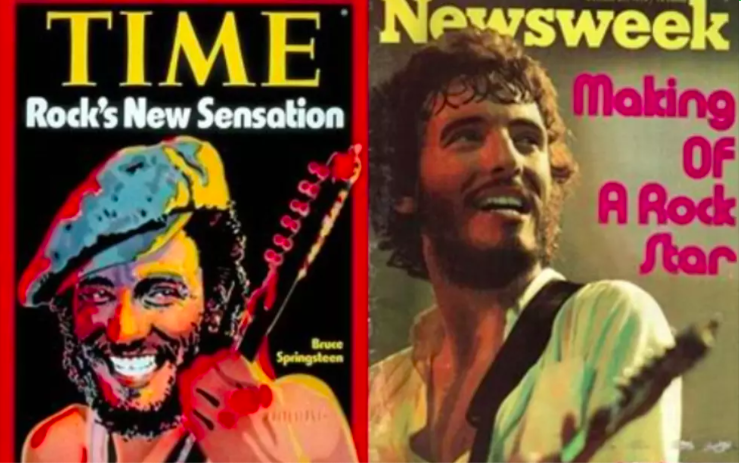
It was almost fifty years ago now, in August of 1975, when Springsteen released his epochal breakthrough album Born to Run. A couple of months later, on October 27, he was simultaneously on the covers of Time and Newsweek, a very, very big deal back in the day, and all of us immediately sat up and took notice. The hype, soon fully borne out, was that a fresh American voice, a tremendous new talent, had come to pull pop music out of its mid-Seventies doldrums and perhaps even save American rock ‘n roll. Well, I don’t know if Bruce actually saved rock, end of the day – a lot of the time it’s seemed beyond salvation – but he sure as hell tried, and indeed he’s still trying.
Over a long career he’s been consistently great, consistently thoughtful, spinning out archetypal American vignettes, often using autos, the quintessentially totemistic American machines that used to come out of Detroit, as metaphor, in songs by turns monumental and quietly, mournfully intimate. He’s certainly produced a mountain of estimable output since 1975, yet this listener, at least, finds himself drawn back repeatedly to Born to Run, the songs of which certainly weren’t like anything else being played on AM radio at the time, featuring compositions typified by almost cinematic storytelling, infused with an unusual street-level brand of eloquence. The best of them weren’t necessarily even that radio-friendly; they demanded undivided attention, particularly to the lyrics, and came that close to being bombastic and off-puttingly over the top. Yet coming from Bruce, they weren’t off-putting, but instead felt as authentic as they were passionate, focused as they were upon the hopes and often broken dreams of decidedly regular people slogging their way through the rocky terrain of a world that wasn’t at all like the vision of the American Dream that had long been sold to the common folk. These songs were gritty, urban, disillusioned, and sometimes angry, or at least bitterly aware of the realities facing those born into no particular privilege. They were often almost the sonic equivalent of film noir, and so frigging dramatic as to verge on operatic, as perhaps best exemplified by Born to Run’s title track, and the album opener, Thunder Road, my own favourite, and a powerful distillation of themes he’d be pursuing for the rest of his artistic life. I swear, from the opening lines what you’re hearing isn’t so much a song as the soundtrack to an old-school black-and-white movie that begins playing in your head, you can see it, like something shot in retro style by Spielberg, or maybe decades earlier by Elia Kazan:
The screen door slams, Mary’s dress sways
Like a vision, she dances across the porch as the radio plays
Roy Orbison singing for the lonely
Hey, that’s me, and I want you only
Don’t turn me home again
I just can’t face myself alone again
That could have been Brando talking to Eva Marie Saint. This guy wants to be somebody.
The lyrical nod to Roy Orbison’s Only the Lonely is, one can rest assured, more than just a convenient way to craft rhyming verse with the proper meter. Orbison was plainly a key influence on Springsteen’s early compositional style, not just in his embrace of intense emotionalism – an Orbison hallmark – but in the way his songs are structured. Thunder Road doesn’t hew to the convention followed by about 90 – 95% of popular songs, which tend to proceed along the lines of verse-verse-chorus-verse-chorus, or “A-A-B-A-B”, often with a middle section, thus “A-A-B-A-B-C-A-B”, as the musical theorists would have it; Thunder Road doesn’t have a chorus at all, and only arguably has a bridge, or “middle eight” (the part that begins “well I got this guitar and I learned how to make it talk”, which some wouldn’t characterize as a bridge at all). Instead it builds verse upon verse, with successive variations, in a progression that sounds, to my ears anyway, more like A-A-B-C-D-E-C, while working towards its stirring conclusion. As I discovered while doing the usual background reading for this post, you’ll hear the same sort of thing in a number of Orbison’s biggest hits. Oh, Pretty Woman, for example, likewise has no chorus at all, and is structured A-A-B-C-A-D, while Crying has been described as proceeding A-B-C-D-E-F-G-A-B-C-D-E-F-H:
It’s this sort of departure from the norm, which the listener may barely perceive except sub-consciously, that helps create a sense of mounting energy and tension, until finally the thing comes to an immensely satisfying climax, augmented mightily by the typically deft and powerful saxophone outro from “Big Man” Clarence Clemons. By that point you pretty much want to stand and cheer, while exhorting young Mary (who maybe isn’t quite so young anymore) to go on, stop wasting time and get in the man’s car. This could be your last chance to break on out of this dump and get somewhere, Mary! For God’s sake, girl, take it! Go!
It’s not every songwriter that can get you going like that. Bruce always could, and still does it all the time, yet after all these years, and everything he’s since achieved, I’m still prepared to hear arguments that this bracing kick in the pants from 1975 remains the greatest song in his remarkably varied and accomplished repertoire.
U2 – With or Without You (June 4, 2024)
https://m.youtube.com/watch?v=ujNeHIo7oTE&pp=ygUTV2l0aCBvciB3aXRob3V0IHlvdQ%3D%3D
With Or Without You has a lot of ‘yearn’ in it. What I get from it is you’re ready to accept but you’re ready to leave something behind, much like life itself. Something comes your way but there’s a sacrifice and you have to leave something else behind.
Daniel Lanois
The first big hit off Joshua Tree, which immediately became one of popular music’s most massive zeitgeist albums upon its release in 1987, of a piece with Sgt. Pepper, Abbey Road, Tapestry, Bridge Over Troubled Water, Rumours, Thriller, Born in the USA, Jagged Little Pill, and I don’t know, whatever it is that fills the niche these days, something by Taylor Swift, I suppose. It was everywhere, as was With or Without You, a powerful, moodily ambient crie de coeur about the sometimes perfect overlap between pain and love, inspired by lead singer Bono’s contemporary marriage woes, which featured a fascinating construction that was on the one hand about as conventional as could be, and on the other refreshingly unusual.
On the conventional side is the chord structure, which is bog-standard, with a twist. With or Without You is built around what may be the most frequently used chord progression in all of popular music, instantly recognizable to anybody who isn’t tone-deaf, and referred to by those with training in musical theory as I-V-vi-IV. For some reason surpassing understanding, the human mind seems wired to respond immediately to those chords, as if they mimic some sound in nature, invariably heralding good things, that our auditory circuits have been naturally selected to favour. It’s the backbone of all sorts of songs, from rockers like the Rolling Stones’ Beast of Burden and Green Day’s When I Come Around to sublime ballads like Neil Finn’s Fall at Your Feet, and McCartney’s Let it Be. If you’re a fan of Beyonce, or Taylor Swift, you know these chords in your bones; no matter the arrangement, rhythm, tempo, or key, they just work. They’re magical. The comedic pop combo Axis of Awesome lays it out in this celebrated clip:
Hard to believe that the same essential musical structure, with some variations, supports songs as diverse as No Woman No Cry, Forever Young, Take On Me, Country Roads, If I Was a Boy, Don’t Stop Believing, Poker Face, One of Us, and Torn, not to mention fitting Auld Lang Syne and Waltzing Matilda like a glove, but there you have it. There’s a Wikipedia article if you’re keen:
https://en.wikipedia.org/wiki/I%E2%80%93V%E2%80%93vi%E2%80%93IV_progression
The clever bit with U2’s iteration is that the song is structured around those chords, yet they aren’t actually played, but instead only implied by the single leading notes of Adam Clayton’s simple yet mesmerizingly captivating bass line, which repeats the root note of each chord eight times in succession:
So basic, yet so effective; there’s something both soothing and immersive about that bass line, isn’t there? It’s like you’re floating in the womb, listening to your mother’s heartbeat.
What’s decidedly unconventional is the verse structure, which, just like prior song of the day Thunder Road, forgoes any chorus or bridge, and simply builds, one verse atop another, until reaching an emotional climax, as noted by famed Joshua Tree producer Daniel Lanois: “It has tension and builds like one of those great Roy Orbison songs, where every section is unique and never repeats. I like that kind of sophistication”.
The scintillating guitar part from David Evans, A.K.A. The Edge, arguably supplies even more drama than Paul Hewson’s, er, Bono’s rousing vocal, and was the product of a novel modification of the electric guitar concocted by one Michael Brook, through which the ability to sustain notes more or less indefinitely is provided by an electronic circuit that takes the signal from the standard guitar pickup, then amplifies it and feeds it back into a separate pickup coil, as will make perfect sense to anybody who understands these things better than I do. Said Lanois:
We had a little secret weapon. It was called the ‘infinite sustain guitar,’ invented by my good friend Michael Brook, a Canadian associate. Michael had invented this instrument where you didn’t have to use your right hand on the guitar. You just held a note with your left hand, and he had a little self-looping system built into the instrument. But as you went up higher on the guitar, the infinite sustain just kept going into the stratosphere.
Brook’s thus-named Infinite Guitar made sounds unlike anything anybody’d ever heard, but it quite literally wasn’t for the faint of heart – it turned a basic Stratocaster into a potentially death-dealing, jury-rigged sort of contraption apt to administer severe electric shocks unless handled with the utmost caution, as U2’s stage hands were soon none too happy to discover. “It would have failed even the most basic of safety inspections” said The Edge, but the device, which he described as essentially a guitar that played itself, created endless, looping notes that were at once piercing yet ethereal, perfect for the piece’s theme of anguished longing. Advance this clip to the 1:45 mark, and try to imagine the song minus that chiming, keening, soaring, emotionally aching guitar line, echoing across the sound stage as if being played within a Gothic cathedral:
As described by Lanois, The Edge’s ability to wring the perfect sounds out of the Infinite Guitar was almost instinctual. It took him only two takes to lay it all down, the tapes of which Lanois fused to form the final track on the recording.
Believe it or not, the band’s manager, Paul McGuinness, was initially opposed to the release of With or Without You as the lead single from Joshua Tree. He didn’t think it sounded right for radio, perhaps owing to its deviation from the standard verse-chorus-verse-bridge-chorus model of most popular songs, besides which it was about pain, ambivalence, and moral crisis, with a couple of religious overtones thrown in just to add to the discomfort, and who wanted to hear that in the middle of the afternoon? Who wants such stuff coming out of the dashboard radio while idling, frustrated, in rush-hour traffic? People crave danceable toons, not spiritual agony, right? They want Peter Pick-Me-Up, not Debby Downer, much less the sincerely long-suffering, self-excoriating, on-the-cusp-of-an-emotional-breakdown Harry Hairshirt.
Well that’s right, except not this time. Buoyed by an unusually artful video, With or Without You shot straight to #1 all over the world, and turned U2 from a band with a solid following into a stadium-filling juggernaut, with few rivals in the pop pantheon. They hadn’t just arrived, they’d reached an altitude at which they could even emulate the Beatles, and snarl up traffic in a major city by holding an impromptu concert from a rooftop, as depicted in the excellent Rattle and Hum, the documentary that captured U2 at its spectacular zenith during their tour following Joshua Tree‘s release. For anybody else, at any other moment, this attempted assumption of the Fab Four’s mantle would have seemed hubristic, even vaguely offensive, but these guys could get away with it. They’d demonstrated the chops, and earned the mystique. Watch this, and tell me they didn’t pull it off:
Creedence Clearwater Revival – Fortunate Son (June 21, 2024)
Creedence Clearwater Revival … were progressive and anachronistic at the same time. An unapologetic throwback to the golden era of rock and roll, they broke ranks with their peers on the progressive, psychedelic San Francisco scene. Their approach was basic and uncompromising, holding true to the band members’ working-class origins. The term “roots rock” had not yet been invented when Creedence came along, but in essence, they defined it, drawing inspiration from the likes of Little Richard, Hank Williams, Elvis Presley, Chuck Berry, and the artisans of soul at Motown and Stax. In so doing, Creedence Clearwater Revival became the standard bearers and foremost celebrants of homegrown American music.
As read at CCR’s induction into the Rock and Roll Hall of Fame.
I’m surprised to note that this is Creedence Clearwater Revival’s first appearance in Songs of the Day, which seems a strange oversight, given how much I’ve always admired the group once touted in the Rolling Stone Record Guide as America’s greatest singles band. They aren’t the only ones vying for that title (hey what about the Supremes?) but they certainly racked up a lot of hits, and almost continuous airplay, during their brief heyday in the late Sixties and early Seventies, charting with 14 top 10 records between 1969 and 1971, many of which remain standards: Proud Mary, Run Through the Jungle, Green River, Who’ll Stop the Rain, Bad Moon Rising, and many others, a collection that eventually made for a jam-packed greatest hits album dubbed Chronicle, which went 12X platinum, has sold six million copies since 1991, and surged back on to the Billboard Hot 200 again this year.
No wonder; there’s an evergreen, earthy, unpretentious quality to their songs, none of which sound anything like the trippy psychedelia of the era (much less the output of the West Coast music scene that emerged later), despite the group’s origins in the San Francisco Bay area community of El Cerrito. These were working class guys from working class families on the wrong side of the tracks, and to them, the whole drug-fuelled flower power movement was a frivolous indulgence of privileged kids from wealthy backgrounds, people who could afford to screw around and wallow in decadence for a while before running back home to Mommy and Daddy. Fine for the likes of them to lie around like hobos in the street at Haight-Ashbury, listening to Jefferson Airplane, the Electric Prunes, Moby Grape, the Grateful Dead, and Strawberry Alarm Clock, or some such shit, until they passed out from all the cosmic sunshine. There’d be none of that opaque, addle-brained nonsense from CCR. As noted during their Hall of Fame induction, Creedence was all about what later came to be called “Roots Rock”, the sort of music you might hear in a bar full of truckers and longshoremen, solid, catchy, often somewhat edgy tunes that ditched the studio wizardry in favour of a sound that could easily be duplicated live, on stage. You know – honest, old school rock ‘n roll, sometimes with a dash of more traditional styles thrown in.
This made their music accessible to a broad audience, especially the more upbeat numbers, many of which still sound as if they could have been written anytime, perhaps just yesterday, or maybe back in 1952, like Lookin’ Out My Back Door, or the 45RPM flip-side of today’s selection, Down On the Corner, my brother’s fondness for which gave rise to one of my favourite childhood memories. I guess it was around 1972, and Mark was going through his Chicago phase. He played Chicago incessantly, and his closed bedroom door did little to mute the bombastic and often shrill-sounding brass that so often formed the backbone of their songs (think 25 Or Six To Four), a particular style that set my father’s teeth on edge. Dad hated Chicago. He cringed whenever Mark slapped one of their discs on our old monophonic turntable with its five-pound tonearm, which had only one little speaker, but still managed somehow to be loud. Why don’t these kids ever play any nice music? he’d moan, like parents everywhere in those days. Well they did, sometimes, and one day I came upon Dad paused motionless outside of Mark’s room, listening as Down On the Corner, decidedly not the despised Chicago, was plainly audible through the woodwork. He seemed both relieved and excited, maybe imagining that my bro’s musical taste had finally turned a corner, and he could bid farewell to all those shrieking horns and screaming vocals (no such luck). There, he said to me with a broad smile, that’s what I mean. That’s what I’ve been talking about. He lingered, bobbing his head to the infectious rhythm. Yes. Yes. That’s the real deal. He had a good ear, my Dad (as did Mark, actually, Chicago notwithstanding), and anyway who could resist a tune like this:
CCR wasn’t always so upbeat, of course, but I don’t think they ever sounded as angry, or as downright bitter, as they did with Fortunate Son. This was a protest song, plain and simple, a musical screed against the iniquities of America’s class system in general, and the administration of the military draft in particular, and the way it always seemed to be the poor kids who got sent off to the meat-grinder then chewing up America’s minority and lower class youth in South East Asia (with a fully justified rant about America’s perennially unfair distribution of tax burdens thrown in for good measure). Said composer and lead singer John Fogerty, interviewed recently in the wake of Donald Trump’s frequent use of Fortunate Son to warm up the crowds at his Nuremberg Rallies:
Recently, the President’s been using my song ‘Fortunate Son’ at his rallies, which I find confounding to say the least… I wrote the song back in 1969 at the height of the Vietnam War. By the time I wrote the song I had already been drafted and had served in the military. I’ve been a lifelong supporter of our guys and gals in the military probably because of that experience. Back in those days we still had a draft, and something I was very upset about was that people of privilege – in other words, rich people or people that had position – could use that to avoid the draft. I found that very upsetting, and that’s why I wrote ‘Fortunate Son.’ That was the whole intent of the song, the inspiration for the song.
The very first lines are:
Some folks are born made to wave the flag
Ohh, they’re red, white and blue
But when the band plays “Hail to the chief”
They point the cannon at you
Well, that’s exactly what happened recently in Lafayette Park. When the President decided to take a walk across the park, he cleared out the area using federal troops so that he could stand in front of St. John’s Church with a bible.
Trump and his campaign staff were apparently mistaking Fortunate Son for a patriotic salute to the good old Hew Ess of A, like Lee Greenwood’s god-awful God Bless the USA (a mistake also made frequently by Republican politicians, including Ronald Reagan, when making use of Springsteen’s Born in the USA), and it browned Fogerty to no end. Patriotic? Rah-rah America?? As if! And of all people to make use of it! Trump himself, the draft-dodging Private Bone Spurs, was exactly the sort of privileged prick Fogerty had been writing about, one of those rich kids who avoided service by being in college, or having Daddy pull some strings. Somehow, Donald kept getting his bogus medical deferrals, keeping him out of harm’s way, unlike all those losers who couldn’t evade Uncle Sam. Talk about a fortunate son! The song was actually an enraged indictment of Donald and his kind, didn’t he get that?
Well no, of course he didn’t.
I’ve read commentary in the music press opining that the first hints of Heavy Metal, Grunge, and even Punk can be heard in the strident, in-your-face guitar riffs of Fortunate Son. Maybe. In any case, it sure does rock hard, and it sure is full of the same sort of passion and political awareness that would later turn up in the output of Springsteen, and even harder-rocking outfits like the Clash. Like them, CCR aimed to be a voice for the little guy, the poor, downtrodden working folk who always get the shit-end while doing all the dirty jobs, including, whenever the shit hit the fan, dying in some god-forsaken jungle or scorching third world sandlot. Looking around today, taking in the growing disparity in wealth, the tax relief repeatedly granted to the already super-rich, and the way that America’s all-volunteer armed forces nevertheless continue to fill their ranks with lower and lower-middle class recruits, Fogerty must mutter to himself that some things never change, except, of course, for the worse.
The Who – Baba O’Riley (July 8, 2024)
In 1978 the Who put on a concert for a select audience of 300 fans at Shepperton Studios, which was filmed by first-time director (and Who superfan) Jeff Stein for his documentary/career retrospective The Kids Are All Right. Among the tracks performed were a couple of the classics from Who’s Next, surely one of the greatest albums ever recorded: Won’t Get Fooled Again, and today’s selection, which everybody wants to call “Teenage Wasteland”, but is actually the enigmatically titled Baba O’Riley, a dual tribute to spiritual guru Meher Baba and American minimalist composer Terry O’Riley, each among Townshend’s major spiritual and artistic influences at the time (the synthesizer intro is, essentially, classical avant-garde minimalism). The lyrics have to do with the libretto for Lifehouse, the visionary rock opera that Townshend drove himself all the way ’round the bend trying to complete, before the project was abandoned and its finished songs were gathered together for what became the ultimate Who record, all of them, sadly, save Pure and Easy, the work’s philosophical core and one of Pete’s finest compositions, which appears not on Who’s Next but on one of Pete’s solo albums. You can read about the madly ambitious, quasi-mystical, borderline batshit crazy Lifehouse in this prior blog post:
The lament for the “teenage wasteland” occurred to Pete while remembering both the dense debris field left behind by the crowd at the Who’s famous 1970 Isle of Wight concert, as well as the godawful, rainy, muddy mess that was Woodstock, where just about everybody seemed to be high on acid, including Pete himself, who’d been dosed unwittingly by a cup of coffee that was, like just about every other available consumable, spiked with the stuff (the rosy memory of Woodstock cherished by we Boomers nowadays rather ignores that it was, on the ground, a bit of a fiasco, and a drug-fest that involved numerous overdoses and more than a few emergency medevacs). You can read here about Pete’s impressions of the human zoo that confronted the band as they took to the stage at 5AM on a Sunday, and looked out over the madding crowd neck-deep in the muck of Max Yasgur’s trampled farm:
He hated it. So did Roger Daltrey, who didn’t see much peace, love and understanding by the time the festival was wrapping up, and wasn’t himself much of a flower child anyway (he said, with calculated understatement).
I’m grappling, as I write this, with the idea that the raucous, hugely energetic performance attached above is just four years shy of its 50th anniversary. Some part of me seems to imagine that the band still exists, and those four young men remain just as they were, the best damned rock n’ roll outfit on the planet, perhaps coming soon to a town near you. Of course, Townshend and Daltrey are now old men, Pete 79, Roger having just turned 80, while Keith Moon and John Entwistle are gone. It’s sad to note that the concert at Shepperton was Keith’s very last with the band; he overdosed only three months later.
Ah, but they were in fine form that night, weren’t they? Recreating the songs from Who’s Next had proved difficult on stage, especially level-matching and synching properly with the pre-recorded synthesizer tape loops that Pete felt were essential (and indeed, it’s hard to imagine Baba O’Riley without them), but by 1978 they had it down to a science. Jeff Stein caught them here revelling in the last, highest moments of their greatness, fully at their performative zenith, Pete still windmilling, Roger still swinging his microphone at the end of thirty odd feet of cord, Moon still thrashing away maniacally, and Entwistle still masterful on bass, holding it all together, looking stalwart and unperturbed as the others storm about the stage. This is one of their best performances of one of the greatest songs of the modern era, and you can go right ahead and deride me for being one of those antiquated Boomers always muttering about the good old days, go ahead, you can’t upset me, because I know I’m right about this much: nobody ever did it better than these guys, and nobody ever will.
I’ll leave you with this, from the same show, at which the band was also pioneering the use of laser lighting for dramatic effect. This is, in my not at all humble opinion, the greatest live performance of the rock ‘n roll era, not just on account of its energy, but because the song is extraordinarily complex, and the band executes it perfectly, perhaps even better than they did in the studio. Amazing:
Robbie Robertson – Broken Arrow (July 26, 2024)
I want to breathe when you breathe
When you whisper like that hot summer breeze
Count the beads of sweat that cover me
Didn’t you show me a sign this time…
I want to come when you call
And I’ll get to you if I have to crawl
They can’t hold me with these iron walls
We’ve got mountains to climb
Man oh man, they don’t come much more passionate than that.
A singularly beautiful and meditative love song from Robbie Robertson’s eponymous first solo album, released in 1987, Broken Arrow received less attention than companion tracks Showdown at Big Sky and Somewhere Down the Crazy River, but it’s my favourite. A lush studio arrangement wraps itself around a gorgeous, yearning melody, accompanied by musical and lyrical elements suggestive of Robertson’s First Nations heritage (his mother was Cayuga-Mohawk, and Robbie spent his early years, and many a subsequent summer, on the land of the Six Nations of the Grand River, Canada’s most populous Reserve, located about 15 miles south-west of Hamilton). The narrator’s romantic emotions are certainly intense – this guy really, really desires that woman, no two ways about it – yet the mood is more contemplative than urgent, as if he means to win her over through what he reckons is the gentle yet irresistible power of calm persuasion. Reviewing the critical commentary, as I always do before writing my own, I found that listeners react to it in different ways. For some, it’s a straightforward love song, something expressed at the beginning of a courtship, while others hear a sadder, more plaintive message, as if the narrator is hoping to win the woman back, or still pleading his case, deflated but still hopeful after being turned away. I’ve got a foot in both camps, depending upon my own mood when I listen. Sometimes it seems positive, optimistic, even soothing, and others it’s more melancholy, as if he took his best shot but failed to move her, and now he’s making his forlorn case to empty space, the repeated question “who else”? perhaps suggesting that she’s already found him wanting, and now he’s imagining what he’d say, if only she’d listen: but who else will ever love you like I do? Either way, it sure does tug at the heart strings.
It’s curious, isn’t it, even a little mystical, how a given piece of music can make you feel a certain way, sometimes tapping into your deepest emotions of hope or anxiety, joy or sadness, and you can’t explain how. It just does.
I’ve been writing these Songs of the Day pieces for almost seven years now, and as time’s passed, and I’ve strained to articulate exactly why certain songs seem to be a cut above, whether in their apparent complexity, harmonic sophistication, melodic range, clever key changes, or rhythmic novelty – whatever strikes me – I’ve grown more and more fascinated with music theory, about which, sadly, I understand next to nothing. It’s complex, sometimes seeming impenetrable, yet even a little bit of investigation reveals that there’s a science to it, as precise as mathematics, and almost as elaborate. Approaching the subject is like learning a new language, and let’s be clear, I haven’t learned much; it’s as if I’m taking a course in German, and so far I’ve learned the words for “fast” and “slow”, and the phrase I could use to get a passer-by to direct me to the nearest public washroom. Scales vs. keys, majors vs. minors, modes, diatonic vs. pentatonic, harmonic vs. melodic intervals, the circle of fifths, tones vs. semitones, it’s all mind-boggling, and one can’t help but stand in awe of the composers and musicians who fully understand it, and know how to exploit its secrets.
In essence, if I’m understanding correctly, the emotional quality of a piece, the mood it somehow evokes, all comes down to surprisingly minor variations in intervals, the distance between tones – or, more fundamentally, how many piano keys you skip between, say, the notes in a chord – and it’s amazing to realize even a little of how the magic works. An example: a basic chord consists of a three notes struck in unison (a “triad”), and whether it’s a major or minor chord depends on the intervals between the first and last notes. In the Music for Dummies version, you start at any root note – say, C – count forward seven more piano keys, or “semi-tones” (including the black ones) – so a spread of eight keys in total – and you’ve got the beginning and ending of a chord, what they call a “fifth”. Having started at C you’ll end up on G, two notes that sound delicious when blended. Next, you choose the note that comes between; starting again at C, skip two keys before selecting the middle note (which is therefore three semi-tones above C), thus leaving a gap of three more before completing the fifth (thus another four semi-tones), and you’ve got a minor chord. Reverse that, skipping three and then two, and presto, it’s a major. It works in much the same way for keys (which are particular sets of notes, each progressing from, and named after, its root note, not to be confused with scales – a whole other topic, whoo boy), and the wonderful thing is that these seemingly trivial changes create dramatic harmonic differences that stir much different emotions, pretty much universally. Minor chords and keys are associated with feelings of sadness, while majors evoke happiness and optimism. Watch this:
Sorcery! Tell me that isn’t magical! It’s all the more fascinating when you discover that the whole range of possible keys can be categorized by the particular shades of joy or melancholy which they’re generally perceived to represent. For example, the key of C Major is said to have the character of purity, innocence, and child-like naïveté. D Minor creates a mood of anxiety, and brooding despair. E Major, by contrast, is described as “noisy shouts of joy, laughing pleasure and not yet complete: full delight lies in E Major”.
Watching these YouTube tutorials for beginners, and reading the introductory primers, I feel like the Amazing Randi is letting me in on where the rabbit actually was before he pulled it out of his apparently empty top hat. Oh, so that’s how it’s done! Great, that’s a start, but I’m still a long, long way from learning how he always knows which card I picked, let alone how he saws those women in half, their toes wriggling the whole time. I’m wading into a very broad, frighteningly deep ocean here. As usual, the more you know, the more you realize how much you don’t know, and will probably never understand. End of the day, how much can the poor rube in the audience really comprehend about the wizardry on stage?
All you can do is try, to which end, here’s a little more musical sleight of hand – this is a description I found for G Major: “Everything rustic, idyllic and lyrical, every calm and satisfied passion, every tender gratitude for true friendship and faithful love – in a word every gentle and peaceful emotion of the heart – is correctly expressed by this key”. Broken Arrow is written in G Major (and no, I can’t discern that by ear, I had to look it up!). It pretty much fits the description, doesn’t it? Yet there’s still something more, and were I to spend hours upon hours delving into it I might discover how Robertson adds those undertones of sadness to all that faithful love and gentle emotion.
Like I say, magic.
I’ve done a little on-line searching, trying to nail down the metaphorical significance of the broken arrow and bottle of rain he holds out as the tokens of his love, without finding anything definitive. Some sources say these are traditional indigenous offerings, which sounds plausible, if vague, but being as that’s the view of some white guys who likely don’t really know, it’s hard to take as gospel. I also found this:
Well, I don’t know how reliable it is, but according to this site (http://www.fanfiction.net/s/1755444/1/), “the phrases ‘Broken Arrow’ and ‘Bottle of Rain’ are Native American expressions, meaning (respectively) ‘Peaceful End of Conflict’ and ‘Good Prospects/Good Fortune.’ For one to actually give another a ‘broken arrow’ in concert with an entire ‘bottle of rain’ (more than one drop of rain), would actually signal the intention to have or develop a lasting strong relationship with the other party, a wish for both peace and happiness.
That sounds good, but since this explanation’s prefaced by saying “well, I don’t know how reliable it is”, I guess I still have my doubts. I like the idea, though. It certainly fits the song’s general sentiment, so what the heck, let’s run with it.
If the big studio sound reminds you of the contemporary albums of U2 and Peter Gabriel, that’s because it was Daniel Lanois manning the booth, who was also the producer on Gabriel’s So and U2’s Joshua Tree, both landmark albums of the era. That’s also Gabriel on keyboard. The similarity to both U2 and especially Peter Gabriel is even more pronounced on another nice cut from the album, Fallen Angel, which also features backing vocals by Gabriel:
Some might find the production a little too slick and polished, but I’m not among them. I like slick and polished. I like the attention to detail.
Robbie Robertson was a big seller, and was generally received rapturously by the music press, but after that Robertson, never terribly prolific, faded into relative obscurity. There were three more solo albums, the last as recently as 2019, but none of them had anywhere near the impact of his first. Still, Robertson’s musical legacy is secure, and enviable. With The Band, he wrote such classics as The Weight (an enigmatic tale of personal debt and the taxing assumption of burdens, which nobody seems to understand), Up On Cripple Creek, Life is a Carnival, The Shape I’m In, King Harvest (Has Surely Come), and perhaps most moving, the iconic, anthemic lament of the fall of the Confederacy, The Night They Drove Old Dixie Down, controversial these days on account of being misunderstood as some sort of endorsement of Lost Cause mythology, when it’s really a bitter account of a horrified Southerner coming to grips with how very much the ill-conceived rebellion has cost both him and his breakaway nation (I swear, I have to reach for the Kleenex when Virgil relates how his kid brother was just nineteen, proud and brave / but a Yankee laid him in his grave). These are masterful examples of the songwriters’ art, and Broken Arrow takes its worthy place among them.
Robbie Robertson died last year, aged 80. The Six Nations were among many who released tributes to mark his passing:
Spirit of the West – Political (August 13, 2024)
Hey, if you’ve ever had it up to here with happy love songs, and crave an antidote to the grating good cheer and puerile positivity of mainstream pop – and you aren’t about to resort to the angry, cretinous, rhythmic shouting of complaining, empty-headed hip-hoppers like Drake, no matter how sour your mood – I have just the thing for you. Today’s selection is welcome proof that the Eighties weren’t all about Culture Club, The Fixx, Thompson Twins, Duran Bloody Duran, and Spandau F’ing Ballet; it’s one of those rare pop gems characterized by true emotional resonance. This one is personal. The protagonist in Political isn’t just momentarily exasperated, and this is no mere bump in an otherwise happy road winding it’s way toward relationship bliss. No, this guy is done. It’s finished. He’s over it. The snark, the judgment, the head games, the walking on eggshells, it’s all finally too much, he’s folding up his tent, and he’s no longer inclined to apologize for how he’s repeatedly come up short and been such a big frigging disappointment.
Right back at ya, sweetheart. Screw it.
Yet, despite the song’s theme of indignant, almost baffled disillusionment, and the expression of sentiments which might, in lesser hands, have devolved into nothing more than petty spite, the musical tone here is as much bittersweet as angry, more weary than aggressive, agitated but not at all menacing, misogynist, or vindictive. This guy is at a loss really, upset, yes, but also confused about how everything went so far south. He’s not coming out the other end of this feeling vindicated or righteous. He’s hurting. This hurts. This is an account of mixed emotions at an unhappy moment of decision, which manages to be energetic, urgent, and melodic, while somehow simultaneously upbeat and depressed. The unusual arrangement, especially the prominence of Geoffrey Kelly’s melodious work on flute, lends the song a bit of a wistful, regretful, philosophical tone, buttressed by lyrics that display unusual emotional maturity. Nobody’s looking for payback here. Nobody feels like holding a grudge. The narrator may finally have resolved that it’s well past time to cut his losses, but high hopes have been dashed, something that was supposed to have been sweet turned sour, good faith effort was wasted, and it’s not at all satisfying that he’s now packing it in, even while it’s a huge relief.
This is an ambitious, multi-layered composition, as befits its subject. Life is complicated. Breakdowns in once loving relationships are complicated. A story like this one can’t be conveyed properly with simple rhythms, rote chord progressions, and standard instrumental accompaniment. Political, with its woodwind harmonies, forcefully strummed acoustic guitar, bluesy harmonica, and drumless tambourine percussion, sounds as unusual as the feelings it’s meant to evoke.
Described variously as proponents of the “alternative”, “indie”, and “folk rock” genres, the musicians of Spirit of the West were plainly, despite the group’s name and Vancouver roots, steeped in the traditional Celtic folk music of the East, as you can hear as well in the excellent Dark House, also off 1988’s Labour Day, and a Song of the Day pick a couple of years back:
Upon first hearing them, I figured they must have been part of the Newfoundland music scene, like Great Big Sea, and nothing about their sound has ever put me in mind of the Pacific coast. A pier-side pub in St. John’s, sure. Stanley Park, not so much.
Labour Day was the beginning of big things for the band. They were able to leave their small indie distributor and sign with a major label on the strength of the album’s healthy sales and positive critical reaction, and went on to record a string of gold and platinum albums in the early 1990s, while landing repeated Juno nominations and touring with the likes of the Tragically Hip, a very big deal up here north of the 49th. Political, while it never charted higher than the low sixties, received steady FM airplay for years after its release, and came to be considered a major artistic breakthrough. Over the years it’s consistently been rated as one of the best songs ever to come out of Canada.
It’s painful to note that lead singer John Mann, the composer of both Political and Dark House, suffered the cruel fate of early onset Alzheimer’s, and died in 2019, aged only 57. He was a year younger than me. So often, these song of the day postings turn out to be part celebration, part obituary, which of course just has to be the pattern as the release dates of the albums that moved me so much in my younger days recede farther and farther into the past.
Pink – What About Us (August 24, 2024)
Attached above are the original studio release and accompanying video, classified as “electronic dance music” for chart purposes, and the recent live performance at the DNC, which doesn’t sound at all like something composed with carefree dancing in mind.
Maybe you’re not as much of a political junkie as me, and didn’t tune in to the final night of the Democratic National Convention, in which case, whoo boy, you missed a hell of a fine performance by Pink, just belting it out in a female vocal ensemble that included her thirteen year old daughter Willow, whose clear, sweet delivery, sounding so like her mother’s, must have put listeners in mind of the old adage that the apple doesn’t fall far from the tree. I’m not bashful about admitting that it got me right in the pumper. They delivered it with conviction, and I found it surprisingly moving, jaded, sneering, cynical snark merchant though I’m touted to be.
It’s all just politics, right? Except this time, and for a while now, it’s not just politics, is it?
If it was, then Pink, a thinking person’s sort of pop star and nobody’s shill, wouldn’t be putting her shoulder to the wheel at a partisan political event. She’s ready to do that now because there’s too much at stake to affect any sort of cool, disinterested detachment, not when yet again, it’s the most important f’ing election of our lifetimes. There’s no morality in sitting on the sidelines. It’s a time for choosing which team you’re on, and Pink isn’t about to choose MAGA.
That said, being nobody’s shill means she’s no shill for the Dems either, and the DNC’s decision to let her perform a piece like What About Us?, a passionate, bitter, altogether disillusioned indictment of the entire political process, and the long-standing failure of political leaders to live up to their avowed commitment to improve ordinary peoples’ lives, was a pretty brave one. Maybe the party faithful hear it as a protest against Trump and Trumpism, but the song needn’t be interpreted as a slam against only the Republican Party. Not at all. The whole system, whoever happens to inhabit the White House, and whichever party happens to control Congress, has all too often proved itself incapable of delivering the outcomes that the governed both need and desire. There are, of course, all sorts of factors that contribute to this ongoing disappointment, a lot of them built into the framework of America’s ludicrously anti-democratic, slave-state-appeasing constitution, and no reasonable person could insist upon any sort of moral equivalence between America’s two political parties, or the policies they pursue; but still. The ordinary citizen hears the promises, trudges to the polls hoping against hope that maybe this time it’ll be different, and while sometimes it is, if only a little – I’d argue that the Biden administration did as much to help ordinary Americans as it possibly could within such a fucked-up constitutional framework – it’s never really enough, and the hard-won gains are always tenuous.
You can feel it. Pink isn’t there just to boost Kamala, and bury Trump. She’s issuing a challenge to the room around her. She’s speaking to the candidates. This time, don’t put the lie to your lofty rhetoric, and have the guts to do what it takes to be on our side.
Watching Pink on stage with her child, I really felt that now, at this sorely needed moment of hope, it’s possible to believe in a better future.
Maybe this time.
Jay Unger & The Molly Mason Band – Ashokan Farewell (August 26, 2024)
This almost painfully poignant D-major Celtic waltz became familiar to tens of millions as the musical strand that ran throughout Ken Burns’s landmark documentary series on the American Civil War, sounding so much of a piece with the period music that formed the rest of the soundtrack that most, myself included, assumed it was an artifact of the same era. It sounded melancholy, with a tinge of regret, but also peaceful, contemplative, and even a little hopeful. I imagined it might have been written before the war; or perhaps it was composed some time after, at a remove, maybe about the men returning from battle, grateful to have survived, hopeful about the future, but sure to be haunted forever by all they’d seen, and by the memory of all those who weren’t returning home with them.
It was many years after I’d first heard it that I learned the song’s name, that it was written in 1982 by a Jewish fellow from the Bronx named Jay Ungar, and that it had nothing to do with any sort of war, or homecoming. It was instead a bittersweet last waltz about saying goodbye, maybe just for now, maybe just until next time, but maybe, sadly, forever.
Ashokan is a locale in upstate New York, where Jay Ungar and his wife Molly Mason ran Ashokan Camp, a summer arts school specializing in fiddle and dancing. The final day of the program always featured an evening dance concert, and Ungar wrote Ashokan Farewell to serve as a final “goodnight and farewell” waltz, closing out the season, and capturing what Jay described as the “sense of loss and longing” he always felt when summer ended, and everyone went their separate ways, plunging him into what he called “Post-Ashokan depression syndrome”. As so often seems to happen with talented songwriters, the tune occurred to him spontaneously, one particularly gloomy morning, as if he wasn’t so much composing it as acting as its medium; it poured out of him all at once, as if he was only the instrument being played by some outside spirit communing with his subconscious. It’s a feeling he’d had many times before. As he told a writer for the New Yorker, “I don’t do this consciously. While it’s happening I have the feeling that I’m a channel for something else – that the tune exists somewhere, and it’s coming out of me – so I try not to interfere with it and think too much, because then I lose it”. It ended up sounding, he thought, a bit like a couple of old Scottish airs he knew, Old Mountain Thyme and Margaret Ann Robertson, and it even shared a few notes in the verse with the Star-Spangled Banner, before veering off into an eerily haunting note that magically perfects the melody (the B flat struck first at the 50 second mark below):
When I first heard Ungar’s fiddle linger on that gorgeous note, it gave me goosebumps. Still does.
It was Molly who supplied the title. Later, friend and fellow songwriter Grian MacGregor composed a set of lyrics, which, if you sing along, march in lockstep with the tune in a manner worthy of Hal David:
The sun is sinking low in the sky above Ashokan
The pines and the willows know that soon we will part
There’s a whisper in the wind of promises unspoken
And a love that will always remain in my heart
My thoughts will return to the sound of your laughter
The magic of moving as one
And a time we’ll remember long ever after
The moonlight and music and dancing are done
Ashokan Farewell was first released in the early 1980s by a group calling itself Fiddle Fever, formed by Ungar and Mason, on Waltz of the Wind, an album which doesn’t seem to have made much of a splash. It might have remained an obscure little number known only to a few, but then, lucky for us, somehow Ken Burns got wind of it. The tune played beneath roughly 60 minutes of The Civil War‘s eleven-hour run-time, and was thus gifted to a hugely expanded audience, much as the advertising executives helping Volkswagen flog its convertible Cabrio exposed most of us to Nick Drake’s sublime Pink Moon, and from there to the rest of his ethereal catalog. It makes you wonder what else remains out there, waiting to tug at our heart strings, if only somebody, someday, decides to bring it to our attention.
****************************************************************
I’ll leave this here, in case you haven’t seen the VW ad in a while. It really is a masterpiece of its kind.
Tragically Hip – Ahead By A Century (August 31, 2024)
The last song played by The Hip at their final concert in 2016, held in Kingston, Gord Downie’s home town, at the conclusion of the farewell tour that preceded the beloved, unofficial poet laureate’s death by about 14 months, aged only 53. We all knew it was coming. He’d been diagnosed with glioblastoma, an incurable and aggressive form of brain cancer, and that last song of the last concert wasn’t just a so-long, it was the final goodbye, and there wasn’t a dry eye in the house. The Canadian music scene hasn’t been the same since.
I’ve gone on the record several times in this space that I’m not particularly impressed with rock compositions that lean heavily on chords instead of melody to grab the listener’s ear – from where I sit it’s the oldest trick in the book, maintaining a flat, “horizontal” tune consisting of one or maybe two notes, while the chords shift behind them, creating what sometimes seems a false sense of musical progression – yet, you may have noticed, I keep showcasing just such chord-driven numbers in Songs of the Day, from Paul Westerberg’s Love Untold, to Sarah Harmer’s Basement Apartment, to various selections by the Hip, like Nautical Disaster, and today’s pick, Ahead By a Century. What can I tell you? Done right, novel chord progressions can be fascinating too. Were that not the case I don’t suppose there ever would have been a dominant genre of pop music called Rock ‘n’ Roll.
I suppose, then, that one day soon I should feature I Am the Walrus, John Lennon’s masterful, heavily orchestrated screed against schoolroom abuse, sneering cops, self-satisfied experts, oppressive conformity, and pretty much everything and everybody else, which boasts a melody about as supple as the blaring of a European police siren, but undergirds it with a chord structure so complex that composer and musicologist Howard Goodall characterized it as a “musical mudslide”, employing 16 chords in total, eight in the introduction alone.
Ahead by a Century isn’t quite in that league, its level of difficulty being described in most of the guitar tutorials as “intermediate”, but on the other hand its melody isn’t quite so flat, and it manages to be more accessible, more akin to a hummable pop tune, while still achieving something close to the same visceral intensity, no small feat.
As with so many of Gord’s compositions, the lyrics, enigmatic yet compelling, do a lot of the song’s heavy lifting, drawing the listener into a story that seems deeply personal and emotional, filled both with regret and a newfound determination to finally move past the traumas and grievances of the past, and to start really enjoying life again, while there’s still time. It begins with memories of an innocent, unbothered childhood, the uncomplicated joys of which are punctured by the metaphorical stings of life’s marauding hornets. Gloom sets in, “rain falls in real time”, and something drags the narrator down, holding him back, while his young female friend, one gathers, moves on without him, leaving him behind. She’s the one, I’m assuming, who’s now a hundred years ahead of him, perhaps in the achievement of traditional life goals, perhaps in the attainment of maturity and happiness, or maybe, in fact probably, both. In any case, he knows he’s been a disappointment; oh, how he knows it. I’m reminded of the line from Jackson Browne’s sublime These Days: Don’t confront me with my failures, I have not forgotten them.
One wonders, were he and this girl maybe a lot more than childhood buddies? Are they still in touch? Has she been openly disapproving? Has she stung him too? Or did they go their separate ways long ago, and today he’s beating himself up because he’s sure how she’d react if she could see what’s become of him?
Well, either way, never mind. Enough with the past. Enough with the self-doubt, the old grudges, the slights, real and imagined, the urge to get back at those who’ve inflicted hurt, the embarrassments, the disappointments, and the being disappointing. This is no dress rehearsal, this is real life, life is short, and those nasty, stinging yellow-jackets have been running the show for far too long.
Tonight he smokes them out.
Dave Edmunds – Girls Talk (September 4, 2024)
While my musical heart will always dwell in the Sixties, I was only nine years old when they ended (though I do have memories of the big songs of the era being on the radio, and on my older brother Mark’s turntable), and I really came of age in the Seventies, so were I to affect any passion for the music of the bulk of my formative years, I’d have to somehow flog myself into being all hot and bothered about, I don’t know, Fleetwood Mac, The Eagles, and maybe, what, Steely Dan? Pink Floyd? Or Led Zeppelin, Deep Purple, and the heavy metal brigade? Maybe The Bee Gees? ABBA? Elton John? Olivia Newton John? The soundtracks from Grease and Saturday Night Fever? God help me, KISS? None of it worked for me, really, not like the stuff of just a few years prior, heck, not like the epochal albums that kicked off the decade, landmark records like Who’s Next, Exile on Main Street, and Every Picture Tells a Story, recordings which, in hindsight, are more properly grouped with the greatest output of the previous decade. As the Seventies wore on, I started to feel like a pop music orphan. There was nowhere contemporary to call home.
Not that there wasn’t great music as the Seventies got going for real, sure, but what I remember most is the death of AM radio, spurred along by dreck like Popcorn, Monster Mash, Convoy and The Night the Lights Went Out in Georgia – and hey, who could forget Billy Don’t Be A Hero and The Night Chicago Died? – then Disco, the Invasion of the Singer-Songwriters, the often flaccid West Coast sound, and Corporate Rock taking over. Just as Lester Bangs tried to warn the kid, they were ruining rock ‘n’ roll and strangling everything there was to love about it:
That’s how I felt about it, anyway. I did not like the Seventies. Nossir. Somehow the movies were fantastic (I’d argue the 1970s were easily the greatest era for American cinema), but the rest of pop culture, and for that matter fashion and design, were positively godawful. Remember platform shoes? Bell bottoms? Shag carpets? Harvest Gold appliances (or, in the alternative if you pleased, Avocado Green)? Orange formica and wood panelling all over the place? God damn, remember the cars? The cars sucked. The TV shows mostly sucked, too, unless you want to tell me that Happy Days, Laverne and Shirley, Fantasy Island, The Love Boat, The Six Million Dollar Man, Three’s Company, Mork and Mindy, Charlie’s Angels, and the serial presentations of the Battle of the Network Stars, a kind of half-assed TV celebrity special olympics featuring as many shots of Lynda Carter’s boobs and backside as decency allowed, were quality fare. It all S-U-C-K-E-D. So did most of the Top 40, as far as I was concerned. There are Great Big Hits from that miserable time that still make me want to plunge a knitting needle straight down my ear canal to skewer my writhing, tortured brain – I can’t even bear to write out their titles, but muskrats, dancing ducks, skyrockets, an old oak tree, a comfy easy chair, a certain chain of youth hostels, and a ship sinking upside down, among other absurdities, figured prominently. Even the TV theme songs were apparently conceived to drive people toward the contemplation of desperate solutions. Jesus Christ on a pogo stick, remember this?
OMG: Down at our rendez-voooooooooooooooooooo…Or how about this, from the aforementioned Love Boat?
Ay caramba! Say, that reminds me of a pitch I once wrote up for a new reality TV show I was proposing, to be called The Court Ship, in which contestants would engage in various idiotic competitions amid litigating their disputes in a cross between Survivor and Judge Judy, while sailing around the Caribbean on a Carnival Cruise liner. You know, they could run a rock-climbing race on C-Deck to determine the burden of proof, that sort of thing. It would have been a real winner, no doubt about it, especially since I planned for it to open each week with a variation of the Love Boat theme featuring new and improved lyrics of my own ingenious devise:
Court
The final venuuuuuuue
Climb aboard!
We will be judging youuuuuuuuu
The Court Ship
Settling every and all dispuuutes
The Court Ship
Chuck in a week in the brig to booooooooot!
We won’t challenge your fitness
To serve as a witness
Come view!
The Courrrrrrrt Shiiiiiiiip!!!
Yeah.
Anyway, I hated mid-to-late Seventies processed cheese music. I didn’t much care for the flailing, slobbering, nihilistic, reactionary Punk counterculture spawned by all that corporate rock, either (Ramones excepted! There’s always an exception!), but then, as the decade drew to a close, and the Eighties began, there dawned what looked to be a glorious renaissance in the making, emanating mainly from the British Isles, not to ignore the contributions of American acts like Blondie and the wonderful Talking Heads. I’ve written nostalgically in this space, more than once by now, about that brief, hopeful era, which saw the emergence of acts like U2, The Police, Squeeze, The English Beat, The Jam, Madness, XTC, and The Clash, all making wonderful new music (while even relative also-rans like The Vapors, The Drivers, and Modern English released some fabulous, still iconic power pop singles). There was also the rise to prominence of what might be considered a sort of UK Axis of Cool, a like-minded and often collaborating group of songwriters standing somewhat to the side of what the pop music press began calling the New Wave: Joe Jackson, Graham Parker, Nick Lowe, Elvis Costello, and Dave Edmunds, whose work was characterized by a return to many of the classic virtues of old school pop-rock, but incorporating motifs and lyrics updated for a savvier, much more cynical era. The compositions of this loose musical collective tended to be clever, melodic, well-arranged, often a little off-beat, and sometimes more than a little snarky, and I can think of no better example than today’s sparkling, neo-rockabilly gem, written by Costello but recorded and performed first by Edmunds in 1979.
Girls Talk is a sardonic, thoroughly disgusted take on toxic high school gossip and the emotional damage it wreaks, which preceded by a couple of years the Go-Gos’ similarly themed (and also excellent) Our Lips Are Sealed. Musically, and especially lyrically, it has Costello’s fingerprints all over it – few others besides Elvis were then writing words as bitingly, observantly, succinctly jaundiced as these:
There are some things
You can’t cover up with lipstick and powder
Thought I heard you mention my name
Can’t you talk any louder?
Got a loaded imagination being fired by girls talk
It’s a more or less situation inspired by girls talk
But I can’t say the words you wanna hear
I suppose you’re gonna have to play it by ear, right here (right here)
And now girls talk
And they wanna know how, girls talk
And they say it’s not allowed, girls talk
If they say that it’s so
Don’t they think that I know by now?
You can tell straight away from the melody, the verse-chorus structure, and the clipped cadence of the words that this is a signature Costello tune, but Edmunds worked up his own arrangement that infused the number with a great deal of extra energy – compare and contrast to the version attached at top:
Not only does Costello’s track lack the exhilarating, rhythmic acoustic work, pounding along like the Everlys on speed (almost to the level of Flamenco) – an Edmunds hallmark – it omits the delicious, ear-pleasing modulation from B to D immediately following the intro, which, along with the temporary modulation back to B for the middle eight guitar solo, takes the song to a whole different level. Plus, it’s just so charmingly upbeat about delivering its downbeat message; with Edmunds, the song loses little of its underlying edge, but comes off at the same time as utterly joyful, like he’s not griping at the malicious little small-minded gossips, he’s laughing at them.
Edmunds is a better vocalist, too, I’d say.
For more in this vein, have a listen to the gleefully naughty and not at all politically correct Teacher Teacher, written by Kenny Pickett and Eddie Phillips, but given the Nick Lowe/Dave Edmunds treatment by the band Rockpile, which the two of them formed back around 1979, only to go their separate ways after a single album, 1980’s Seconds of Pleasure:
++++++++++++++++++++++++++++++++++++++++++++++++++++++++++++++++++++++++++
The Beatles – I Am the Walrus (September 23, 2024)
As threatened a while back in my post on the Tragically Hip’s Ahead by a Century, here’s my take on this classic slice of mid-Sixties psychedelia.
Many years ago now, it must have been back around 1978, I had a strange experience in high school English class. We were listening to a recording of Shakespeare’s King Lear, when an eerie, bewildering realization crept over me. It was during Act IV Scene VI, Oswald had just been slain, and as the actors delivered their lines, I realized that I knew the words by heart. Beginning at a certain point, I could speak right along with them, matching pronunciation, cadence, and intonation, and I had no idea how that could be. I’d never read or seen the play. We were just beginning a new set of lessons. Yet somehow in the recent past, over countless listenings, I’d already heard – not read, but heard spoken – these very words:
Oswald: Slave, thou hast slain me. Villain, take my purse.
If ever thou wilt thrive, bury my body
And give the letters which you find’st about me
To Edmund, Earl of Gloucester. Seek him out
Upon the English party. O, untimely death!
Death!
Edgar: I know thee well: a serviceable villain,
As duteous to the vices of thy mistress
As badness would desire.
Gloucester: What, is he dead?
Edgar: Sit you down, father. Rest you.
What the…? How??
Well, what was then about eight years’ worth of listening to this, that’s how:
It was Lennon’s idea to enhance the general spookiness of the extended fade-out at the end of I Am the Walrus – already rendered surreal by a mixture of ascending strings, electronic noise, and Ringo’s rather expert, almost chaotic drumming, overlaid by two chanting choruses, one repeating the phrase oompah, oompah, stick it up your jumper, the other intoning everybody’s got one – by mixing in random radio chatter. Somebody in the studio flipped on the BBC, King Lear was being performed, and John figured perfect, put it in the mix. Like so many elements of the song, it doesn’t really mean anything in context, but it seems to. It works.
I am the Walrus is an undeniably strange composition, and not everybody’s cup of tea, yet it’s widely considered a masterpiece of its kind, a view shared most emphatically here at Needlefish H.Q., even though it provides those on the wrong side of the great chords vs. melody debate with powerful proof that a tune can function brilliantly on the strength of its chord shifts alone, despite having, in essence, no melody at all. True, obviously, since there it sits, though I’d respond that nobody ever pulled it off quite like Lennon did in this instance, not even John, who never hit this sort of peak again. It’s pretty much a one-off. Advance Howard Goodall’s wonderful Beatles documentary to the 13 minute mark to see what I mean (and by the by, if you’ve never seen it, the whole documentary is revelatory, and more than worth a full viewing):
Or, if you’re keen on a more detailed musicological analysis:
Walrus was both a high water mark and an inflection point for John. It was the last in the chain of LSD-influenced psychedelic songs that began with Rain in 1966, and carried on through to the end of 1967 with tracks like She Said She Said, Tomorrow Never Knows, Strawberry Fields Forever, and Lucy in the Sky With Diamonds (though some would argue that Cry Baby Cry, off 1968’s White Album, was actually the final spin through LennonLand). It was the zenith of his explorations into the zany wordplay and nonsense verse he’d adored as a young man, devouring the works of Lewis Carroll and Edward Lear, as emulated in his own popular books In His Own Write and A Spaniard in the Works. It may also, sadly, have served as a turning point for the whole Beatles project. Proud of his creation, John lobbied hard for it to be the A-Side of the next Beatles single, but the record company executives much preferred Paul’s Hello Goodbye, a tune that Lennon despised, in part because it was light, airy pop, and in part, I suspect, because he knew it was a guaranteed No. 1, and Walrus, as the folks at EMI had concluded, probably wasn’t. Many think that the perceived slight is what sealed the deal for John (though clearly there were lots of other factors then contributing to the group’s impending dissolution).
It couldn’t have done much to impress the bean counters at EMI that the music wasn’t exactly upbeat and enjoyable, in the usual radio-friendly way, while John’s oddball lyrics seemed genuinely, and perhaps even deliberately, meaningless. What was all this business about pilchards, corn flakes, egg men and walruses? Goo Goo Ga Joob? Seriously? Honestly, it was utter nonsense. Were AM deejays supposed to slap such a thing onto their platters for heavy rotation? What were the teenyboppers then supposed to make of it? For the love of God, man, whatever happened to holding hands, falling in love, and having your poor adolescent heart broken? Had the Beatles gone mad?
No, not exactly, though there was a fair bit of lysergic acid diethylamide involved, on top of which Lennon was feeling a little more mischievously bloody-minded than usual. As the story’s usually told, John wasn’t just in the mood to indulge in the sort of wordplay in which he’d delighted since childhood, he wanted to poke fun at the often obtusely symbolic lyrics of Bob Dylan, who, John believed, “had been getting away with murder”, as well as mess with the minds of a growing subculture of “Beatleologists” who’d begun looking for hidden meanings in the band’s lyrics (a cultish pursuit that was already starting to spiral into the insane conspiracy theory that Paul had died in a car accident in 1966, and been replaced by a look-alike). They were even teaching Beatle songs in school, an idea that struck Lennon as both absurd and hilarious. This is from John Lennon In My Life, the memoir published in 1983 by John’s lifelong friend and confidant Pete Shotton:
One afternoon, while taking “lucky dips” into the day’s sack of fan mail, John, much to both our amusement, chanced to pull out a letter from a student at Quarry Bank. Following the usual expressions of adoration, this lad revealed that his literature master was playing Beatles songs in class; after the boys all took their turns analyzing the lyrics, the teacher would weigh in with his own interpretation of what the Beatles were really talking about. (This, of course, was the same institution of learning whose headmaster had summed up young Lennon’s prospects with the words: “This boy is bound to fail.”)
“John and I howled in laughter over the absurdity of it all. “Pete,” he said, “what’s that ‘Dead Dog’s Eye’ song we used to sing when we were at Quarry Bank?” I thought for a moment and it all came back to me:
Yellow matter custard, green slop pie,
All mixed together with a dead dog’s eye,
Slap it on a butty, ten foot thick,
Then wash it all down with a cup of cold sick.
“That’s it!” said John. “Fantastic!” He found a pen and commenced scribbling: “Yellow matter custard dripping from a dead dog’s eye….” Such was the genesis of “I Am the Walrus” (The Walrus itself was to materialize after, almost literally stepping out of a page in Lewis Carroll’s ‘Through the Looking Glass’)
Inspired by the picture of that Quarry Bank literature master pontificating about the symbolism of Lennon-McCartney, John threw in the most ludicrous images his imagination could conjure. He thought of “semolina” (an insipid pudding we’d been forced to eat as kids) and “pilchard” (a sardine we often fed to our cats). Semolina pilchard climbing up the Eiffel Tower….,” John intoned, writing it down with considerable relish.
He turned to me, smiling. “let the f*ckers work THAT one out, Pete.”
Warming to the task, John threw all sorts of verbal spaghetti at the wall, the better to confound the serious-minded listener. The opening line, sometimes interpreted as an allusion to Eastern mysticism, was actually cribbed from the first verse of the old Boer War song Marching to Pretoria (I’m with you and you’re with me and we are all together). The bit about being an eggman among eggmen seems an obvious reference to Humpty Dumpty (perhaps John was suggesting we’d all had a great fall of late?). There were phrases that seem to have been inserted simply to confuse while seeming deeply yet inscrutably meaningful (crabalocker fishwife, pornographic priestess), and surreal imagery straight out of a bad acid trip (sitting on a cornflake waiting for the van to come, semolina pilchard climbing up the Eiffel Tower). Clearly, none of it meant anything at all.
In the conventional wisdom, Walrus was thus little more than the musical version of an upraised middle finger captioned analyze this, ya f%+#in’ propeller-heads.
Well, hold up for a second. Not so fast. There’s more going on here, and it’s plainly audible in Lennon’s voice. If he’s only pulling our legs, then why’s he so frickin’ angry? If this is all an elaborate joke, then why isn’t he smiling? As he dredged his consciousness for portentious-sounding drivel, was he digging up something else along with it? That’s sure how it sounds to me. John was nothing if not somebody with a whole heap of axes to grind, and to these ears, in between the poetic pranks he’s grinding all kinds of them here.
The title is itself a bit of a political statement, lifted from The Walrus and the Carpenter, a poem recited by Tweedledum and Tweedledee in Lewis Carroll’s Through the Looking Glass, which John rightly interpreted as a critique of capitalism, power, entitlement, and greed (John was a little chagrined later, upon realizing that the walrus was actually the villain of the poem, but reckoned that the song’s title still worked better because “nobody would have listened to something called I Am The Carpenter”. Actually, the carpenter is a bit of a louse too; it’s the poor little oysters, who end up getting eaten, who’re meant to be sympathetic, though I suppose I Am the Oyster doesn’t have much of a ring to it either). The words, meanwhile, are only part gibberish. There’s an even greater measure of perfectly comprehensible grievance, as, verse by verse, John, obviously keen to have a go at just about everything that had ever ticked him off, takes scornful pot-shots at all and sundry. Among the items on his burgeoning shit list: quotidian drear (stupid bloody Tuesday), religious nuttiness (elementary penguin singing Hare Krishna), scolding prudes (boy you’ve been a naughty girl, you let your knickers down), forced cheerfulness (man you’ve been a naughty boy, you let your face grow long), phoney-baloney experts (expert texpert choking smokers don’t you think the joker laughs at you?), self-satisfied cops (mister city policeman sitting pretty little policemen in a row), narrow-minded critics (man you should have seen them kicking Edgar Allen Poe), and oblivious, bone-headed persistence in defiance of all reason (sitting in an English garden waiting for the Sun / if the Sun don’t come you’ll get your tan from standing in the English rain).
Lennon’s version of Wonderland was populated with sneering bullies, idiots, and abusers, the weak all going along to get along, the powerful all insisting on conformity and obedience, or else.
Special kudos to George Martin, whose typically perfect understanding of the assignment led him to score the strings to sound like a royally pissed-off Vaughn Williams. His contribution here was as significant as it was to McCartney’s Eleanor Rigby, and in both instances, arguably, he deserved a co-writing credit, but Martin was never particularly fussed about such things. The lads inspired him. In their company he reached heights as a producer and arranger that were beyond anything he could have imagined, back in the days when he toiled in obscurity at the little Parlophone label, an EMI backwater which, before he decided to audition a not altogether promising pop-rock guitar combo from Liverpool, produced mainly novelty records and the occasional comedy offering of the Goon Show troupe. Then young Harrison opined that for starters, he didn’t much care for the producer’s taste in neckties, and it wasn’t long before the tail was wagging the dog at the world’s biggest record company. Songwriting credit? Don’t be daft. It was more than enough, much more, to be there to nurture the genius that kept growing by leaps and bounds, right there in front of him, the luckiest guy who ever manned a recording console, privileged to be there at the creation.
Something that’s never, it seems to me, given the proper emphasis in the recounting of the fable: somehow, every fateful step along the way, they managed to encounter just the right person to ensure they achieved their potential, whether it was a formidable bouncer on the Reeperbahn, a beautiful Bohemian girl plugged into the Hamburg artistic community, a dapper record store owner in Liverpool, or a little known knob-turner at an unimportant record label who already possessed every skill and instinct required to help them flourish – or, for that matter, each other.
It was all more than a little bit miraculous.
Buffalo Springfield – Kind Woman; Sit Down, I Think I Love You (October 16, 2024)
These days it’s the Byrds that get most of the credit for fusing elements of folk and country music to the electrified rock genre – indeed the term “folk rock” was coined by a music journalist to describe their first album – but the release of the West Coast band’s debut occurred barely a month prior to Bob Dylan’s famous performance at the 1965 Newport Folk Festival, at which he plugged in his electric guitar and scandalized the purists in attendance (imagine, the great Dylan, at the peak of his career, being all but booed off the stage!), becoming a huge influence on the new style. As today’s selections attest, Buffalo Springfield, appearing on the scene in 1966, was also at the forefront of the movement.
It’s remarkable that these two sublime country music compositions were produced by the same group that cranked out the hard rock of Mr. Soul, the gorgeously wistful pop of On The Way Home, and the genuine art rock of Expecting to Fly and Broken Arrow, not to mention acoustic masterpieces like Bluebird and For What It’s Worth; in all of popular music, only the Beatles synthesized more influences while mastering a greater range of musical styles.
Kind Woman is Richie Furay’s gentle ode to his wife Nancy, and, I’d contend, stands with the greatest country music ever produced. As a pure love song, it’s arguably the equal of contemporary classics like Here There and Everywhere and God Only Knows, and is in its own understated way comparably beautiful, graceful, and sophisticated, especially in its delicate interplay between guitar and piano. Kind Woman is the sort of song that the superstars of the modern Country genre stopped writing ages ago, and represented, for Furay, a creative peak he’d rarely equal in his subsequent years with groups like Poco (though he came close with the late 1970s hit Crazy Love).
Sit Down I Think I love You is Stephen Stills at his most happily accessible, characterized by a certain innocent optimism which in general tone reminds these ears of the early Fab Four, and in its specific sound recalls the best output of the Everly Brothers (who, come to think of it, were producing what could have been called “folk rock” over a decade earlier). The expert guitar work throughout barely draws attention to itself, everyone playing in peak form in service of the song, nobody showing off. It’s some of the best ensemble work you’re ever going to hear.
Here’s another Stills composition in the same vein, Go and Say Goodbye, just for fun, featuring more of the same expert ensemble playing.
The greatest rock group ever to come out of North America? Discuss.
 the needlefish