Song of the Day: Suzanne Vega – Edith Wharton’s Figurines (January 10, 2019)
Immensely talented, cerebral, beautiful, and tragically under-appreciated, with the sort of unwavering voice that conveys formidable intelligence independent of her always sensitive lyrics, Suzanne Vega has had me under her spell since the mid-1980s. Like Aimee Mann, she’s apt to be characterized as “feminist”, since she sometimes writes about her own experiences and the truths she perceives as a woman, as if that’s deserving of a special label, as if the slanted perspective of gender is ever absent from the work of male songwriters. She had a couple of top 40 hits back in the eighties, most notably Luka, the story of an abused child who lives upstairs, insisting that his various marks and bruises come from being clumsy and walking into doors. It’s a spirited and melodic piece (which perhaps makes its mainstream success all the more mysterious), and a good representation of the style and substance Suzanne always brings to her compositions, but she’s done so much more in her long career. Throughout, she’s displayed a distinctive gift for melody, harmony and arrangement, matched to nuanced lyrics that always seem to make something real about one’s own life stand out in stark relief.
Before Jewel, before Alanis Morissette, Sheyl Crow, Liz Phair and so many others, Suzanne was setting the standard. She has, to my mind, established herself as a worthy successor to Joni Mitchell, and a peer to the likes of Jackson Browne and Randy Newman. Few can write with the understated grace and emotional heft that characterizes Vega’s best work, of which Edith Wharton’s Figurines is perhaps my favourite.
Novelist Edith Wharton wrote in the late 19th and early 20th centuries about high society in the Gilded Age, and the travails of those seeking to secure their place within the tight little circle of New York’s upper classes, with all their snobbery, taboos, and mock-sacred conventions. Her characters need their wiles and wits about them as they struggle against the current, while failing, usually, to break out of the corrupt and hypocritical little bubbles within which their fates were probably sealed since birth. She’s known today for the novels Ethan Frome and The Age of Innocence – the latter earned her the first Pulitzer ever awarded to a woman – and, most relevant here, The House of Mirth, in which the heroine, Lily Bart, feels her beauty fading and her prospects for a good marriage drifting out of reach, as she approaches the wholly undesirable age of 30. Lily has a best before date, her standing among the elites being set to expire as soon as she’s no longer the sort of pretty young thing that the right kind of wealthy gentleman invariably prefers. For Lily, this is a matter of survival.
In Vega’s poignant portrayal of the anxieties that afflict all women as they struggle to live up to the feminine ideal, Edith Wharton’s “figurines”, the barely fictional characters like Lily Bart, are with us still, little having changed despite the passing of a century:
Edith Wharton’s lovely figurines
Still speak to me today
From their mantelpiece in time
Where they wrestle and they play
With passions and with prudences
Finances and fears
Her face and what it’s worth to her
In the passing of the years
Wharton’s observations provide the context, but the song isn’t about her. It’s about Olivia Goldsmith, the author of (among many other books) The First Wives Club, a satire about women thrown over by their husbands in favour of more youthful arm candy, a rather Wharton-esque theme that lent itself to a highly successful movie in 1996. Goldsmith had herself been divorced by a husband looking to trade up – it was messy – and it was in the wake of that nastiness that she began writing books about men’s mistreatment of the women they once purported to love. I see here, as I dig around on the internet, that a somewhat desperate resort to cosmetic surgery often figured into the stories.
Olivia thus had insight, but she wasn’t immune. Not long after her 50th birthday, in 2004, she decided to have plastic surgery, a simple “chin tuck” to improve her looks.
Now Olivia lies under anesthesia
Her wit and wonder snuffed
In a routine operation
Her own beauty not enough
Her passions and her prudences
Finances and fears
Her face – what it’s worth to her
In the passing of the years
The tragedy of Olivia’s story, something too ironic and melodramatic to ever find its way into her own fiction, is that the simple cosmetic procedure killed her. She fell victim to the irreducible minimum risk inherent in general anesthesia, lapsing into coma and dying of cardiac arrest within minutes of going under.
Her own beauty not enough. Heartbreaking. Look, I’m just a guy, which presumably disqualifies me from even having a view on this – a woman might tell me that this is a song about a reality I’ll never experience, and can never understand. Yet the point of this series has been that a powerful song can make you understand – if not fully, then enough. I’ve never parachuted out of a C-47 on top of a forest fire, either, and I’ve never been the survivor of a nautical disaster or a young girl terrified of becoming pregnant, but the songs have given me a feel for all of those predicaments. Besides, you don’t have to be female to understand this fundamental truth:
In the struggle for survival
Love is never blind.
You just have to listen. See, she doesn’t just tell you. She makes you feel it.
The final verse is a thing of remarkable beauty, the counterpoint of the cello communicating a world of grief and regret. There are just a few minor variations in the words at this point, which seem to expand the message to embrace all of us, gender aside. All of us struggling, one way or another, to meet the standards others have imposed; all of us out there trudging through our routines, careful to conform in our eagerness for approval; all of us numb and hiding deep inside ourselves, lest we be found out for the frauds we are; all of us fearing that everything we have to offer is yet insufficient. As the song closes, Suzanne makes the message universal:
We lie under anesthesia
Our wit and wonder snuffed
In our routine operations
Our own beauty not enough
Not enough. Everything we hold inside, every little insight we’ve gleaned over the decades, everything we love, despise, fear, or dream about, all the things we like to believe make us special, it all sits there on the auction block waiting vainly in the silence for somebody to bid so much as the minimum asking price. Olivia has been quoted as advising that “the secret to true happiness is low expectations and insensitivity”. Have a care for the hopeful, sensitive souls who can never make that work.

Song of the Day: Bruce Springsteen – Reason to Believe (January 11, 2019)
Whenever I hear this song, I’m reminded of a movie.
Back in the Seventies, director Terrence Malick produced Badlands, from where I sit one of the greatest films ever made. It’s a visually gorgeous and unexpectedly poetic account of the cross-country killing spree of a couple of otherwise unremarkable young lovers, played by Martin Sheen and Sissy Spacek. Malick’s inspiration was the murderous saga of Charles Starkweather, who killed eleven people in Nebraska and Wyoming over a short stretch of just a couple of months in the late 1950s, teenaged girlfriend Caril Ann Fugate in tow. In the film, the protagonists are little people set against a vast, empty landscape that’s as flat and featureless as the open ocean on a calm day, him gunning his way mercilessly toward the only sort of fame he’s ever going to attain, her along for the ride as an almost neutral observer, and a model of dull affect. She describes her feelings at one point as being “kinda blah, like when you’re sittin’ there, and all the water’s run out of the bathtub”. The final act of the movie has them on the run, tearing across the badlands of Montana in a stolen Cadillac, moving fast and seeming to go nowhere, surrounded on all sides by this:


Sheen’s character, “Kit”, might be a dangerous predator, but he’s still over-awed by his societal betters. You can sense this when, in an interlude little short of surreal, the two of them take a break from being on the lam, and carry out a home invasion of a “rich man’s house”, aiming to stock up on food and sundries. He and “Holly”, Spacek’s character, wander around the house like little kids, wide-eyed at the trappings of wealth. They try out sitting in the ornate chairs. They take a turn at the big dining room table, while Holly rubs the rim of a leaded crystal goblet to hear it sing. Kit parks for a while at the rich man’s desk and plays with his Dictaphone, trying to record something profound for posterity. When they reckon it’s time to leave, you expect Kit to kill the wealthy homeowner, held captive throughout, since after all, Kit kills just about everybody that crosses his path. Instead, the “rich man” is locked in a closet with his maid. It’s as if Kit feels that somehow, you don’t just up and kill somebody who lives that high on the totem pole, it just isn’t done. It’s almost like a sub-conscious, instinctive deference. Those are the people whose respect he craves, and never gets.
In 1982, Bruce Springsteen released Nebraska, an incomparably bleak collection of what were originally intended to be demos, recorded at home on cassette, just Bruce and his guitar, telling the stories of small people desperate for a break. One look at the album cover and I felt like I was back with Kit in his stolen Cadillac, on a long road through the badlands going nowhere:
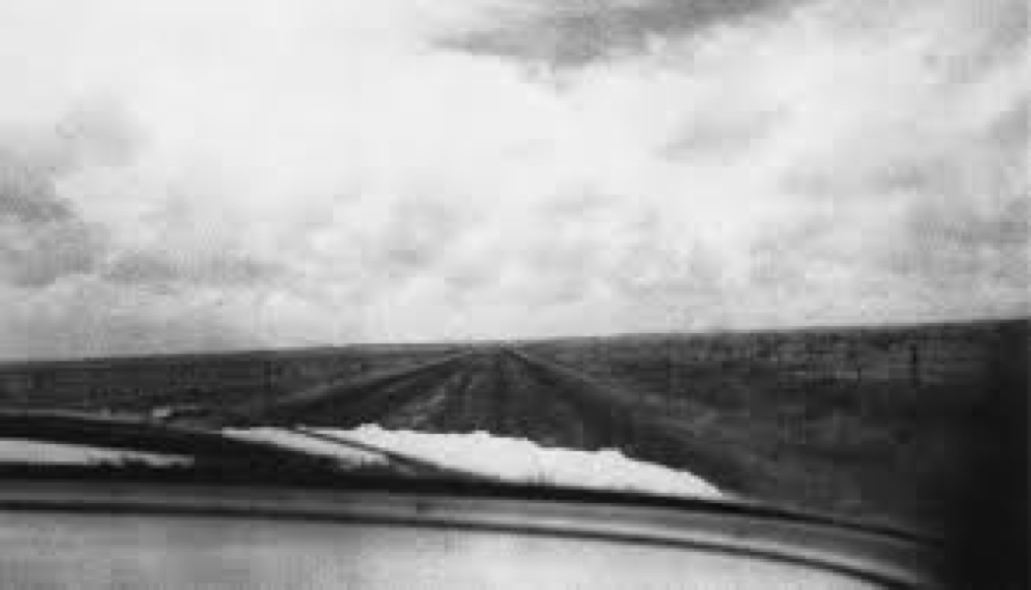
In a lot of the songs we hear a voice not so different from Kit’s, less pathological, but just as small, just as unimportant to anybody that matters, and sometimes just as flat and matter-of-fact. The one that grabs me most powerfully is Reason to Believe. Springsteen often writes from the perspective of small-time hustlers and grifters, and in my mind’s eye the narrator of Reason to Believe is one of those, maybe under interrogation in a small room somewhere, maybe in a little trouble, referring to his listener as “sir” as if by reflex, ever mindful of his obligation to pay due deference. It’s like he’s talking to someone off camera, while the conversation comes around to how he just doesn’t understand where people find hope, or how they manage to persist when hope runs counter to what’s obvious:
Seen a man standin’ over a dead dog
lyin’ by the highway in a ditch
He’s lookin’ down kinda puzzled
pokin’ that dog with a stick
Got his car door flung open
he’s standin’ out on Highway 31
Like if he stood there long enough
that dog’d get up and run
Struck me kinda funny
seemed kinda funny, sir, to me
Still at the end of every hard day
people find some reason to believe
You see it all the time, sir, don’t you? Abandoned women who can’t believe that Johnny isn’t coming back. Some stiff left jilted at the altar, who must have been nuts to think that girl really loved him. People full of hope who get their kids baptized – man, those kids are likely going to die alone in some shotgun shack. When that time comes, they’ll lay them in the ground while everybody prays, doing them about as much good as it did when everybody mumbled prayers back when they were little kids, and some priest trickled water on their heads. Perhaps the good Lord could tell us what it means.
He’s not angry at anybody, he’s not even frustrated, and he’s not asking when the poor slobs are going to wake up and smell the pile of crap they’re standing in. He’s just sayin’. No matter what, they still believe. Maybe he envies them.
For years I wondered, did Springsteen see Badlands? The movie is full of little moments that Bruce could have scripted. Kit, warned by his girlfriend’s father to stay the hell away from the girl, backing away respectfully, apparently without rancour, saying only that “it takes all kinds, sir.” The two fugitives out in the middle of nowhere, bickering about something until Kit gives in with a flat and ambivalent “well, I’m not sayin’ I know”. Holly, in voice-over, relating how when she got bored with Kit, she stopped listening, and spelled out whole sentences with her tongue on the roof of her mouth, where nobody would ever read them. Kit, working as a garbage man, staring down bemusedly at a dead dog that somebody put out with the trash. “I’ll give you a dollar to eat that collie” he says to his co-worker, who doesn’t seem to think that’s a strange thing to say. “I wouldn’t eat it for a dollar”, he answers, as if he might for a little more, “and I don’t think that’s a collie neither…it’s some kind of dog though”. Some kind of dog, thrown out in the garbage. I saw a man standin’ over a dead dog.
These are Springsteen’s sort of characters. They seem imbued with a sort of detached fatalism. They don’t have much to say, and nobody would listen if they did. They’re used to life on the bottom rung, swimming in boredom and banality. They aren’t noble. They’re just people, none too bright maybe, but they might have been able to do better than this, if they ever got a fair shake. They know the score, though: by the rules, they belong at the bottom of the heap, that’s just how it works, and you just have to accept that none of your betters are there to cut you a break, or leave you with something to feel proud about. Of course, the downtrodden folk who populate Bruce’s songs are usually much more sympathetic, and often still have hopes of busting out of their current ruts, like the characters in Meeting Across the River, Atlantic City, and Thunder Road. Still, they’re made out of a lot of the same stuff as Kit and Holly, and even in his love songs they sound a lot like Kit to me. Take this from I’m on Fire:
Sometimes it’s like
someone took a knife, baby,
edgy and dull,
and cut a six-inch valley
through the middle of my skull
At night I wake up
with the sheets soaking wet
and a freight train running
through the middle of my head
In Badlands, there’s a scene with Kit lying awake on a bed, his eyes fixed and glazed over, while Holly’s narration relates how when he’s awake at night, he hears a constant roar like somebody is holding a seashell up to his ear.
It’s all about the class system we like to pretend doesn’t exist, when you get right down to it. That’s what Springsteen writes about, and that’s a large part of what Malick’s movie was about, too. About ten years after Badlands was released, a scholar named Elliott Leyton produced what’s come to be regarded as a classic psychological study of mass murderers, Hunting Humans. He has a chapter about Starkweather. Leyton’s conclusion is what Malick had already communicated with eloquent clarity on film: mass killings are very often a kind of class warfare. It’s revenge against the people that hog the top of the pyramid, often displaced and meted out on the wrong targets, but revenge nonetheless. Keep enough people down, and let them stew in a culture that glorifies violence, grants fame to mass murderers, fetishizes guns, and romanticizes loners who aren’t going to take it anymore, and look what you get.
You get the feeling this is something Springsteen would understand. The plight of the common people from the wrong side of the tracks isn’t merely unjust. It’s dangerous.
In a way, there are two Springsteens. One writes thundering stadium rock tailor-made to get people out of their seats, and the other writes quiet, contemplative vignettes of people leading mournful and often desperate lives. There might seem to be a world of difference between Reason to Believe and, say, Born to Run, and there is, musically, but no matter how he writes it, Springsteen is always writing about the same thing. His concern is for the little guy, and all the crap he’s put through by those above him, whether that’s losing a job, watching his beloved home town corrode into Rust Belt dust, or being sent to fight a pointless war in some jungle or god-forsaken third world sandlot. He writes songs about guys who work border patrol, and guys whose wives stopped loving them a long time ago. Sometimes they’re resigned, sometimes they’re determined to take a chance, but they’re all starting behind the 8-ball, one way or another. They all sound real. I can’t think of anybody else who’s so determined to tell their stories, not since Woody Guthrie, anyway.
Nebraska, its songs as cheerless as its cover photo, isn’t for the faint of heart; but Bruce knows, and a large enough part of the public seems to have appreciated, that sometimes you have to take an unblinking look at reality and tell it like it is, and the truth is, a lot of the time it’s desolate and brutally unfair.
Last year, I read Springsteen’s autobiography, and sure enough, he cites the films of Malick as part of his inspiration for Nebraska.
Of course, prior to that he also had a song titled Badlands, off the album Darkness on the Edge of Town.
Song of the Day: Electric Youth – A Real Hero (January 17, 2019)
A couple of days ago, January 15, marked the 10th anniversary of the date upon which Capt. Chesley “Sully” Sullenberger, his Airbus crippled just after take-off by bird strikes that took out both of his engines, mentally calculated his altitude, airspeed, and the distance to the nearest plausible landing strip, and realized he couldn’t make it.
Ever so calmly, he informed air traffic control that no, he wouldn’t be trying for LaGuardia, and couldn’t make Newark. He was ditching in the Hudson.
This simple, yet to my ears rather lovely little piece of electronica was written in honour of what Sully managed that day. I first heard it on the soundtrack of the underrated movie Drive, went searching for it on iTunes, and listened to it happily for a long time before it hit me that it could only be about one thing:
A pilot on a cold, cold morn’
One-hundred fifty-five people on board
All safe and all rescued
From the slowly sinking ship
Water warmer than his head so cool
In that tight bind knew what to do
And you have proved to be
A real human being and a real hero
It wasn’t just the piloting skill that impresses. It was the presence of mind, the preternatural calm with which the crisis was handled. Sully would have known that ditching an airliner in water is almost guaranteed to end in disaster, but that’s because water landings almost always happen at sea, with high waves that invariably catch a wingtip, or slam into and over-stress the airframe as the plane tries to settle in. A river, though, is different. The Hudson was placid that day, and while smooth water isn’t tarmac, it’s actually a lot better than a dead stick landing on some bumpy patch of ground that’s liable to be too short, and surrounded by buildings, or maybe trees. Ditching in the river is thus a perfectly good option, even a great one, provided you can bring it in just right: gear up, nose a little high, catch the tail first, and ease it down. The smooth, rounded bottom of an airliner is almost like a boat. You could skid to a nice, slow stop and settle down relatively smoothly, though you’d have do it with finesse – water is incompressible, and if you hit it fast enough you may as well be landing on concrete. So, finesse it would have to be.
That’s the physics of it, but figuring that out and deciding to go for it in the time allotted would, for anyone else, be a superhuman and highly improbable exercise in dispassionate logic. Laguardia was tantalizingly close to being within reach, and other pilots might have felt an overwhelming urge to try for a proper runway landing. You get the impression, though, that the river as Option C was just part of Sully’s hard-wiring, no extra thought required, let alone second thoughts. They might not make LaGuardia, but the river was a sure bet, as well as the longest runway on Earth, if you looked at it that way. Option C thus posed the least risk, and there’s no indication that Sully had any doubts at all, as if he’d run the equations and come up with the irrefutably higher value. This is the stuff of test pilots.
Listen to the exchange between “Cactus 1549” and the tower, attached below. You can hear Sully realize very quickly that he might end up in the river, even as they try to divert him to Newark or maybe Teterboro airport in New Jersey, and clear runways for him; while at first still hoping to make it to an airport, any airport, Sully was considering the Hudson just 40 seconds after sucking Canada Geese through both turbofans. As the conventional options are eliminated, Sully’s voice doesn’t even rise in pitch.
Tower: OK Cactus 1549, it’s going to be left traffic on runway 31.
Sullenberger: Unable.
Just like that. “Unable”. I don’t sound that calm, cool, and collected if I can’t get the cork out of a bottle of Veuve Clicquot.
Then, simply, We can’t do it. We’re going to be in the Hudson. He doesn’t even cuss.
With the plane ditched as gently as possible (still hard enough to rip up the tail section), and the Airbus sinking slowly enough to get everybody out the doors, Sully did a last search of the plane, up and down the aisle, making sure that nobody was still left on board, and then exited himself, the last man off.
In its breathy melodicism, A Real Hero seems to celebrate not just Sully’s raw skill and cool-headedness, but the care and concern with which he did his best to get everybody down safely, with all that weight on his shoulders. It wasn’t self-preservation. It was duty.
Here’s a great piece on the incident from Vanity Fair, well worth a read if you’re interested:
https://www.vanityfair.com/culture/2009/06/us-airways-200906
Song of the Day: Liz Phair – Perfect World (January 30, 2019)
Liz Phair has had her creative ups and downs, but on a good day she can be wry, cynical, scathing, brutally honest, and wonderfully adept at pop songcraft. I submit that Perfect World, my favourite, was written on a very, very good day.
I’m always a sucker for a song that bewitches and then wraps up tidily before you’ve had enough, and this compact and almost formally perfect guitar piece clocks in at just a little over two minutes before it’s done and out. It’s a marvel of tight construction, and while it’s easy to get lost in Liz’s unwavering voice, listen too to the lovely contrapuntal bass line. In typical Liz fashion, Perfect World matches a pretty tune to lyrics that contemplate her own quirky femininity with almost mournful bitterness, describing herself as not cool enough, not tall enough, too opinionated, too mouthy, and, if you dig just a little into the subtext, too damned smart, to be desirable.
The “perfect world” is the one she can’t enter, where prettier, more vapid girls get the man who has everything – what a pretty life you have, she sings, oh boy it’s a pretty life you have. It sounds like he does well for himself, in more ways than one. You’d need a map just to navigate the guy’s backyard, for chrissakes. Guess who gets in to frolic:
I know the girls that live inside your world
Just sitting next to a mortal makes their skin crawl
And that ain’t her, those aren’t the circles she travels in, though she wishes most fervently, just now, that it was.
I want to be cool, tall, vulnerable, and luscious
I would have it all if I’d only had this much
No need for Lucifer to fall if he’d learn to keep his mouth shut
I wanna be involved, be involved, be involved, be involved
I would be involved with you
You get the feeling she doesn’t really want to be like the other girls, and this is just a crystallized moment of extreme frustration. Anyway, she’s never going to be, because she’s never going to learn to keep her mouth shut, no matter how hard she tries.
Good. I want to hear what she has to say, and with that voice she can say anything at all, and it’s fine by me.
By the by, it’s perhaps symptomatic of our toxic culture of ludicrous idealized femininity if this woman really thinks she isn’t desirable.

Song of the Day: Bonnie Raitt – I Can’t Make You Love Me (February 22, 2019)
Everybody feels the need for a good, cathartic hurtin’ song sometimes, but I bet for a lot of folks this one hurts a bit too much. It’s beautiful, but it’s real, and this level of emotional honesty cuts pretty deep.
It kind of guts me, too, but I can’t help myself.
It seems such a perfect expression of a particularly feminine point of view, and the way women process heartbreak, that it may come as a surprise that it was written by a couple of guys, who based it on a true story that was purely about male folly. The composers, Mike Reid and Allen Shamblin, were inspired by a newspaper article. The report was in the “crime and punishment” genre on the back page of the morning edition, and concerned this fairly pathetic back-hollow sort of country boy who, one gathers, had been dumped by his girlfriend, and wasn’t ready to accept it. Sad, frustrated, and angry, he got himself all drunked up on moonshine and shot her car full of holes, like that was going to show her something. Well, that lands you in the slam, sonny. At sentencing the judge asked him if he’d learned anything from all this, probably expecting him to admit that guns and alcohol don’t mix and he was powerful sorry, but instead he looked balefully at the bench and said “Yes your honour. You can’t make a woman love you, if she don’t.”
Mike Reid remembers that when they finished the song, it was the only time he ever really felt they’d done something they couldn’t improve upon. Bonnie Raitt and Linda Ronstadt were the only ones they felt could possibly do right by it, and Raitt got the first crack. She didn’t need time to think about it. Her first impression was that it might be one of the greatest songs ever written. Other songwriters agree, including the great Carole King, who described it as “torn from the depths of feeling, from the bottom of that place where your love is unrequited”.
You can’t make a woman love you, if she don’t. Maybe to some that sounds kind of dumb. Not to me. It is, actually, one of the most painful and important lessons every young man needs to learn, and one he’ll ignore at his peril.
Anyone familiar with the work of Bruce Hornsby, who had a couple of hits in the 80s, will immediately recognize his playing on the piano accompaniment.
Song of the Day: Cyndi Lauper – True Colours (March 1, 2019)
Cyndi didn’t write this one, it’s from the team of Tom Kelley and Billy Steinberg, but she sure sings the hell out of it, and she came up with the arrangement – I read here in Wikipedia that it started life as a sort of gospel song. Steinberg liked Cindy’s take better, and found her arrangement “stark and breathtaking”.
Cyndi herself is a bit of an enigma. Her first album, She’s So Unusual, was inordinately huge, almost Thriller huge, with seven top 40 singles on it. You’d swear it was a greatest hits collection. She showed real range too, veering from not-so-silly pop in Girls Just Wanna Have Fun to hard Van Halen style rock in Money Changes Everything, to sensitive love balladry in Time After Time. The album was on the charts all year, sold over 20 million copies, and looked to be the beginning of an amazing career. Conventional wisdom at the time was that this Madonna person was just a flash in the pan, cranking out danceable ephemera, while the real sustainable talent was Cyndi.
True Colours became a sort of anthem for the gay community – it wasn’t written to be, but Cyndi has always said she’s glad they adopted it as their own. It really does sound like a gentle exhortation to come out of the closet, but it’s really about how it ought to be possible for all harmless folk to simply be who they are, unafraid of scorn or disapproval, which just goes to show how all of us are the same, in the same boat, with the same fears. Steinberg actually wrote it for his mother, who must have been a gentle soul.
I sure wish I could have written something so kind and loving for my Mom.
Song of the Day: The Kinks – Oklahoma USA (March 4, 2019)
Some songs are built around questions, a simple device and old trick of the trade, like call-and-response. What do the simple folk do? Will you still love me tomorrow? Do you know the way to San Jose? Do you love me, surfer girl? In the sixties some of those questions became rather serious: have you ever seen the rain? How many times can a man turn his head and pretend that he just doesn’t see? Writing about Eleanor Rigby, and its refrain that asked after all the lonely people, where they all came from and where they could all possibly belong, author Jonathan Gould noted that some questions aren’t rhetorical – they’re just unanswerable. That’s what you get in Oklahoma, USA, about a woman who lives a fantasy life to escape the dreariness of her mundane working days, in which the great Ray Davies poses one that could only spring from the deepest fount of melancholy: If life is for living, what’s living for?
Pete Townshend once said in an interview, rather ruefully, that as the Sixties progressed he and Ray Davies had to get comfortable with the idea that The Kinks and The Who were never going to be as big as The Rolling Stones and The Beatles. Pete didn’t think that was quite fair, and when you listen to a song like Oklahoma, USA you can see why. Concise, melodic, thoughtful, and sad beyond words, it’s one of Ray’s very best, and might seem off the beaten path to those who know him only for his early proto-power chord hits, like You Really Got Me and All Day and All of the Night. Ray could rock, all right, but he could also write songs that were out of time and for the ages – this is the guy who didn’t just give you Lola, he also gifted you the beautifully wistful and ethereal Waterloo Sunset.
Ray actually wasn’t so much a rock ‘n roller as a dreamer, a romantic, and his songs are often gentle and nostalgic – when it came to the state of modern England, fiercely nostalgic (who but Ray could write a rollicking pop tune celebrating the age of Queen Victoria?) – and very sad, in an understated sort of way. They only tugged at your heartstrings with full effect once you’d listened a few times, and absorbed the words.
So here’s our unnamed woman, head in the clouds, passing the time by imagining herself living large within the worlds depicted in big Broadway musicals and Hollywood romance pictures, while the days turn to years and time keeps evaporating.
She walks to work but she’s still in a daze,
She’s Rita Hayworth or Doris Day,
And Errol Flynn’s gonna take her away,
To Oklahoma U.S.A…
All life we work but work is a bore,
If life is for for livin’ then what’s livin’ for?
If I knew, dear imaginary reader, I promise I’d tell you.
Song of the Day: Paul Westerberg – Love Untold (March 13, 2019)
Sometimes a highly enjoyable pop tune isn’t so much extraordinary as perfectly executed within the limits of what it is. They can’t all be Strawberry Fields Forever. They can’t all have astonishing chord sequences, unexpected key changes, innovative structures, and bold conceptual underpinnings. Yet a song that objectively might offer nothing particularly new might still be assembled with such craftsmanship that it’s just plain delightful – sometimes a really good rock ‘n roll song adopts all the tried and true conventions and just does it right, all of it just so, leaving you wanting to hear it again. I think one of the best recent examples of this can be heard in the Lumineers’ Ho Hey, which you can find on this blog site under Graeme’s Video Emporium, or on YouTube etc., if that suits you better.
Paul Westerberg’s Love Untold is that sort of song. Westerberg is a very good songwriter who cut his teeth in a much admired if commercially luke-warm band called The Replacements. On his own he’s enjoyed only moderate success, but this song gleaned a little airplay for a while, and should have got more. All the traditional elements are in perfect balance, the power chords, the descending melody of the verses, the forceful middle eight. It’s one of those songs that manages to be poignant even as it rocks pretty hard, and tells a story about missed chances and unrequited love that has real emotional heft.
Does anyone recall the saddest love of all, the one that lets you fall, nothing to hold?
Song of the Day: The Tragically Hip – Bobcaygeon (March 16, 2019)
A beautiful and at first blush enigmatic song, Bobcaygeon is named after a small Ontario town on the Kawartha Lakes, which composer Gord Downie is said to have chosen for the lyrics because he wanted a place name that came as close as possible to rhyming with the word “constellation”.
A close listen to the lyrics, and its description of being on horseback, trying to restore order, reveals what’s made explicit in the video: the protagonist is a cop, grown weary and stressed by the challenges he confronts daily in the concrete canyons of Toronto, where the skies are “dull and hypothetical” – the latter, perhaps, because often, when you’re downtown between the tall buildings, you can barely see the sky at all, those times when you’re actually outdoors. On foggy days, the grey nothing above can blend in with the tops of towers and seem to vanish. I remember telling myself once, it’s gotta be up there somewhere.
One thing that has always struck me in the video is how utterly credible Gord looks, garbed as a police officer.
The narrative’s central event, set out in the bridge, is about things going south at a concert at Toronto’s legendary Horseshoe Tavern, the place with the “checkerboard floors”. The Men They Couldn’t Hang isn’t a description, but the name of an English band described in Wikipedia as “folk-punk”, whatever that is, and one gathers that Gord must have seen them at the Horseshoe at some point, and heard them perform their song “Ghosts of Cable Street”. The song within a song was about a street battle that occurred in 1936 in London’s Whitechapel district, involving members of the British Union of Fascists led by the notorious Oswald Mosley, the thousands of police detailed to protect them and prevent violence, and a mixed throng of anti-fascists, anarchists, communists, Jewish activists, socialists, and just about everybody else in Greater London who then had an axe to grind. The Battle of Cable Street was no small thing, as detailed in Wikipedia:
The main confrontation took place around Gardiner’s Corner in Whitechapel. An estimated 20,000 anti-fascist demonstrators turned out, and were met by 6,000–7,000 policemen (including mounted police), who attempted to clear the road to permit the march of 2,000–3,000 fascists to proceed. The demonstrators fought back with sticks, rocks, chair legs and other improvised weapons. Rubbish, rotten vegetables and the contents of chamber pots were thrown at the police by women in houses along the street. After a series of running battles, Mosley agreed to abandon the march to prevent bloodshed. …Around 175 people were injured including police, women and children.
https://en.wikipedia.org/wiki/Battle_of_Cable_Street
It’s often suggested that Downie was also alluding to a smaller but locally famous street fight that occurred in Toronto in 1933, in which Jewish citizens and supporters from the Italian community clashed with Nazi sympathizers in what came to be known as the Christie Pits Riot. Perhaps. Whenever I hear the song I’m reminded of the neo-Nazi group with which I had dealings as a lawyer, the Heritage Front, who were involved in a similar street brawl in the early 1990s, not long before Bobcaygeon was written. In the video, the neo-Nazi who stirs up trouble on stage actually looks a lot like the Heritage Front’s then-leader, Wolfgang Droege.
Perhaps it’s about all of that, and nothing so specific. In the song, it seems as if the riot is taking place right there at the Horseshoe, forcing the narrator to wade in, but in any case, violence between extremists and their antagonists is something this cop knows more about than he’d care to, and supplies the context for the character’s primary motivation: surprisingly, Bobcaygeon turns out to be a tender love song. It’s the town where his lover resides, his haven, a rural retreat where everything stands in stark contrast to the urban unpleasantness of the GTA. In one of the prettiest sentiments you’ll ever hear in a pop song, Downie contrasts the dull skies of downtown Toronto with what he sees overhead out in the countryside:
’cause it was in Bobcaygeon
where I saw the constellations
reveal themselves one star at time
…a reference not just to the myriad brilliant stars that you can never see in the city, where their existence can indeed seem purely hypothetical, but also to the rejuvenating power of making love when you’re really in love.
Musically, as befits a love song, Bobcaygeon is more sweetly melodic and accessible than a lot of the Hip’s most celebrated songs, which tend to be chord-driven, and often rock pretty hard; this is the one your mom would like. Don’t be misled, though – sweet and tuneful it may be, but Bobcaygeon is no piece of pop puffery. It’s a powerful, emotional song about serious things, which is the only way Gord knew how to write them. There’s a cinematic sort of sweep to it, too, this depiction of the beleaguered riot cop thinking only of getting back home to his love, even as the violence bids fair to swamp both him and his horse. The only sure antidote to the madding crowd’s ignoble strife, it seems, is to be far away in your lover’s arms. If that doesn’t get you right in the pumper, then, well, I guess I just don’t know.
It’s hard to think of Gord Downie, felled young by brain cancer, without tearing up a little. He was the real deal, a great talent, a deep thinker, a quintessential Canadian, and by all accounts a lovely guy. He left behind a trove of that rarest of things, pop songs with lyrics that really mean something, and move the listener in much the same way as good literature, with stories that fascinate, resonate with genuine emotion, and often embrace some pretty big ideas. With Bobcaygeon, he left us a very fine piece of himself, which doesn’t make it all better, but hey, if you can’t live to a ripe old age, then burning brightly while you’re here, and being loved and remembered for your art when you’re gone, has to be reckoned a fair second best.

Songs of the Day: Remembering Brian Wilson (March 19, 2019)
 the needlefish