Song of the Day: The Bangles – If She Knew What She Wants (August 27, 2019)
A sad, sweet, almost philosophical portrayal of heartache, with a poignant question at its centre: what do you do when the thing that makes her most alluring is the thing that makes her impossible to please? He’s crazy for this mercurial girl, and he can’t do a thing to make her happy.
The first thing anybody noticed about the Bangles, when they rose to prominence and started getting heavy rotation on MTV, was that they were all pretty, but their lead singer was beyond good-looking. She was gorgeous. That, and the general consensus that the group was just a riff on the formula perfected by the Go-Gos, tended to obscure that the Bangles were the real deal. The beautiful singer could really sing, in a clear, supple, unwavering voice utterly free of vibrato, while the band was tight, and much more than just a backup group for the main attraction – and they could sing too. Moreover they had a fine ear for material. Whether it was the silly but insanely catchy Walk Like an Egyptian (Billboard’s number one song of 1987), or the much more substantial pop masterpiece Manic Monday, penned for them by Prince, their music was always full of lilting melody and hardly ever less than eminently listenable. They covered the tuneful yet rocking Goin’ Down to Liverpool, a superb bit of Brit-pop originally performed by Katrina and the Waves, Paul Simon’s Hazy Shade of Winter, and this, If She Knew What She Wants, maybe the best of them all.
Written by Jules Shears in 1985, it might seem an odd choice, being essentially a pained complaint about a woman voiced from a man’s perspective, except it’s such a humane and loving complaint, neither angry nor dismissive. The girl is complicated, that’s all, she’s difficult, but for all of that fascinating too, though maybe a little bit self-absorbed – the narrator explains that she has so many thoughts rolling around in her head that she sure doesn’t need any from him – and oh, how he’d love to give her what she needs, if only she had any idea what that was. The call and response makes clear his dilemma:
But she wants everything
(He can pretend to give her everything)
Or there’s nothing she wants
(She don’t want to sort it out)
He’s crazy for this girl
(But she don’t know what she’s looking for)
If she knew what she wants
He’d be giving it to her
Giving it to her
It’s a beautiful bit of pop tune-smithing, and by making it their own, the Bangles create such an atmosphere of sympathetic female energy that one can imagine the singer wishes the guy would just give up, and give her a look instead. Look at this good guy having a hard time; there’s real warmth to it.
The Bangles broke up when they were at peak popularity, but reformed in the late 1990s. They still play together, showing off the musical chops that once propelled them to the top – see the second clip above – and a fella can’t help but note that Susanna Hoffs remains almost supernaturally beautiful, having somehow managed to become even more attractive with age (and that ain’t fair). Now 60, she can still sing like nobody’s business.

Song of the Day: Jefferson Airplane – Embryonic Journey (September 9, 2019)
Since I’m wallowing in wistful nostalgia these days, here, have a listen to a really fine example of something you don’t hear much anymore, the brief instrumental, and my favourite track on Surrealistic Pillow despite the presence of the more famous pair of Sixties classics, White Rabbit and Somebody to Love. It was composed and played on record by ace guitarist Jorma Kaukonen, who wrote it back in 1962 as part of a guitar-playing workshop, years before Paul Kantner enlisted him to play with the Airplane. It was the album highlight for a lot of people, especially those aspiring to master the acoustic, for whom the piece is considered a sort of acid test.
The sound is so complex and lush that it’s hard to believe it’s just a single player, neither accompanied nor double-tracked. It has the rare quality of being both timeless and very much of its time, evoking the Sixties like few others, a classic artifact of 1967 psychedelia which, despite its far-out title, wasn’t really psychedelic. The lesser songs of that era can sound dated and silly today (Electric Prunes, anybody?), but the esteem for Embryonic Journey has grown to the point that you can find any number of YouTube videos showcasing the talent needed to play it properly, including this one, by the composer himself:
I was only about six years old when Surrealistic Pillow came out, and I didn’t hear it for the first time until the early 1980s, yet somehow this one takes me back to that high summer of 1967, the Summer of Love, the summer of Sgt. Pepper, from which I remember only a few little musical snippets – Ruby Tuesday, Penny Lane, The Monkees, and a couple of singles that were kicking around the house, particularly the Boxtops doing The Letter. I do have vivid recall of the excitement around Expo 67, the world’s fair marking the Centennial of Confederation, when all of us school kids received a commemorative medallion:

It was considered cool to punch a hole in it and hang it around your neck on a piece of string. I’m sure that’s what happened to mine, before I lost it.
For my fellow Canucks, a blast from the long-vanished past:
Song of the Day: Thomas Newman – The Farm (September 20, 2019)
Not a song, really, but an excerpt from a soundtrack, though just like a song, compact, with a clear beginning and end, only two minutes and ten seconds of the most beautiful, sorrowful, yet not quite despondent music.
Thomas Newman has been my favourite of the modern crop of film composers ever since I first heard his score for the lovely 1990s remake of Little Women. He combines popular, folk, and traditional themes and instrumentation with classical elements in a way that I’ve always found haunting and intriguing, and his uncanny ear for structure, melody, and inherently melancholy keys has lent moments of wonder, joy, sadness, and deep, philosophical contemplation to many of my favourite films. He’s done a fair bit of work for Pixar, adding heft to some of the most emotional scenes ever rendered in animation, such as the moment at the start of Finding Nemo, when the papa clown fish Marlin finds just a solitary egg left after a predator has taken his mate and a whole nursery of little clown fish to be, and the beautiful scene in Wall-E, as the robots perform a sort of euphoric minuet out in space, scored to a segment titled Define Dancing. I blogged about that one, a couple of years ago:
Great Movie Scenes: Wall-E
The Farm comes from the terrific and strangely overlooked drama Road to Perdition, a moody period piece set in the 1930s starring Tom Hanks, Jude Law, and Paul Newman, which on the surface is about life as a foot soldier in Al Capone’s mob, but’s really a story about fatherhood, tragic loss, moral ambiguity, painful choices, and the terrible, inevitable momentum of events that can push everybody knowingly and yet unwillingly towards the only possible outcome. It’s the score for a montage in which a worried son waits to see whether his dad is going to survive and recover after being shot, as he’s nursed back to health by a kindly old couple who happen to live on the first rural property the child could find, after he drove his dad away from a shoot-out, desperately looking for help. The father does recover, but the music is written from that sad, frightened place that precedes the good news, when the boy isn’t sure whether he’s soon to be orphaned, and all he can do is wait.
It’s almost funereal, but not quite. There’s hope there too. The outcome isn’t certain. Things are grim, but might still turn out all right, and it’s that delicate combination of fear and hope that makes this little piece so special.
Song of the Day: Kate and Anna McGarrigle – Love Over and Over (October 10, 2019)
I’ve walked upon the moors
On many misguided tours
Where Emily, Anne and Charlotte
Poured their hearts out…
I first heard this captivating song while I was up a ladder, burning thick layers of ancient paint off the shingles of a house in Dartmouth, NS, little drops of molten paint, probably full of lead and a dozen other carcinogens, searing little red pits into my forearms. We had a boom box going on the lawn. Summer of 1984.
Kate and Anna were from Montreal, and were the sort of musicians and songwriters who enjoy only moderate success with the public while earning the adoration of their peers. Their compositions were liable to be covered by the likes of Emmylou Harris, Judy Collins, Joan Baez, and Linda Ronstadt, who made Anna’s Heart Like a Wheel the title track of her breakthrough number one album of 1974 (they allude to that success in the lyrics of today’s selection: You ask me how I feel / I said my heart was like a wheel / why don’t you listen to it some time?). Love Over and Over manages to be bouncy, melodic, wry, doubtful, straightforward, complex, very clever, joyful, and highly exasperated all at once, wondering what the hell anybody really knows about love when even the frickin’ Brontë sisters couldn’t figure it out.
That’s Mark Knopfler on guitar.
In Canada, at least, they’re perhaps most famous for something they didn’t write, Wade Hemsworth’s Log Driver’s Waltz, which they performed for an endlessly charming little cartoon produced by the National Film Board. If you’ve never seen it, you simply must:
They recorded well-received albums up until 2008, by which time they’d both been awarded with an Order of Canada, a bunch of Junos, and several other such gongs. Then Kate, beset with cancer, died in 2010, at only 63. The Guardian posted a nice obit:
https://www.theguardian.com/music/2010/jan/19/kate-mcgarrigle-obituary
Songs of the Day: Tracy Chapman – Change; Talkin’ ‘Bout a Revolution (October 29, 2019)
Her guitar isn’t emblazoned with the slogan “This machine kills fascists”, but it might as well be. Chapman writes with a direct, unaffected, challenging honesty that reminds the listener how a song can do so much more than merely entertain. She’s angry, and sad, and wants to know what the hell and why, and in just a couple of minutes you’ll feel the same.
Attached are two versions of Talkin’ ‘Bout a Revolution, one recorded live, and the studio track from her first album, each powerful in its own way. When I first heard this in the mid 1980s, blasting out of the boombox while I rolled paint on to the walls of a Rosedale mansion, it seemed out of time and place, written for a less happy era – what did I know? I thought the people I worked for deserved what they had. I thought things were getting better. Thirty years on, the song sounds almost painfully on point, doesn’t it? Who really thinks any more that anything around us in this new Gilded Age smacks of fairness? Who really supposes there’s been progress in race relations, wealth concentration, or criminal justice? Who even believes in progress? Who thinks this isn’t a plutocracy run mainly for the benefit of about two thousand rich white men? Look, there are 26 billionaires who together hold as much wealth as the poorest 50% of the world’s population, 26 guys on one side of the ledger, almost four billion souls on the other, and here we sit, complacent, practically brainwashed, nodding along whenever they meet any proposal to do even the smallest thing to mitigate human misery with the old refrain: “Where’s the money going to come from”?
Thirty years ago, it was just a catchy protest song. Now when I hear Tracy sing of the poor crying at the Salvation Army doorsteps, I feel anxious. It puts me in mind of Harlem, that great poem by Langston Hughes – what happens to a dream deferred? You wonder how much more of this people are going to take, and whether we’re just one more Wall Street meltdown, one more police video of a fleeing, unarmed black kid being shot to death, from the whole thing exploding. Yet what am I prepared to do? That’s what she’s asking: what is it going to take? Which unbearable truths am I going to acknowledge, and what will happen if I do? The question is pretty much rhetorical, because Tracy already knows that I’m not going to do a damned thing, and I guess it’s a little odd to admire her for saying so, being as she’s calling me out.
Yeah, but I always was a little odd that way. Something I get from my dad, I think.
Song of the Day: The Beatles – All You Need is Love (September 7, 2019)
Yes, he’s at it again. Bloody song of the day.
I have an excuse – I’ve been stimulated by third party provocateurs. You see, I just finished watching a popular music documentary series produced for CNN by Tom Hanks’s Playtone company, which went decade by decade up to the 2000s, with clips and commentary by various famous people, some of whom even knew what they were talking about. I’m a sucker for this sort of retrospective, and the nostalgia that’s always evoked.
One thing that struck me was the way that the talking heads almost invariably wound up concluding that the decade under review was for sure the best. The 80s were the best. No, the 2000s were the best. Nobody had ever heard anything like the stuff in the 90s. Name any form of popular music you like, and the very best example comes from the 70s. Disco was great. Fleetwood Mac was great. Madonna was great. Nirvana was great. Tupac was great, and Biggie Smalls too. Lady Ga Ga is great, and so’s Katy Perry, and Kanye.
Yes, well…there’s great music in every decade, sure enough, and every decade has its peaks. Yet I always find myself drawn back to a time now receding into the distant past, when the very greatest music of its era was not only uniquely plentiful but also the most popular, when every second song you heard really was revolutionary, when the melodies soared, the words were ever more poetic, and the arrangements ever more elegant and complex – when that new thing on the radio really was unlike anything you or anybody had ever heard. This wasn’t the music of my formative years; my time was the Seventies and Eighties, I was still just 15 when Kiss was big, and 22 when Culture Club was huge, and if I was in love with the music that was in the air when I was growing up and paying attention, I’d be waxing eloquent about Convoy, Disco Inferno, Bohemian Rhapsody, My Sharona, Ran So far Away and Saved By Zero. I hated the most popular music of my adolescence and early adulthood, and cast about desperately for an alternative, finding it in the songs of a decade prior, which seemed a long time ago, even then.
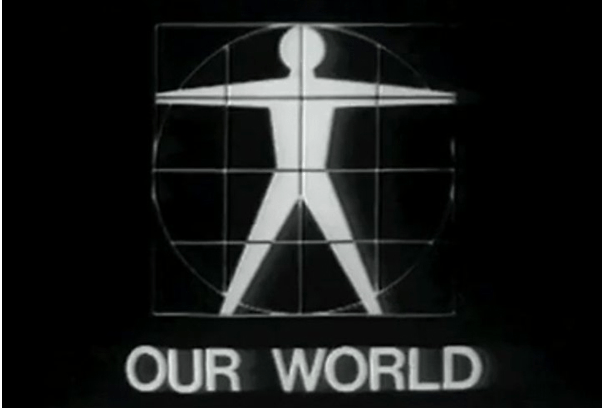
There are peaks, and then there are peaks, you know? For me, one in particular stands out, more than 50 years on. It was in June of 1967, and the occasion was the very first international satellite broadcast, Our World, during which nations from all over the globe were given a few minutes to beam out anything they pleased, anything at all that they thought would convey something interesting or meaningful about themselves. There were just a couple of rules: no heads of state or politicians, and it had to be live, not taped. Other than that, participating countries were told to have at it. Canada’s contribution was an interview with Marshall McLuhan, as befit this first real-world realization of the instantaneous global village. Spain broadcast a segment with Pablo Picasso.
The UK, most famously, offered up its Beatles.
Something between 400 and 700 million viewers (estimates vary widely) were thus ushered in to Abbey Road Studio Two, to see the boys laying down a backing vocal track for a new song soon to be performed live, George Martin and Geoff Emerick in the booth tweaking the knobs (most video clips omit this part of the segment, which is attached in black and white, above). This is a genuine recording session. Once the backing vocal track is laid down, the tape is rewound, the orchestra is ushered in, and the Beatles debut live their brand new song, All You Need is Love, singing and playing over parts that were previously recorded.
Contemporary luminaries such as Donovan, Mick Jagger, Keith Richards, Eric Clapton, Keith Moon, Graham Nash and Marianne Faithful are in attendance, sitting cross-legged on the studio floor, as, improbably, the orchestra opens with the familiar strains of the Marseillaise. Then they’re off.
The rollicking, anthemic song for the whole world was written by Lennon, whose mandate was to produce something light on words with a simple message that would be more readily understood by the non-English speakers in the audience. He obliged with the chorus (which was helpfully set out in different languages on sandwich boards that audience members displayed at the end), but being John, he sprinkled the verses with apparent non-sequiturs that have had even the most accomplished English speakers guessing ever since, though to me the message seems quite simple, and consonant with the theme: strive all you want, and imagine yourself accomplishing great things, if that suits you, but you’ll never transcend the bounds of the possible, and really there’s nothing that matters except the love you manage to give and receive while you’re here. There’s nothing you can do that can’t be done, nothing you can sing that can’t be sung. You don’t need the hollow achievements touted by our shallow, materialistic culture. What does it prove? That stuff is an illusion. You’re missing the point. All you really need is love.
People really believed in that sort of thing in those days.
Just look at them sitting there, headphones on, enjoying the hell out of making the record. They’re just coming off the dizzying success of Sgt. Pepper, and they are at that moment, without question, the coolest people alive, with the world at their feet, and everybody listening, everyone at once all over the planet for the very first time.
There’s a small, lovely little interaction near the conclusion, when Paul shouts All to-gether now! Every-body! – he looks over at John, and their eyes meet as both smile at each other, enjoying the moment as they lay down what sounds like a perfect take (though John was typically unsatisfied, and insisted on further overdubs). Endless discord and mutual antagonism were just over the next rise, but at that moment they were still in complete sympathy and perfect harmony, Lennon-McCartney, symbiotic, almost a single being, doing what nobody had ever done before in a manner that would never quite be replicated.
As if aware of the status they’d one day enjoy in the annals of Western music, they had the song close out with interwoven strains of notable works selected from several different eras: Greensleeves, Bach’s Invention No. 8 in F major (the baroque trumpet voiced by David Mason, of Penny Lane fame), In the Mood, and then, cheekily, their own She Loves You, as John inserted the Beatles into the pantheon.
Their best song? Nah. Their finest moment? Absolutely.
xx
Song of the Day: John Lennon – Watching the Wheels (November 17, 2019)
In the five years between 1975 and 1980 Lennon retreated from public life and holed up in his luxury apartment in New York’s Dakota building, determined to be a better father to his new son Sean than he had ever been to Julian. Absorbed in domestic life, he changed nappies, baked bread, and took his little boy for walks in Central Park, just across the street, where passers-by were cordial but not smothering. John loved New York, and how the people there just let you be, how they were cool with the Beatle in their midst. At night, he would sit in Sean’s darkened bedroom, watching the lights of passing cars make shadow pictures on the wall, and eventually, the urge to make music returned. This is a demo he recorded right there in his apartment, for the final album he ever released. It’s hard not to think, as you hear this, that at that moment he didn’t have long to live.
Most people think Imagine is John’s greatest post-Beatles song, but not me. I always found its rather forced utopian sentiments a little naive and silly, and not at all like the cynical John we all knew (Lennon may have thought so too; at one point he was bitching about royalties or the like when somebody on staff reminded him “Imagine no possessions, John”, to which John responded “it’s only a fucking song”. That’s our boy). I like Watching the Wheels much better, especially this stripped down acoustic version, it’s honest, and reflects perfectly the state of mind that made him content to stay silent and apart for a while. It’s nice to know that what finally drew him out was hearing one of Paul’s latest hits on the radio, and thinking it was fabulous. Accounts vary, but apparently he exclaimed something like “fuck a duck, that’s Paul, that has to be him, it’s fantastic”. Like before, he was filled with the urge to prove he could do that too, and with Watching the Wheels, he surely did.
These days there’s a little slice of Central Park opposite the Dakota dedicated to John’s memory, officially named Strawberry Fields.

Unlikely Song of the Day: Elvis – In the Ghetto (November 25, 2019)
Well, this is odd. I never liked Elvis, not one little bit. By the time I was entering adolescence he was already well into his Vegas self-parody phase, and the sight of him bloating up and bursting out of those preposterous one-piece sequinned jumpers he favoured made me seethe at the idiots who idolized him. Like Sinatra, he may have been an occasionally gifted interpreter of material, when he chose wisely, but he wasn’t a writer, and he didn’t even play an instrument, really (though he was sometimes seen hanging on to a guitar, as pictured above), and sorry, but that just doesn’t cut it. His sneering intonation, and his typically overcooked delivery, left me cold too. Elvis. Yuck. Gimme a break.
Yet I always adored In the Ghetto. Loved it when I first heard it as a kid in 1969, love it now, and I’m not sure whether I’m supposed to be bashful about that. You could think of it as maudlin schtick, I suppose, and these days a white guy singing something written by another white guy that purports to say something about the reality of black peoples’ lives in America is probably disreputable, at least as an idea, but damn, I don’t know. Written by a twenty-something Mac Davis, based on the impoverished life of a black kid from the wrong side of the tracks whom he counted as a close pal when he was growing up in Lubbock, there’s something sincere about the song, and it tends toward both musical and lyrical understatement when it might be expected to launch itself over the top. The story plainly inspired Presley, then on the cusp of a major late-sixties comeback, who normally avoided message songs like the plague. His vocal on this beautifully recorded, superbly arranged version of the song is beyond reproach.
I’m temperamentally inclined to scoff at cliches and melodrama, yet it gets me every time, this story of a single mom who needs another hungry mouth to feed like a hole in the head, and can’t stop her kid from growing up angry and winding up dead, face down in the cold wet Chicago streets. Of course privileged white guys like me can’t know the first thing about any of that, yet surely it doesn’t hurt if somebody, anybody, tries to make us understand just enough to realize that there’s something horribly wrong. Maybe it’d be better if we got the message from somebody who actually lived it, I don’t know, but the message still resonates, no matter the source – doesn’t it? In the Ghetto doesn’t strike me as cultural appropriation or musical “blaxploitation”. It’s an artifact of an era when a lot of insular white folk were waking up to some ugly realities, and it was possible to have a hit record that told people like me to be ashamed of their indifference. The story was as real then as it remains today, and yeah, it was written and performed by white guys, but what’s true is true, and maybe that renders questions of authenticity beside the point.
What matters is to get people to listen. If that takes Elvis, so be it. I don’t care if it’s sung by Michael Fucking Bublé . What’s true is true, and we don’t get reminded enough.
Song of the Day: Aaron Copland – Appalachian Spring; Allison Krauss – Simple Gifts (A Night at the Symphony) (November 21, 2019)
While, like the old song says, I don’t get around much any more, I was drawn out of my lair last night by a chance to see Copland’s Appalachian Spring, my favourite piece of music, performed live by chamber ensemble at Roy Thomson Hall. The performance was fine, but the inevitable respiratory distress of audience members planted a couple of big hairy flies in the ointment; virtually every five seconds of the performance was punctuated by somebody in the audience coughing loudly, climaxing with a massive barking sound during the exquisitely delicate denouement that rang out like a rifle shot. Even at that, it was better than the last time I saw Copland’s masterpiece performed, that time by full orchestra, when a very ill fellow one row down and about five seats over spent the entire 26 minutes barking like a harbour seal through what must have been the tertiary stage of terminal tuberculosis.
No matter. You can mar this order of beauty, but it’s almost impossible to kill it.
The deeply moving climax of Appalachian Spring is a set of variations on Simple Gifts, a hymn written in the 19th century by Joseph Brackett to be a dance song for the “Shakers”, the religious sect otherwise known as The United Society of Believers in Christ’s Second Appearing. They got their name from the ecstatic gyrations that tended to overtake them during religious services. They were odd ducks, the Shakers; once you joined, sex was prohibited and procreation forbidden, a philosophy that tends rather to thin out the ranks over time. There’s only one Shaker community still in existence, in Maine.
Fun fact: they had an unusual aptitude for carpentry and particularly furniture, and their designs for chairs, desks and so on were astonishingly elegant and modern in appearance. It really is wonderful stuff – check it out:
They also, apparently, knew a terrific piece of music when they heard one. To my ears, Simple Gifts is the world’s most beautiful hymn, bar none. It’s been recycled at various times, and the listener might be familiar with a reworded version called Lord of the Dance. It’s the perfect, quintessentially American melody for a work originally titled Ballet for Martha, in honour of Martha Graham, who commissioned it for a dance piece built around themes of pioneer life. Copland knew nothing of the final choreography when he wrote Appalachian Spring, and didn’t even supply the title – as composed, it drew no inspiration whatever from grand, romantic visions of the New World’s mountains and valleys, or even the Spring season, yet somehow, there’s no way to think of anything else when you hear it. This is the music of a young land settled, amid many challenges, tribulations, and almost infinite hope, by a young people seeking their freedom and independence in beautiful Appalachia. It isn’t, not really; but it is.
Attached up top is a lovely rendition of Simple Gifts by Alison Krauss and Yo-Yo Ma, who perform the classic tune with a purity and austerity that one suspects would have seemed wholly appropriate to the Shakers themselves. You can hear Copland’s magisterial treatment here, excerpted from the larger work:
And here’s a lovely rendition of the entire piece, performed in its thirteen piece chamber orchestral arrangement:
I’ve never been much for religion, and the Shakers were kind of kooky, but merciful Jesus, Simple Gifts makes me want to start a faith of my own, one worthy of its grace and ethereal beauty. I don’t suppose I’d draw much of crowd though, not when I’d likely preach on the impossibility of knowing the mind of God, supposing there is one, and that maybe we shouldn’t carry on as if we actually understand what any of this means. That’s just not what’s selling these days, you know? Maybe if it’s put this way: that by living through all life’s turns, maybe by turning, and turning, we’ll eventually come ’round right, even if we never quite grasp what’s really going on.
Song of the Day: Bright Eyes – Hot Knives (November 26, 2019)
Ladies and gentlemen, I today give you Bright Eyes, the most potent thing to hail from Omaha, Nebraska since Strategic Air Command. A song I stumbled upon by accident, flipping the channels idly until I arrived at the very performance recorded here live on David Letterman, back when Letterman had a show, which always featured superlative musical guests. I was riveted.
Letterman broadcast from the old Ed Sullivan theatre, and when it came to musical acts he imposed the same strictures as Ed always did: it had to be live, no lip-synching, no overdubs. You’ll see in this clip how the band more than rose to the challenge of performing this compelling, highly ambitious, deliciously complex song, with its layers of strings, keyboards, guitars, flutes, several varieties of percussion, and backing vocals all mixed perfectly in what struck me as a something akin to a cross between Strawberry Fields Forever and Street Fighting Man. Speaking of hybrids, pay special attention to the woman on drums, apparently the product of a spectacularly successful genetic experiment to mix the best attributes of Charlie Watts and Keith Moon; she’s rock-steady when she needs to be, and just slams the kit with wild abandon when the song calls for it, and only when the song calls for it. Black eyes to the moron in the booth who made the directorial decision to give her short shrift – you only catch glimpses of her in the wide angle shots, when it would have been better if she’d been the focus of attention.
Special mention too for the second female percussionist who sings backup while alternating between bongos, maracas, tambourine, and xylophone, and the guy who whales away on lead guitar despite being, by all appearances, a mild-mannered certified public accountant. Plus – I always make note of this when it’s in evidence – they know how to bring a song to a tidy, satisfying conclusion.
This is art rock in the best sense, hard-driving and infused with genuine gravitas, and a song that anybody could be happy to claim as the culmination of a career. They don’t write ’em like they used to, except on those odd occasions when they do.
 the needlefish