Vanilla Sky
From the Cameron Crowe movie of the same name, and inspired when McCartney found himself momentarily nonplussed while out to dinner with the director at one of those fancy L.A. restaurants. The chef approached the table and proffered an amuse bouche, funny sounding words with which Paul, at his core still an unreconstructed Scouse git from Liverpool, bless his heart, was completely unfamiliar. “What’s he on about with this ‘musey bush’ business?” he thought, a little embarrassed that he didn’t understand, and the idea for the song began to germinate. There’s something lingering, something anxious and vaguely menacing, about Vanilla Sky. It’s like the internal monologue of a societal fish out of water who’s had some luck, and now finds himself travelling in new circles, enjoying luxuries he barely knew existed in the before time: wow, look at you, everything’s going great, just look at all the fancy food and shiny silverware, tonight you’re flying on a private jet, oh boy! – now don’t blow it, knucklehead.
Early Days
McCartney has a complicated relationship with his past, and the way others have portrayed it. In this lovely, scratchy-voiced old man’s reminiscence of youth, a time when he and his new best buddy John were striding the streets of late-1950s Liverpool, guitars strapped across their backs, unknown but destined, they both were sure, for the toppermost of the poppermost, a certain bitterness floats to the surface, even defensiveness. Paul’s still smarting, apparently, from the preposterously misguided misperception, promulgated mainly by snarky 1970s era rock & roll pundits like Jann Wenner over at Rolling Stone, that John was the real talent in the Beatles, and Paul was just the guy who wrote the lightweight toe-tappers for the old folks. Indeed, he’s pissed off generally about a whole host of distortions in the mythology about who wrote what, and who did what to whom, and he’s here to tell you that you weren’t there, and you don’t know. Screw all the nay-sayers anyway. There are those who know better, John knew better, and nobody can take that away from him.
The irony, of course, is that practically nobody still hews to the old nonsense that’s fuelled Paul’s insecurities for all these years. There’s been a belated but wholesale re-assessment, and from all I’m seeing lately, the official record has finally, and almost fully, been set straight. You can tell that McCartney still has his doubts.
Drive My Car
An archetypal distillation of the Beatles’ mid-period sound, recorded during the Rubber Soul sessions, and exemplifying the move away from songs about puppy love to the more imaginative stories and character studies that were coming to dominate the Lennon/McCartney songbook. Anomalous among the songs chosen here in being neither especially melodic nor particularly complicated – “sometimes two chords are all you need” said Paul – Drive My Car nevertheless charms on the strength of its catchy riff and its happy chants of “beep-beep, beep-beep, yeah!” Lennon referred to it as “son of Day Tripper”, after his own, similarly riff-dominated piece that sat on the flip side of We Can Work it Out on one of the group’s legendary double-A-side singles.
She Came in Through the Bathroom Window
During what came to be known as the “studio years”, after they quit touring, the Beatles continued to sell monumental craploads of records, but the madhouse hysteria of Beatlemania waned, for the most part, devolving into something more akin to the merely rabid fandom enjoyed by inferior mortal celebrities like movie stars and sports heroes. Still, there remained a hard core of obsessives, mostly female, who camped out in front of the Apple offices on Saville Row, and set up shop across the street from Paul’s house in St. John’s Wood, hoping to catch a glimpse of their idols. They were known, not without some affection, as the “Apple Scruffs”, and it was one of these, a young woman later identified as Diane Ashley, who provided the inspiration for She Came in Through the Bathroom Window when she actually did just that, breaking into Paul’s home. As she later told a reporter:
We were bored, he was out, and so we decided to pay him a visit. We found a ladder in his garden and stuck it up at the bathroom window which he’d left slightly open. I was the one who climbed up and got in.
She and the others rummaged around and stole a few items, mainly some clothing and a number of photographs, one of which, a picture of Paul’s Dad, was later retrieved by an Apple staffer, but Paul wasn’t about to call the cops and get them into any real trouble. Instead, he wrote the song that serves as the rollicking finale to the seamless part of Abbey Road’s Long Medley, coming just after Lennon’s hard-rock Polythene Pam (a real scorcher), and just before the album’s big conclusion, the majestic Golden Slumbers/Carry That Weight/The End, which begins after a brief but suitable pause.
From the Songfacts article:
Now married with four children, Diane keeps a framed photo of herself with Paul on her kitchen shelf and looks back on her days as an Apple Scruff with affection: “I don’t regret any of it. I had a great time, a really great time.”
https://www.songfacts.com/facts/the-beatles/she-came-in-through-the-bathroom-window
For No One
This masterwork from Revolver is perhaps Paul’s most formally perfect composition, a really rather crushing tale of being kicked to the romantic curb told in spare, crisp verse that many regard as Paul’s best set of lyrics. It’s almost matter-of-fact; he really needs her, she really doesn’t need him back, and that there is what it is. The poor slob seems to have been labouring under the delusion that she was The One, and their love was mutual and timeless, but now, when he looks into her eyes, he sees nothing.
The famous French horn solo was performed by Alan Civil of the Philharmonia Orchestra, one of the very few session players to get a credit on a Beatles album sleeve. Like the later trumpet solo in Penny Lane, it was transcribed for the classical musician by George Martin, as hummed to him by Paul.
You Never Give Me Your Money
Another multi-part tour de force, serving as a virtually self-contained medley within a medley on the legendary second side of Abbey Road. Opinions differ on whether the “Long Medley” actually begins with John’s contemplative Because, or only starts here with the plaintive, heart-rending opening notes of a lament, written about the soul-destroying business squabbles at Apple, that sounds sad enough to be about the death of a loved one, which, in a way, it was. It’s barely underway, delicate and mournful, before transitioning into an up-tempo, R&B/boogie-styled piece describing the state of being young, rudderless, and chronically unemployed (but oh, that magic feeling, nowhere to go), then shifting again into a straight-ahead rock and roll fantasy about making a getaway in a fast car (step on the gas, and wipe that tear away). It’s masterfully done – when essayist Alan Gopnik writes about McCartney’s supernatural “grasp of the materials of music”, this is just what he’s talking about – and washes over the listener in a dense, beautifully recorded soundscape that several generations of Prog Rock wannabes would spend the next several decades trying to emulate. It was getting difficult to believe, at this point, but the Beatles were still growing, evolving, and changing their basic sound.
Here There and Everywhere
If For No One isn’t Paul’s most formally perfect composition, this companion piece from Revolver has to take the prize. Written in a style that harks back to an earlier era of songwriting, with its brief melodic preamble (just the way the Old Masters used to do it) and its pure, unselfconscious romanticism, Here There and Everywhere is just so disarmingly, enchantingly beautiful that even loquacious blabbermouths like me can barely find the words. This is what Richard Rodgers saw coming when he telegrammed the Ed Sullivan show to inform the lads that he’d just joined the Beatles fan club, and I’d wager that if only they’d lived to hear it, Cole Porter and George Frigging Gershwin would have signed up too. Plus – plus – and sorry, not sorry to keep banging away on this kettle drum – pause for a moment to consider the sheer elegance with which Paul brings it to a satisfying close. Wow. Honestly, wow. As long as you live, you’ll never hear it done any better than that.
Hey Jude
Once again, what can I say?
Well, plenty, actually, so here’s my prior Song of the Day entry:
Eleanor Rigby
Yet another masterpiece from Revolver – young Paul was certainly on a roll wasn’t he? – Eleanor Rigby was frankly an amazing thing to hear coming out of the same electric guitar pop combo that just a couple of years prior had been whipping the teeny-boppers into a lather with songs about holding hands and falling in and out of delirious adolescent love. Yes, it has an obvious antecedent in the similarly orchestrated Yesterday, from 1965, but the earlier song was still about love and heartbreak. Yes, the songs of the Rubber Soul period had seen both John and Paul turning away from simple love songs to something richer, and more sophisticated, but In My Life, I’m Looking Through You, Girl, Day Tripper and so on were again focused squarely on the opposite sex (it’s just that the women were no longer portrayed as mere idealized love objects). This, on the other hand, was a stark portrayal of lonely, forgotten people dying anonymous deaths, tragic, but clear-eyed and unsentimental. That brief, blunt description of poor Eleanor’s funeral, dry almost to the point of indifference: nobody came; the indelible image of the old priest sitting alone at night, darning his socks all by himself, and writing sermons that nobody ever hears; the strange yet eerily compelling description of Eleanor wearing a face that she keeps in a jar by the door, as if she goes through the motions behind a facade, while underneath there’s nothing but an absence, because really there’s nobody there any more; it prompted a reappraisal of what a pop song could be, and of what the Beatles, manifestly, were able to do.
The string arrangement features an octet, not a quartet as widely asserted, and was scored with the considerable assistance of George Martin to resemble the tense, unnerving work of film composer Bernard Herrmann (think of the shower scene in Psycho). The generally morbid tone is also enhanced by the song’s unconventional structure, based not on a key, but a mode, a more ancient musical form that hadn’t been widely popular with composers since sometime around 1400 AD or so, but remained a facet of the church music Paul would have heard as a child. I’ll let Howard Goodall explain – this time advance the video to the 29 minute mark:
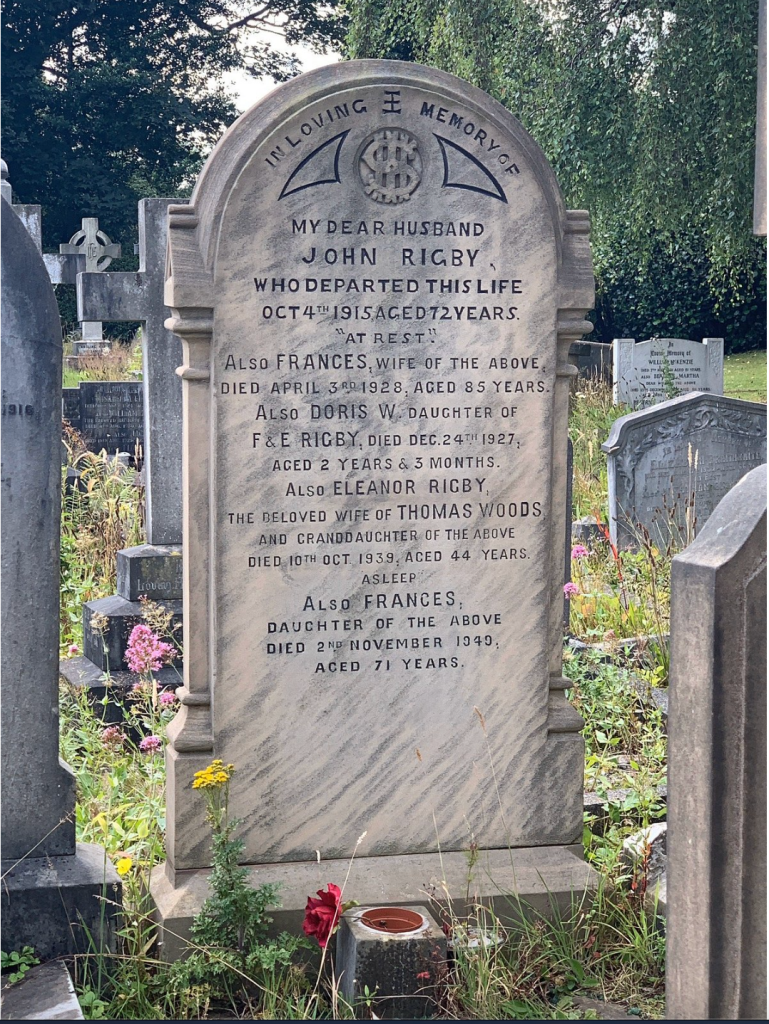
Paul has always insisted, and no doubt honestly believes, that he fabricated the name Eleanor Rigby out of pure imagination, thinking on the one hand about actress Eleanor Bron, who’d appeared in Help!, and on the other of the proprietor’s last name as displayed on the sign over a wine and spirits store he’d run across in Bristol. Yet nobody can get past the extraordinary coincidence, discovered many years later, of a name that appears near the bottom of a forlorn headstone, sitting in the graveyard located only a stone’s throw from the very spot where John and Paul first met on the afternoon of July 6, 1957:
Golden Slumbers / Carry That Weight / The End
And then the magic carpet ride was over. Nobody knew this was going to be the last hurrah, not out here among the listening public, at any rate, nor was there anything in the immaculately produced music of Abbey Road that hinted at the band’s demise. It was another step forward, like all their albums, vibrant, beautifully recorded, and full of tight ensemble playing. The Beatles had seemed fractured on the prior White Album; now they’d rekindled the spirit of their finest moments, and seemed to be revelling in what their combined talents could produce.
In retrospect, one can’t help but sense that they felt in their bones this was going to be it, and they wanted to go out in style.
So we arrive at the end of the Long Medley, with what has to stand as one of their finest and most magisterial moments, and one of their most philosophically beautiful, too. Once there was a way to get back homeward, begins Paul over his mournful piano. The inspiration came from an Elizabethan Era poem by Thomas Dekker:
Golden slumbers kiss your eyes,
Smiles awake you when you rise;
Sleep, pretty wantons, do not cry,
And I will sing a lullaby,
Rock them, rock them, lullaby.
The lyrics track the poem fairly closely, except, tellingly, the sentiments about losing the way home, and then being left to carry that weight for a long time, were Paul’s own. Still just 27 years old, he was now scaling to dizzying musical heights; did he know he would never be back there again? It’s hard not to discern a sad awareness of all that was soon to be lost in this wonderful little song suite, another remarkable pastiche of disparate styles (including the amazing “guitar duel” in which John, Paul and George take turns cranking out howling riffs on their respective instruments) that seems to have been written deliberately to serve as the capstone of an era – but who wants to exit crying? The great, beautiful music machine that was the Beatles was just about to be sent to the breakers and turned into scrap, but why weep, when instead there was still time to take her out for one last glorious spin? Better to leave on a high note, yes? Thus the howling electrical guitars vanish in a flash, to leave behind a single sweet note played on piano, over which is delivered a sort of benediction:
And in the end, the love you take
is equal to the love you make.
George supplies a beautiful ascending guitar line, beneath which the orchestra swells and lingers on one last gorgeous note for just long enough, and no longer, and it’s all over (listen to the 1:14 mark of the “mini-documentary” attached above, and you’ll hear the preferred take of that very note on the master tape, with Paul exclaiming “Keep that one! Mark it fab!”)
I’ll let musicologist Walter Everett have the last word [See Everett, The Beatles as Musicians, from Revolver to Anthology, beginning at location 5775 in the Kindle edition]:
While not an unusual theme for the Beatles, and certainly one of central importance to John Lennon, as in “The Word”, and “All You Need is Love”, it seems rewarding to hear this uplifting message as a very personal final gift from Paul to his mates, as well as from the Beatles to the world. ‘Tis true that a good play needs no epilogue, but McCartney’s ear for structural balance graces a fine medley with a better coda.
 the needlefish