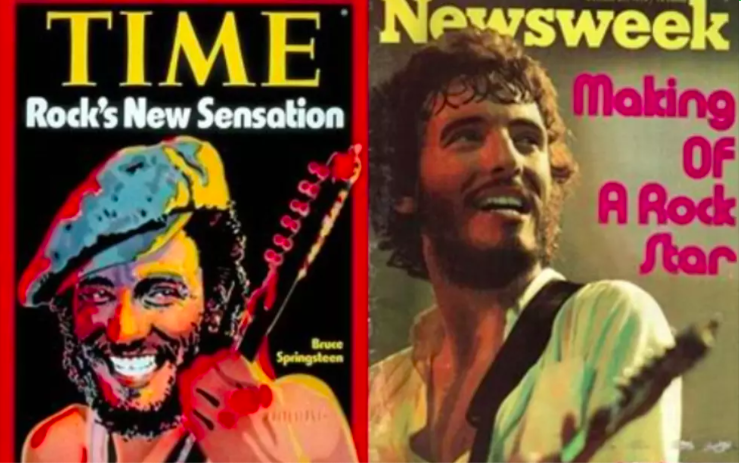
It was almost fifty years ago now, in August of 1975, when Springsteen released his epochal breakthrough album Born to Run. A couple of months later, on October 27, he was simultaneously on the covers of Time and Newsweek, a very, very big deal back in the day, and all of us immediately sat up and took notice. The hype, soon fully borne out, was that a fresh American voice, a tremendous new talent, had come to pull pop music out of its mid-Seventies doldrums and perhaps even save American rock ‘n roll. Well, I don’t know if Bruce actually saved rock, end of the day – a lot of the time it’s seemed beyond salvation – but he sure as hell tried, and indeed he’s still trying.
Over a long career he’s been consistently great, consistently thoughtful, spinning out archetypal American vignettes, often using autos, the quintessentially totemistic American machines that used to come out of Detroit, as metaphor, in songs by turns monumental and quietly, mournfully intimate. He’s certainly produced a mountain of estimable output since 1975, yet this listener, at least, finds himself drawn back repeatedly to Born to Run, the songs of which certainly weren’t like anything else being played on AM radio at the time, featuring compositions typified by almost cinematic storytelling, infused with an unusual street-level brand of eloquence. The best of them weren’t necessarily even that radio-friendly; they demanded undivided attention, particularly to the lyrics, and came that close to being bombastic and off-puttingly over the top. Yet coming from Bruce, they weren’t off-putting, but instead felt as authentic as they were passionate, focused as they were upon the hopes and often broken dreams of decidedly regular people slogging their way through the rocky terrain of a world that wasn’t at all like the vision of the American Dream that had long been sold to the common folk. These songs were gritty, urban, disillusioned, and sometimes angry, or at least bitterly aware of the realities facing those born into no particular privilege. They were often almost the sonic equivalent of film noir, and so frigging dramatic as to verge on operatic, as perhaps best exemplified by Born to Run’s title track, and the album opener, Thunder Road, my own favourite, and a powerful distillation of themes he’d be pursuing for the rest of his artistic life. I swear, from the opening lines what you’re hearing isn’t so much a song as the soundtrack to an old-school black-and-white movie that begins playing in your head, you can see it, like something shot in retro style by Spielberg, or maybe decades earlier by Elia Kazan:
The screen door slams, Mary’s dress sways
Like a vision, she dances across the porch as the radio plays
Roy Orbison singing for the lonely
Hey, that’s me, and I want you only
Don’t turn me home again
I just can’t face myself alone again
That could have been Brando talking to Eva Marie Saint. This guy wants to be somebody.
The lyrical nod to Roy Orbison’s Only the Lonely is, one can rest assured, more than just a convenient way to craft rhyming verse with the proper meter. Orbison was plainly a key influence on Springsteen’s early compositional style, not just in his embrace of intense emotionalism – an Orbison hallmark – but in the way his songs are structured. Thunder Road doesn’t hew to the convention followed by about 90 – 95% of popular songs, which tend to proceed along the lines of verse-verse-chorus-verse-chorus, or “A-A-B-A-B”, often with a middle section, thus “A-A-B-A-B-C-A-B”, as the musical theorists would have it; Thunder Road doesn’t have a chorus at all, and only arguably has a bridge, or “middle eight” (the part that begins “well I got this guitar and I learned how to make it talk”, which some wouldn’t characterize as a bridge at all). Instead it builds verse upon verse, with successive variations, in a progression that sounds, to my ears anyway, more like A-A-B-C-D-E-C, while working towards its stirring conclusion. As I discovered while doing the usual background reading for this post, you’ll hear the same sort of thing in a number of Orbison’s biggest hits. Oh, Pretty Woman, for example, likewise has no chorus at all, and is structured A-A-B-C-A-D, while Crying has been described as proceeding A-B-C-D-E-F-G-A-B-C-D-E-F-H:
It’s this sort of departure from the norm, which the listener may barely perceive except sub-consciously, that helps create a sense of mounting energy and tension, until finally the thing comes to an immensely satisfying climax, augmented mightily by the typically deft and powerful saxophone outro from “Big Man” Clarence Clemons. By that point you pretty much want to stand and cheer, while exhorting young Mary (who maybe isn’t quite so young anymore) to go on, stop wasting time and get in the man’s car. This could be your last chance to break on out of this dump and get somewhere, Mary! For God’s sake, girl, take it! Go!
It’s not every songwriter that can get you going like that. Bruce always could, and still does it all the time, yet after all these years, and everything he’s since achieved, I’m still prepared to hear arguments that this bracing kick in the pants from 1975 remains the greatest song in his remarkably varied and accomplished repertoire.
 the needlefish
Graeme, glad you picked up on “Mary’s dress sways” and not “Mary’s dress waves” Waves was the word printed on the lyrics on the album liner. Apparently, it was a an error. Bruce has confirmed this many times. Not that “waves” makes any real difference in the song overall, but we must go with what the writer wrote.
LikeLike
Thunder Road is, for me, the perfect rock and roll song. That triumphant outro amps me up every time.
LikeLike
Dear Needlefish,
I don’t want to be so flippant to address you by your first name, as we haven’t had the pleasure of meeting in real life … yet. Your latest blog entry definitely resonates with me, as I grew up, although not contemporaneously with the release of the song you analyze, with “Thunder Road” and the poetry of Bruce Springsteen.
First and foremost, I completely agree with you, so my comment is meant as a contribution and complement to your analysis, rather than a counterpoint. The theme and its development are not entirely original. The idea of leaving one’s nowhere place to seek a greater, better destiny has been central to much storytelling since the days of French troubadours or medieval Italian minstrels, often about leaving one’s small town for something bigger, to pursue personal ambition. More recently, on both sides of the Atlantic, we can cite examples like those by Eric Burdon and The Animals from Newcastle. Songs like “We Gotta Get Out of This Place” and “It’s My Life” paved the way – ad admitted by Bruce himself – for what “Thunder Road” would later embody. On this side of the Atlantic, “Johnny B. Goode” tackles the same theme, musically and melodically differently, but still about leaving the small log cabin for the bright lights and big city, with one’s own name on a billboard.
All these songs have been successful because they speak to this innate human desire to aspire towards something greater. The entire “Born to Run” album is constructed in this cinematic way, like “Thunder Road,” evoking the 1950s world of possibility post-war. The title alone, referencing the Robert Mitchum film, sets this tone. “Born to Run” frames the album with great tracks like “Backstreets,” “Jungleland,” and, of course, the title track “Born to Run,” which is a continuation of the themes in “Thunder Road,” I believe.
Your analysis brought all these reflections to mind, and I am grateful for that. To complement what you’ve written, I’d like to share a video on your blog, recorded by me and my brother in 1997 in Naples. Bruce Springsteen, as many know, is 50% Neapolitan, 25% Irish, and 25% Dutch. During the “The Ghost of Tom Joad” tour, he stepped out onto the balcony of Naples’ historical theater and directed his fans through a rendition of “O Sole Mio,” followed by his own impromptu performance of “Thunder Road,” the very song you analyzed here:
https://youtu.be/KsQcmfghM70?si=1R3EEScD55PdEt8a
This video is very dear to me and my brother because it has traveled the world. There isn’t another like it. We prepared for that evening, filming some songs in the theater stealthily. My brother, in the heat of May, wore a heavy leather coat to cover a bulky ’90s camcorder. We still have those microcassette tapes somewhere, but a friend digitized it, making it public. You can even hear my voice telling my brother “no” as Bruce threw the harmonica, which landed a few meters from us, but we were too focused on the camera to grab it, so someone else did.
It’s been a pleasure contributing to your blog for the first time, which I’ve been enjoying for several months.
Best regards,
Francesco
LikeLike
Happy to post your video,Francesco. Thanks for your thoughtful comments.
LikeLike