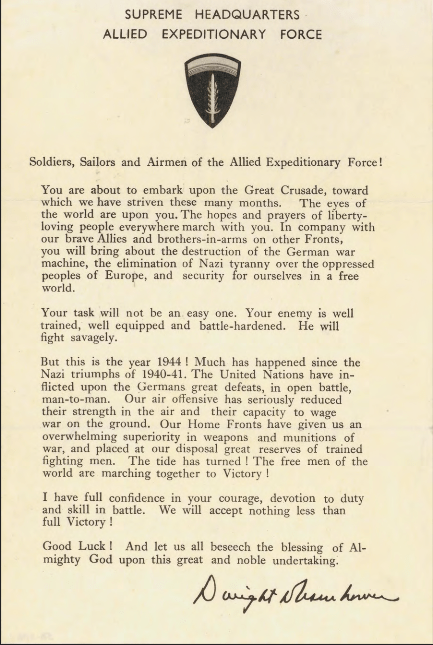
I can barely find the words. It’s been eighty years. Eight entire decades since D-Day, and a couple of years longer since a great nation led by giants, men like Roosevelt, Marshall, Eisenhower, Nimitz – men who commanded the loyalty of gifted subordinates like Spruance, Quesada, Doolittle, Spaatz, Bradley, giants in their own right, and so many others who had both the competence and the courage to take on burdens of command we mortals will never understand – assumed the mantle of leading the entire democratic world in what was indeed a Great Crusade spanning two vast oceans, fulfilling, along the way, Churchill’s confident prophecy that in God’s good time, the New World, with all its power and might, would come to the rescue and the liberation of the Old.
Now look at what’s happening, if you can bear to. The President of the United States is only just barely able to persuade Congress to send arms to a little democracy struggling to survive an unprovoked war of aggression with a totalitarian geopolitical arch-rival of the West. The next President may well be a felonious buffoon who sides with the enemy, and abandons our allies to their fates. In Europe, the nations that America helped liberate from Nazi tyranny are watching Putin’s assault on Ukraine, following closely the insane debate within the United States about whether anything ought to be done about it, taking note of the revival of isolationist posturing and “America First” rhetoric – a slogan coined in the 1930s by Nazi sympathizers who wished to keep America out of the war – and thinking about Anschluss, the Sudetenland, Munich, Czechoslovakia, and the years’ worth of leeway granted to Hitler to murder and subjugate whomever he pleased, before anything was done to stop him. Are we headed down that miserable road again? Is that really where we’ve arrived, after little more than a single human lifespan?
Imagine being in Churchill’s position today.
In those dark days of 1940, many around the Prime Minister saw the situation as hopeless, and urged some sort of peace agreement with the Nazis, even if it involved humiliating capitulation, because what was the alternative? The Germans had steamrolled France, a great power, with what seemed to have been contemptuous ease. The entire British Expeditionary Force, the bulk of Britain’s army, had only just managed to escape back across the Channel from the beaches at Dunkirk, leaving their equipment behind. England would be next. Everybody knew it, or thought they did (few would have believed how ill-prepared the Germans actually were for any sort of cross-Channel amphibious invasion of the British isles). Yet, as I’m sure the reader well knows, Churchill wouldn’t have it. He put his faith in the Royal Navy, the Royal Air Force, the overseas Commonwealth, and, above all, the United States. America wasn’t politically ready, then, to get into the fight, but the British already had America’s extensive logistical and material support, via programs like the Lend-Lease organized by Roosevelt, as the Americans geared up to become, in FDR’s turn of phrase, “the arsenal of democracy”. Churchill knew in his bones that sooner or later, America would feel the geopolitical imperative to put boots on the ground, if not compelled by force of events, then purely on principle. Winston may never have actually said that “the United States can always be counted upon to do the right thing, after exhausting all the alternatives”, as is so often claimed, but that’s pretty much what he believed. It would happen. Deliverance would come. Britain just had to hang on.
He could never have placed such faith in the America of 2024. Not even if it’s Biden in the White House instead of Trump, going forward.
I’m not even confident that the America of 2024 and beyond could come to the rescue if it wanted to.
Lately, I’ve been following the effort of the US Navy to build a pier in the sea just off the Gaza strip, so that ships could then be used to bring in humanitarian relief that can’t get past the Israeli blockade of existing land routes of supply. After several months of work on what was dubbed, with the Pentagon’s typical passion for asinine project acronyms, the JLOTS (Joint Logistics Over-The-Shore facility) – hey fellas, it’s just a place to offload a ship, right, how about the “Gaza Pier”? – and the expenditure of about 230 million dollars, they cobbled together a preposterous floating contraption that lasted about two weeks before it broke apart in moderately heavy seas. No fooling:
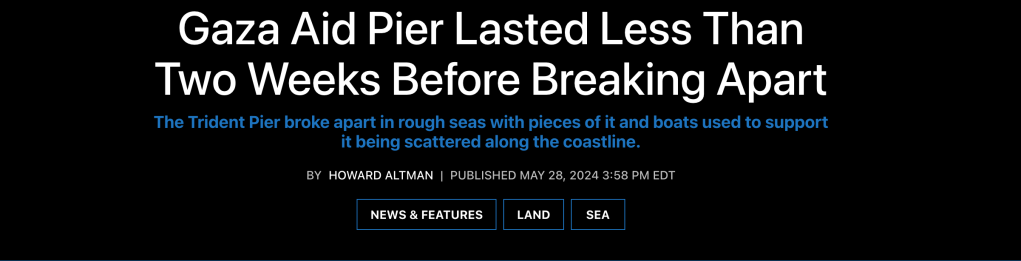
They’ll put it back together, but come on. Time was, they knew better how to go about such projects. I’m reminded of that especially today, because D-Day as conducted wouldn’t have been possible if the military couldn’t have done anything better in 1944 than cooper together the ridiculous JLOTS. You see, the beaches at Normandy, just like those of Gaza, had no harbour or port facilities. This was, in fact, a large part of why Normandy was chosen as the invasion site; the beaches were navigable, but it wasn’t really a suitable place to land an entire army, and that made it the perfect spot for an onslaught that the enemy knew was coming. The Germans would never expect the Allies to take the long way around, just to hit a beach that didn’t have the necessary infrastructure to supply the invasion force, not when they could make a much shorter and eminently more logical hop across the Channel to Calais. The way the Germans saw things, looking at the map, Calais was the obvious and most sensible choice, and after all, they figured, that’s where we’d be coming if we had our wits about us.
The strength of this belief was our ace in the hole. In the run-up to the invasion, we did everything we could to convince the Germans that we had indeed settled upon the obvious choice, to the point of manufacturing a fake military organization with bogus signal traffic, a phoney command headquarters structure with fictional staff, and whole armoured divisions of inflatable fake vehicles, parked just where we’d put them if Calais was the objective. The Germans swallowed it, hook, line, and sinker. So convinced were they that Calais was the true objective that when the first reports of the landings at Normandy began to reach the High Command, it was reckoned this was just a diversionary feint as a prelude to the main assault, with hugely important effects upon the deployment of German defensive forces. It had been a masterstroke of deception, but the flip-side was that the enormous Allied invasion fleet had to land an entire army at a place that was in no way suited to serve as the bridgehead for such a massive military operation.
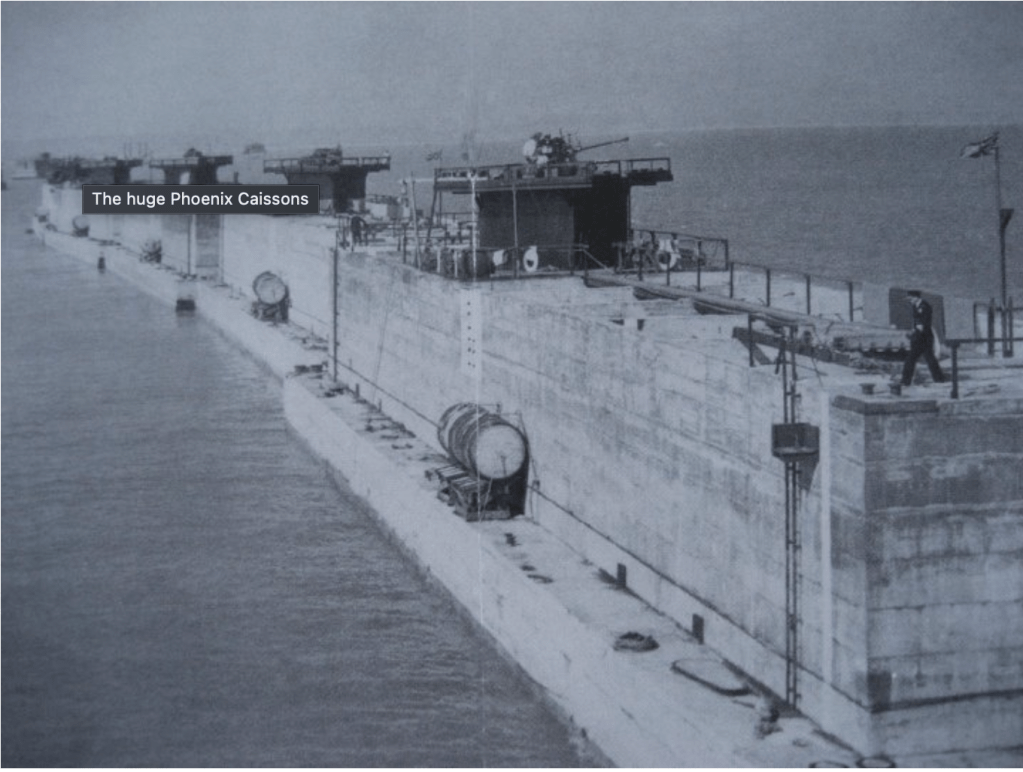
So, they brought an artificial harbour with them, in pieces, like some sort of giant Lego kit, and assembled suitable port facilities on the spot, using, among other things, enormous floating concrete caissons that were towed in from England and sunk on site. These created extensive breakwaters within which the transport vessels could berth, while off-loading materiel to vehicles traversing roadways built on top of floating barge piers, and other pier facilities that were likewise assembled like kits from pre-fabricated modules.
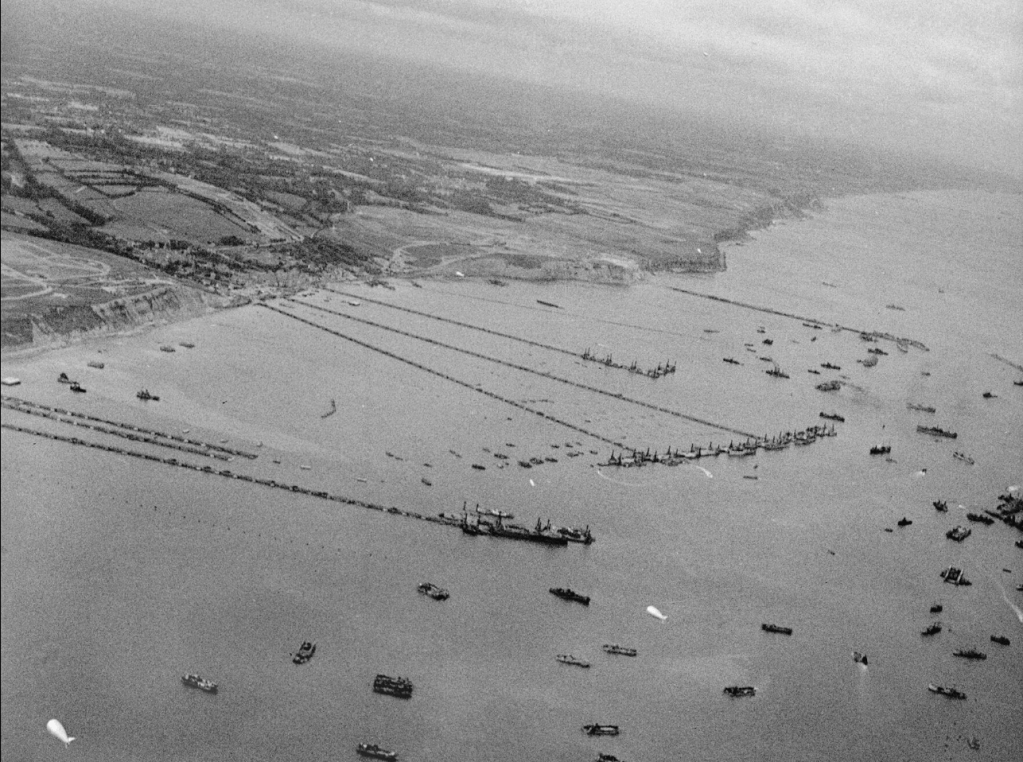
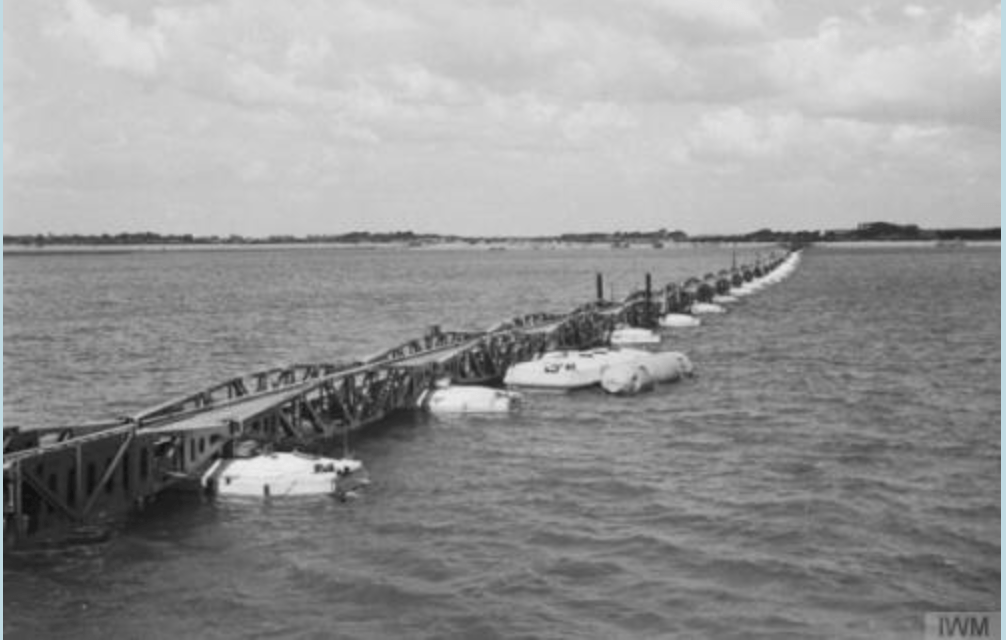
No harbour or port facilities? No problem. We’ll bring those along with us. If you’ve any interest in comprehending the enormity of just this one aspect of the invasion, codenamed, incidentally, “Mulberry”, this is an excellent little resource:
https://www.combinedops.com/Mulberry%20Harbours.htm
Here’s an excerpt to give you just a flavour of it, if you’re among the burgeoning “TL;DR” set:
For security reasons, randomly selected codes were used to describe the various components of the two Mulberry Harbours viz…
Breakwaters
Bombardons – floating breakwaters, comprising huge, metal, crucifix shaped structures ballasted and firmly anchored in place. They were the outermost barrier and, therefore, the first line of defence against rough seas.
Phoenixes – 146 concrete caissons, 60 metres long, 18 metres high and 15 metres wide, making up 9.5 kilometres of the breakwater. They were airtight, floating cases open at the bottom with air-cocks to lower them to the sea-bed in a controlled fashion. Around 2 million tons of steel and concrete were used in their construction.
And that ain’t the half of it. It was an incredible feat of organization, engineering and logistics.
Meanwhile literally thousands of ships teemed over the water, protected by literally thousands of tactical fighter aircraft, while Hitler’s Luftwaffe, depleted and starved of fuel after months of being shot down, strafed, and generally ripped to shreds by Allied air power, was nowhere to be seen. That first day, 130,000 troops were landed. No, I didn’t add an extra zero – one hundred and thirty thousand men were put ashore in one day with all they needed to fight forward into the teeth of Nazi forces, a little less than half of them American, and the balance British and Canadian. Another 24,000 or so were dropped in from the air just in advance of the invasion fleet, some as paratroopers, and some coming in on gliders towed across the channel by C-47s. It didn’t all go off without a hitch, of course, the airdrops often went awry, and it was tough going on Omaha beach, but can you even begin to imagine the organizational prowess necessary to plan all that, and actually pull most of it off? Yeah, me neither. Listen, I can’t even imagine pulling off an operation of that size and complexity in peacetime, to achieve some peaceful objective, let alone figuring out how to accomplish anything comparable knowing that tens of thousands of enemy soldiers will be doing their utmost to blow everything all to hell when things are set in motion. It’d be like putting on the Summer Olympics and a World’s Fair while managing all of the air traffic over U.S. Thanksgiving weekend, with the added complication of incoming artillery at the opening ceremonies, and even that doesn’t really do it justice.
Bear in mind, while all this was going on, the United States was fighting a whole other war in the Pacific, a vast theatre of operations in which they were pushing back the Imperial Japanese one island at a time, in one bloody fight after another, employing almost unbelievably massive and sophisticated air and naval forces. In less than a year after D-Day, on April 1, 1945, the operation to invade the first of the Japanese home islands, Okinawa, would by some measures surpass even D-Day, landing 180,000 troops (though not as quickly; D-Day’s airborne/amphibious insertion of over 150,000 combat personnel into a war zone in less than 24 hours remains unsurpassed).
Now they can’t seem to muster up one lousy pier off Gaza.
The remnants of the Mulberry harbours and associated port facilities are still there, strewn on and about the beaches of Normandy, derelict now, but imposing reminders of what our civilization was once able to do, as well as of the sheer, unadulterated righteousness of having done it.
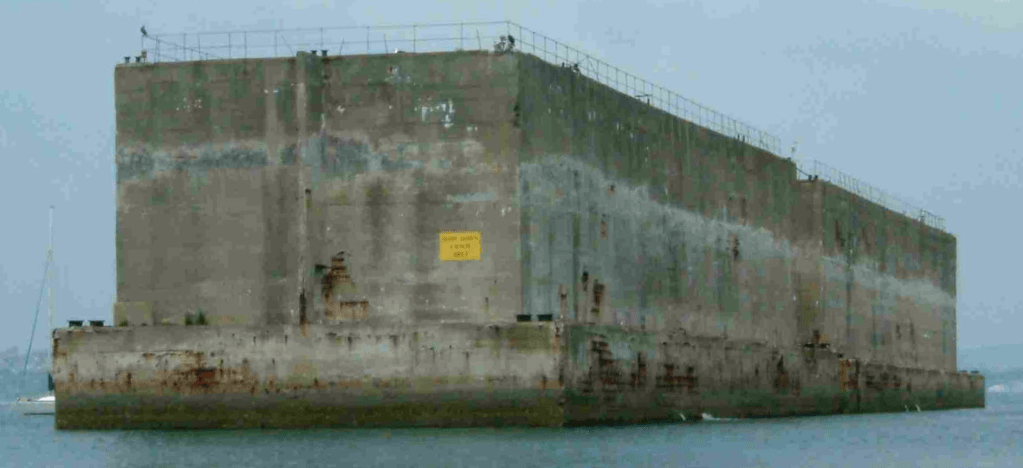
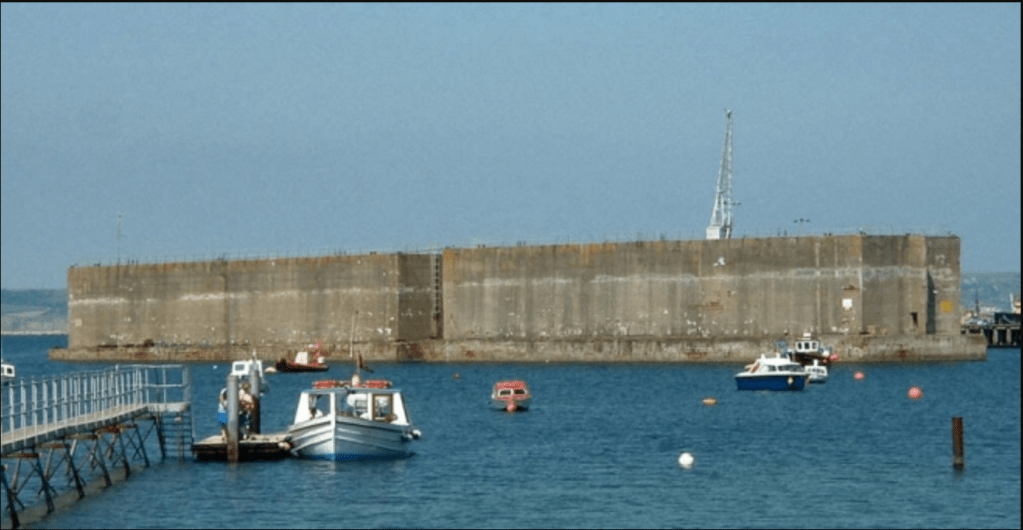
As the dignitaries gather today, and the usual speeches are made, you may catch a glimpse of them in the background. There was a time when the images of these mammoth constructions, still holding up against the sea after all these decades, filled me with a warm sense of confidence. I had faith, in our collective absorption of the hard lessons we’d surely never forget, in the powerful, American-led alliance that still stood firm against any repeat of the aggression that made D-Day necessary, and in the lengths to which we were manifestly able and willing to go to defeat any tyrant foolish enough to repeat Hitler’s grave mistakes. Now the sight of them just makes me sad. They seem like the crumbling monuments of a fallen empire. That was us – once. Not any more. The lessons were forgotten, just when it’s starting to look as if we might again have to face the sort of challenges that were met so bravely on June 6, 1944. I don’t know that we have it in us anymore. I’m afraid that we’re soon to be tested, and that we’re going to stumble towards the crisis, full of denial, unheedful of the things we once understood from history, unprepared, and thus both unwilling and unable to save ourselves.
Honestly, I don’t know what to make of it. I can’t grasp it. I never thought I’d see fascism resurgent; I never would have believed there’d again be an isolationist movement in the U.S., chanting chowder-headed slogans like “America First”; I never could have imagined that one of America’s two political factions, the erstwhile party of patriotism and national security, would be playing footsie with foreign tyrants, hoping to emulate their authoritarian ways back home; I’d have rejected outright the obviously nutty suggestion that there’d be any goddamned debate about whether Ukraine should be rescued from Putin’s invading rabble of brigands and war criminals. Yet here we are, on what’s turned out to be a sad and fretful eightieth anniversary of D-Day, and I’m at a loss.
I think about the Mulberrys, and the Herculean accomplishments of the Allied forces on D-Day, as led by an American General who had the full respect and confidence of the British and Canadians who put their lives on the line that day in June, and I can’t help but ask myself: in the long run, was it all for nothing?

