I was watching a podcast the other day in which the Bulwark’s Tim Miller, a wonderful guy, was interviewing crusty old arch-conservative George Will, whose politics I’ve generally abhorred over the years, but whose philosophy of government, rooted in the traditional, genuinely conservative values of days gone by (having nothing whatever to do with the radical right-wing authoritarianism of the thugs and grifters who’ve lately appropriated the “conservative” label), seems now to inhabit the sane, sunny middle of the political road. George is fundamentally misguided on a number of important matters, but he’s not without his share of smarts, and he was persuasive about something I’ve been hearing elsewhere, but haven’t previously mustered up the nerve to think too much about: that what we’re seeing on the global geopolitical stage is highly reminiscent of the events that eventually coalesced into the Second World War, and that historians of the future (if any) may well point to the present era as the beginning of the Third.
“Americans”, said George, “tend to believe that World War II began with the bombing of Pearl Harbour in 1941, while the better educated understand that at that point the war had already been raging since September 1939, officially, but really it all started much earlier”. There was Germany’s annexation of Austria and the Czechoslovakian Sudetenland, in 1938, and before that there was the Italian subjugation of Ethiopia in 1935-36, and the Japanese invasion of China in 1937, which was an extension of an imperial campaign that started with Japan’s occupation of Manchuria back in 1931. Really, then, the war had been progressing across several fronts for many years before Hitler’s invasion of Poland finally drew the French and the British into the conflict against Germany. Similarly, as Will saw it, it would probably be the consensus view one day that the Third World War kicked off with Russia’s annexation of Crimea in 2014.
Unfortunately, I know enough about history and geopolitics to appreciate the logic of his position.
Suddenly, the world is full of wars of aggression, long-simmering struggles boiling over into something approaching full-scale conflict between nation-states and their assorted non-state proxies, and various flashpoints where long-feared explosions now seem frighteningly close to being triggered. Look at the Middle East, where Israel’s massive attacks on both Gaza and Lebanon have sparked off a series of exchanges with Iran and its Houthi proxies in Yemen, threatening to pull in the United States. At present, after unleashing two massive missile strikes upon military and civilian targets within Israel, a breathtaking escalation that drew U.S. air and naval forces directly into the fray, Iran is licking its wounds following a highly destructive (and typically effective) retaliatory Israeli air strike against Iranian air defence assets, which sent an emphatic signal that Iran has no hope of resisting much more devastating air attacks whenever it suits Israel to launch them. More to come, probably, on that front. American and allied NATO warships continue to patrol the Red Sea, as the Houthis, eager as ever to act at Iran’s behest, have been lobbing anti-ship missiles at the vital commercial traffic entering and exiting the Suez Canal. Syria has been plunged back into the throes of full scale civil war, with the sudden success of an army of rebels run by unsavoury types identified by various governments as terrorists, but backed by Turkey (which has several dogs in the fight) as well as other groups receiving the backing of the U.S. The anti-regime forces seem to be winning at the moment, something that the Russians, who’ve been propping up Syria’s Assad regime for years, in large part because they covet continued access to the airfields, Mediterranean naval ports, and logistical hubs that Assad allows them use, would feel obliged to resist militarily, if only they could.
Of course, military intervention in Syria won’t be as easy as it was in years prior, as Russia finds itself fully engaged in its ruinous “special military operation” in Ukraine, a campaign that’s incurred perhaps 750,000 casualties so far (ye gods!), a staggering total which still, somehow, hasn’t been enough to beat back Putin’s invading rabble of looters, rapists and murderers. Now, drawing upon direct military assistance from North Korea, including not just arms and ammunition but also an infusion of North Korean infantry at division strength, Putin’s armies are continuing a relentless attrition campaign that seems to be succeeding, slowly, despite an estimated cost of about 1,500 – 2,000 Russian and North Korean casualties every single day. Meanwhile, the expansion of the effort to include troops drawn from Communist East Asia has prompted the Biden administration to lift restrictions on the Ukrainians’ use of short range ballistic missiles against targets within Russia proper (as opposed to Russian-occupied Ukrainian territory) – the British and French immediately followed suit by likewise lifting restrictions on the employment of the medium range cruise missiles they’ve been supplying to the Ukrainians – a move which enraged Putin to the point of throwing this alarming ballistic missile tantrum in response:
It’s a terrifying thing to see, and was meant to be; those are multiple independent re-entry vehicles slamming into the Ukrainian city of Dnipro, flung there by an intermediate range ballistic missile designed for nuclear warfare. This was the first ever use of this class of weapon in combat. The warheads in this instance were inert, solid blocks of something like steel-reinforced concrete, which nevertheless wreaked havoc via the sheer kinetic energy of thundering in from the upper atmosphere at something over 15,000 MPH. The weapon used, a version of the RS-26, is a new missile with a range sufficient to strike targets throughout Western Europe, and the message was clear: this time it was inert warheads, but next time maybe not, and maybe not just in Ukraine.
NATO, of course, cannot possibly back down in the face of such threats, and from a strategic military standpoint the Western alliance can’t permit Russia to win this war, either, since Putin’s next move if he prevails – an assault on the former Soviet vassal states of Latvia, Lithuania and Estonia, all NATO members – seems all but pre-ordained. He might have to rebuild his shattered military for a while, and only God knows what the incoming Trump administration will be doing to facilitate or (God willing) impede Putin’s predatory ambitions in the years to come, but if he wins in Ukraine, Vlad seems bound to take a run at the Baltic states just as soon as he’s able.** Even if the U.S. under Donald hangs NATO out to dry, the EU powers, led by the French, Germans, British, and Poles, would have to rouse themselves to resist. Understanding this, it may to them seem sensible, even necessary, to stop Putin in Ukraine before it can ever come to that. France’s Macron has already suggested as much, and the Poles, who’ve been building a hugely capable military, are said to be champing at the bit. It’s entirely possible, then, that Western European armies could soon be going at it hammer and tongs with the Russians and North Koreans in eastern Ukraine, and where that leads, well, I’d say it doesn’t bear thinking about, except, God help me, here I am doing so.
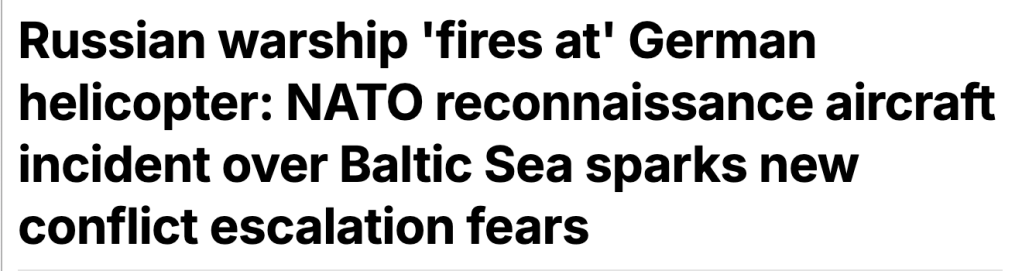
Against this backdrop, the potential spread of conflict into the Baltic, now virtually a NATO lake with the inclusion of Sweden and Finland in the alliance (another derangement factor for Putin), is thoroughly unnerving. We suspect that the Russians, perhaps with Chinese help, mean to embark on a campaign to cut undersea fibre-optic cables in the region – the Chinese, we think, have already done so at least once – a gambit that may feel to them like a step short of open war, but one that could cause profound and intolerable strategic and economic disruptions (the global economy’s reliance on these undersea communications networks is an extreme vulnerability about which few in the lay public have even the smallest understanding). If they get away with it now, this program of sabotage could spread well beyond the Baltic, and there’s so much at stake that a line simply has to be drawn. That’s why NATO assets are now engaged in heightened surveillance, in response to which the Russians have been firing warning shots. If they continue to harass our patrols in international air space, the better to persist in cutting vital undersea telecommunications cables, well…
So, now we’ve got all of Europe and the Middle East either burning already or well and truly primed to go up in flames, and meanwhile, half a world away, the Chinese are watching how the Russians fare and, no doubt, continually recalculating their odds of a successful invasion of Taiwan. This is a longstanding ambition of the Chinese Communist Party, which seems to have been elevated to the level of existential necessity in the thinking of President Xi Jinping, an increasingly absolute dictator increasingly isolated from the advice of anyone not inclined to tell him what he wants to hear. Xi’s obsession with the conquest of the “renegade province” off shore is intensifying at a delicate time for China, which is in severe economic trouble and will soon be suffering the effects of an enervating demographic decline, one of the most severe in history, a legacy of China’s ruinous “one child” policy, which was abandoned too late to stave off what looks to be a coming crisis of population collapse. Given the trends, China may never again be as powerful as it is right now, and if Xi wants to conquer Taiwan, the window of opportunity may be closing. He might just decide that it’s now or never, and from what I can glean from reading the open source intelligence from my chair here in Toronto, it looks like “never” isn’t really on the menu.
Even worse, Xi might figure that as long as he’s taking the plunge, he might just as well take the steps necessary to complete what has thus far been a slow-motion, and entirely illegal, annexation of the international waters of the South China Sea, right up to the fictitious “Nine Dash Line” for which the Chinese Communists have cited risibly specious historic precedent. For years now, the Chinese have been building artificial islands on top of disputed reefs, claiming them as sovereign Chinese territories. From these, they purport to exercise sovereignty over the surrounding ocean, while harassing the vessels of other nations as they attempt to go about their lawful business in international waters. Armed Chinese Coast Guard vessels are even meddling within other nations’ territorial waters, as delineated under the UN Law of the Sea, further turning up the heat on yet another pot that’s been threatening to boil over for a long while, now. Again, Xi may conclude that if China’s really going to annex this huge swath of ocean, once and for all, it’s now or never.
Either move on China’s part, let alone both, ought, other things being equal, provoke an immediate superpower conflict with the United States. Apart from the general equities involved in a neo-fascist authoritarian state’s effort to conquer a peaceable democracy, Taiwan remains of the utmost strategic significance to Western economies, being the sole source of the most advanced integrated circuits which these days make the whole world go ’round (a vulnerability which Biden’s Chips and Science Act is meant to address over the medium-long term, if it survives the onslaught of Trump and Elon Musk, but will persist for many years yet). The South China Sea, meanwhile, contains the sea lanes over which something like three and a half to five trillion dollars worth of international trade flows annually, upwards of a trillion of that being American. If ever the U.S. was to stand up for the bedrock principle of freedom of navigation on the open seas, the launch of a military campaign to seize outright the South China Sea would seem to supply the moment.
Again, only God knows what the Trump administration will do to change America’s once immutable geopolitical priorities, or what Xi perceives of the Trump administration’s intentions in the Asia Pacific region. Should it seem that Donald means to abandon the defence of its Pacific allies, Xi may be emboldened to act, especially if the West falters in Ukraine. At the same time, if the American commitment to regional security and stability seems to be flagging, traditional allies, particularly South Korea and Japan, will surely find it necessary to bolster their own military strength, perhaps with destabilizing consequences. South Korea, while already armed to the teeth with conventional weapons, may see no alternative to the acquisition of its own nuclear capability, given the existing nuclear threat posed by the North, and the prospect of the withdrawal of the American nuclear umbrella. The development of an independent South Korean nuclear deterrent is likely to be viewed as provocative and highly threatening by the lunatic dictator in Pyongyang. Whether Japan, similarly threatened by North Korea, but also the only nation thus far to have suffered atomic attack, would have the stomach to likewise join the nuclear club is another question, but the strategic imperative may be irresistible in the absence of American support. It’s easy to imagine both North Korea and China becoming even more agitated as a consequence. At a minimum, if America ceases to be seen as a reliable ally, Japan will certainly continue, and probably accelerate, its program to increase its conventional capabilities, especially by bolstering its air and naval forces. Japan may also step up recent efforts to improve traditionally chilly relations with South Korea (the people of which are none too fond of the Japanese, for obvious historical reasons), a diplomatic rapprochement with the potential of creating a powerful regional alliance perhaps strong enough to push back against Chinese pressure. Sadly, the mere prospect of any of this might further convince Xi that the time for China to make its big move is now, before Japan can rise again as a major regional (and perhaps nuclear) power, a development which, again for obvious historical reasons, would be more than disquieting to anybody in Xi’s shoes, even somebody much more reasonable.
I could go on – I haven’t even mentioned, for example, Iran’s stake in the Syrian civil war, the recent constitutional crisis in South Korea, Russia’s ongoing program of sabotage, cyber-warfare, electoral interference, and even assassination plots throughout Western Europe, the persistent tension between China and India, or China’s possible designs on large swaths of Russia’s eastern territory (yes, really) – but you can see how the stars are aligning here. It’s easy to spin out almost infinite scenarios that end up in a general global conflagration involving the great powers in every corner of the planet, all of them occurring at a time when an unlikely clique of utterly unqualified clowns, morons, ideologues, grifters, and assorted criminals, possibly with a couple of outright Russian assets thrown in for good measure, stands poised to take control of the American foreign policy apparatus.
I can hardly bear to watch any more. It’s already been a hellish century, and now it bids fair to get a lot worse. We’re in trouble. We would be anyway, even if it was Harry Truman, George Marshall, and Dean Acheson taking the helm in Washington, but with the current crew, I just don’t know. It’s frightening. Trump brings nothing but chaos and instability to a volatile situation in which friends and enemies alike may feel confounded and uncertain in the face of erratic and irrational decision-making on the American side, which under the circumstances would be very, very dangerous. “Who knows what the crazy Americans are going to do?” is not the sort of question you want to be hearing at a time like this. The potential for catastrophic miscalculation, never trivial in such matters, has just risen exponentially, as has the prospect that a general American withdrawal from its global responsibilities will set off a chain reaction of moves and counter-moves that lead to general war.
Maybe then, when it’s too late, all the bone-headed “America First” isolationists will finally see how amazingly, stupidly wrong they’ve been to ignore all the painful lessons of history – though actually, I doubt it. These guys don’t learn. They don’t ever learn any damned thing at all.
+++++++++++++++++++++++++
**Trump may try to impose a treaty in which Russia keeps its present gains in return for a permanent end to hostilities, backed by security guarantees short of Ukrainian membership in NATO, but I don’t see how Ukraine could accept any such thing, knowing both that U.S. promises are hollow, and that the Russians would simply use it as an opportunity to pause and regroup before resuming the war.
 the needlefish
Good analysis! Do you ever play Europa Universalis or one of the Civilization games (new one coming out soon)? Might be a good way to de-stress.
LikeLike
Thanks. No, not much of a gamer I’m afraid.
LikeLike