In making this choice, I know I’m revealing myself, once and for all, to be a dyed-in-the-wool girl, but goddammit I love the 2005 iteration of Pride and Prejudice. It is, to my mind, an almost perfect film, with a wonderful cast, terrific performances, superb dialogue, absolutely sumptuous cinematography, and one of the best musical scores I’ve ever heard. Plus it’s just so frigging romantic, I mean, my God in Heaven.
This movie was plainly a labour of love for everyone involved.
My wife, I’m sure not intending to be a party pooper, feels that Mr. Darcy’s obsessive love interest, played by Keira Knightly, has “tragic hair”, something to do with stringy bangs, and thus seems unlikely to be the sort of girl to knock his or any guy’s socks off, but nope, can’t agree, I actually quite like her hair (I go all wobbly, frankly, for a girl with bangs), and I’m utterly besotted. There are those, too, who insist that Darcy, a man whose taste in the opposite sex would have been shaped by the standards of the era in which he lived, could never have had his mind blown by a woman with such a “boyish” physique – which, I gather, is a comment on Knightley’s bust line and general lack of body fat – but again, nope, and I don’t care what your ordinary male slob of the Regency Period was looking for in a woman, I’m convinced that any guy with his wits about him, which Darcy is portrayed to be, would have been just as enamoured of Keira’s character as I am, supposed ingrained cultural attitudes be damned.
You see, one look into Elizabeth Bennet’s dark brown eyes and you know what sort of intellect you’re dealing with, a mind that’s keen, wickedly quick, stuffed full of knowledge, and utterly impatient in the company of upper class twits. She‘ll suffer no fools, she’s a formidable challenge, and she’s fascinating, possessing an innate, easy ability to make you laugh, prompt you to see things in a way you’ve never considered, or, if it comes to that, cut you down to size. If you’re a guy with some brains of your own, she’s as intoxicating as she is intimidating. There’s commentary all over Reddit and other such internet shitholes that Knightley’s performance is “pouty”, and “angry”, which is preposterous, and just what you’d expect from a bunch of young guys presented with a woman more intelligent than them.
Buttheads.
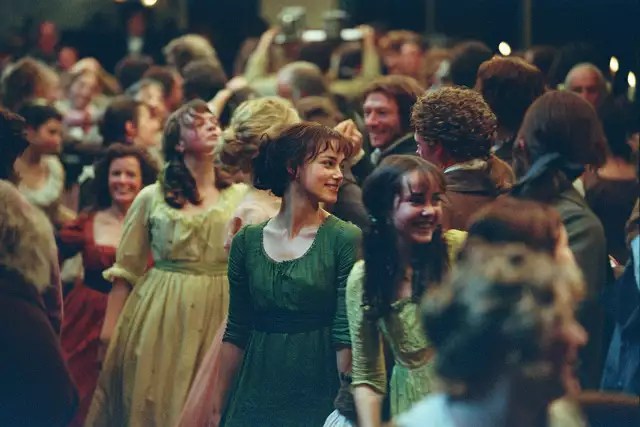
None of which has anything to do with why I’ve singled out this scene for the Needlefish Treatment. It’s not about the romance, and it’s not about the relative beauty of this or that actress. It’s not even about Knightley’s vastly entertaining banter with her sister, played by the exquisite Rosamund Pike, who tells her, as she casts a jaundiced eye at the hopeful male suitors present at the assembly, that “one of these days Lizzie, somebody will catch your eye, and then you’ll have to watch your tongue”. It really is beautiful and heart-warming, the loving relationship between these wonderful sisters. But that’s not it either.
It’s the music. It’s the whole idea of music, as we relate to it today, as opposed to how those in the early 19th century would have experienced it.
I remember watching one of those BBC documentaries featuring composer and musicologist Howard Goodall – who earned my undying love and loyalty by helming a show in which he asserted that the Beatles saved Western music at its most dire moment of mid-20th Century avant-garde crisis – in which he explained that back in the day, hardly anybody, even those who were relatively well to do, had access to any music beyond what could have been played on the standard upright piano sitting in the typical parlour. Before that, I’d never put two and two together, it seems such an alien idea, but think of it: if your favourite composition was, say, Beethoven’s Fifth Piano Concerto (and how would you, as an ordinary person, have ever heard such a composition in the first place?), you might, if you were sufficiently privileged and monied, get to hear it perhaps three or four times over the course of your entire life. There were no record players, no radio broadcasts, nothing but a limited supply of concert halls in which a limited number of upper class people could attend to hear whatever it was that somebody else had decided to put on the program. Living here, today, I can listen to Appalachian Spring, or Clair de Lune, or the New World Symphony, or any song I love, whether it was recorded yesterday or in 1930, any damned time I please, as often as I please, presented in high fidelity or more usually in glorious stereo, as mediated by speakers or headphones designed by audio engineers to make it all sound better than it would if I was listening to a live performance. Even we music lovers scarcely appreciate the miraculous privilege of that everyday capability.
So there they all are at the Meryton Assembly, with a live orchestra playing a delightfully lively piece composed to support one of the elaborate dances of the era, and everybody there is experiencing a magical moment of a sort they might not enjoy again for months, or years, or, for some of them, perhaps ever: orchestral music, in all its glory, no matter that it’s just a little orchestra, not like the enormous ones that performed symphonies which nobody there would ever get a chance to hear. What they’re dancing to at Meryton is an order of magnitude beyond anything they can coax out of the piano in the parlour. You can sense the sheer joy of it.
We’re thus granted, as we are generally, in myriad ways as the film plays out, unusual insight into how people once lived in a much different world, in this instance one in which what we think of today as routine entertainment, available at any time, literally anywhere we like, was a rare gift tied to rare occasions.
Whenever I watch this lovely, beautifully filmed scene, I’m reminded of how lucky we are to have access to the amenities of the 21st Century, with the whole world of human intellectual and artistic achievement at our fingertips, any time it suits us to call it up on any of our many systems and devices. We’ve grown too used to it, I think. We should savour it a little more, that, and a lot of other things beyond the scope of today’s post, which are even more amazing and important.


The pacing of this production differs significantly from the earlier versions. I found the character development much more detailed in this specific release.
LikeLike