Notice that nobody seems to be talking about the war in Ukraine these days? When was the last time you saw anything reported in the mainstream media?
I haven’t written much about the war these past few months either, partly because this sort of post doesn’t exactly draw readers like flies to the Needlefish, but more importantly because until recently there hasn’t really been anything new to say. All through 2025, and into the first half of 2026, the Russians have been almost literally beating their brains out in metronomic, maddeningly futile assaults up and down the front line, trying to make a breakthrough. By some estimates they’ve launched as many as 70,000 individual attacks of varying sizes, all the while hewing bone-headedly to their disastrous “meat grinder” tactics, and gaining mere tens of square kilometers for their trouble. It’s been described as a bloody stalemate, but there’s one distinction: by blunting the attacks, the Ukrainians, by inflicting terrible losses on Russian forces, have been slowly turning the tide through sheer attrition.
As the war grinds through its fifth year – five years to take just 20% of Ukraine, a percentage which hasn’t changed appreciably since 2023 – the Russians have begun to lose so many men, to so little result, that it’s a wonder their whole army hasn’t broken and fled the battlefield. They’re up to about 1,100 to 1,500 casualties a day, every day, killed or seriously wounded (the latter, generally, permanently out of the fight), or 32,000 to 35,000 per month. That’s pushing 400,000 per year, for an army that’s reckoned by Western analysts to have already suffered upwards of 1.3 million casualties, with anywhere from 320 to 500 thousand of those killed. To put that in perspective, that’s about six to eight times the total of US losses in Vietnam, and exceeds the sum of US casualties for the entire Second World War, on all fronts (though of course Soviet losses during the Great Patriotic War dwarfed all of these figures). That means Putin is now squandering his cannon fodder faster than he can recruit replacements, no matter how lavish the bonuses offered, and Vlad will soon be faced with the dilemma he’s plainly been desperate to avoid: whether to move to general mobilization and conscription. That would mean digging deep into the potentially restive urban populations of St. Petersburg and Moscow; he has no more prisons to empty, no more Chechens and rural dupes to sweep up, no more North Koreans, no more options. Vlad may dread the next obvious step, but if he wants to keep fighting, something drastic will need to be done. Even then, it might not be enough.
You see, while I wasn’t paying proper attention, the parameters of the war have changed. It’s no longer just that things are going abysmally at the front, where incremental Russian gains are now being offset by Ukrainian reconquest of similar increments of Russian-held territory. Increasingly, this war is being fought behind the front, at distances of hundreds and even thousands of kilometres, and it’s here that the fight might finally be decided. While Russia continues its illegal pounding of civilian targets, hoping to break Ukrainian resolve, Ukraine has embarked on a much more ambitious strategic campaign to undermine the Russian economy and starve Russia’s forces in the field, and it’s starting to look like Ukraine’s strategy is paying off. The momentum of the conflict is shifting.
It’s all on account of Ukraine’s growing ascendancy in drone warfare. On top of continual attacks on airfields, ammunition depots, military command centres and other such vital military targets, a campaign which has been wearing down Russian military capacity for years now, the Ukrainians are now prosecuting a two-pronged strategic offensive from the air, and it’s a magnificent thing to witness.
The first prong involves deep strikes against the most crucial economic assets of the Russian regime, its oil storage and refining facilities, which despite sanctions continue to supply the bulk of the funding for Putin’s war. Rather than attempt anymore to obtain both the weapons and the necessary permissions from Western suppliers – nobody but the Americans could provide what’s needed anyway, and Trump has shut down any hope there – the Ukrainians have developed their own, in the form of the highly formidable “Flamingo” missile, referred to as a “drone” in the media, but actually a long-ranged cruise missile roughly akin to the American Tomahawk. While far less sophisticated than its US equivalent, it’s bigger, has much longer range, (up to 3,000 Km) and packs a much heavier punch with its 1,150 Kg. warhead. It’s actually a rather crude device as these things go:
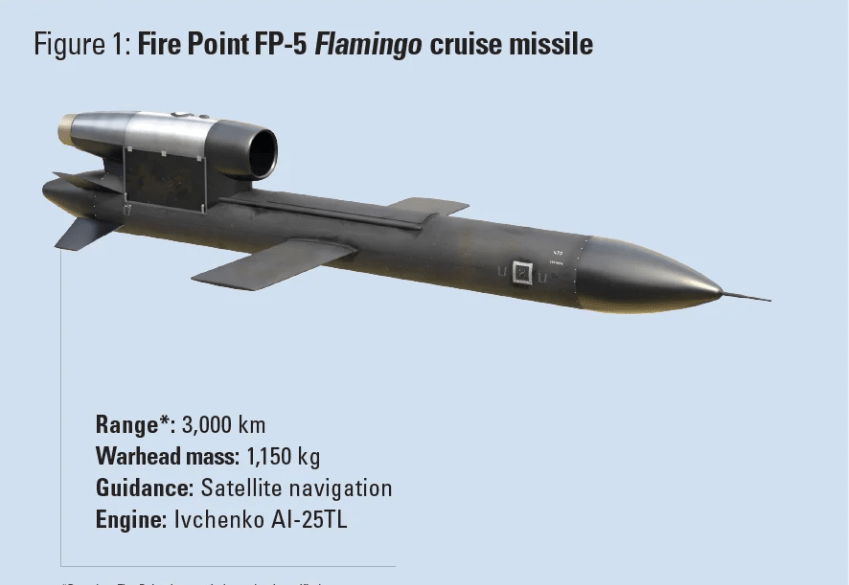
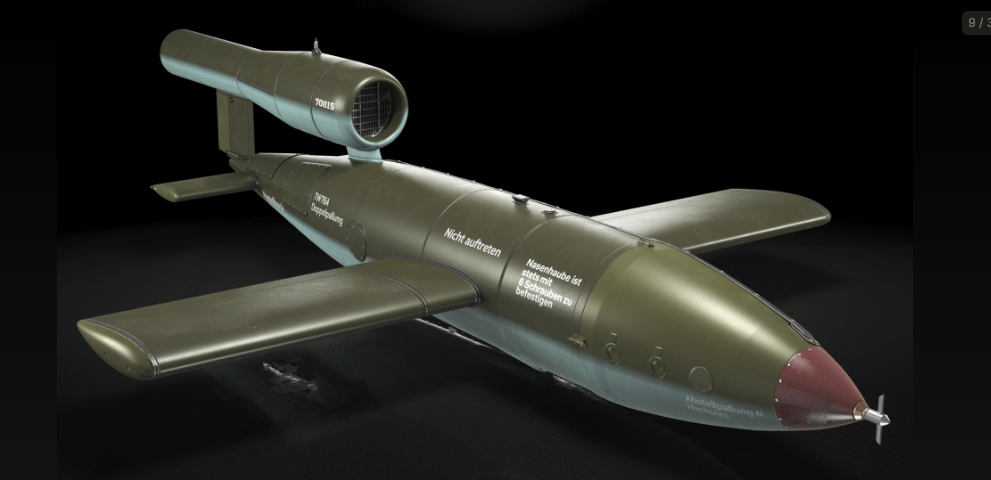
…and looks for all the world like the Nazi V-1 “buzz bomb” that the Germans began launching at Allied targets in the final years of WW II, though it’s much more effective and accurate, navigating by satellite.
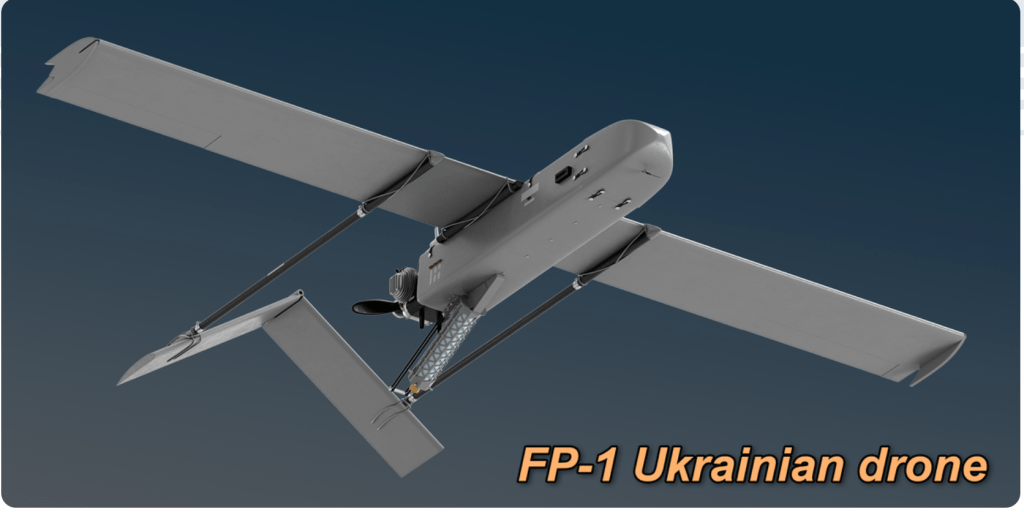
Another key weapon in the deep strike campaign is the FP-1, a simple, prop-driven aircraft with a relatively small warhead of 75 Kg – 120 Kg, and a range of about 1500 Km:
These poor man’s cruise missiles aren’t particularly stealthy, fly fairly low but don’t evade radars by terrain-following “nap-of-the-earth” navigation, and aren’t even particularly fast, yet Russian air defences seem unable to cope with them. No doubt many are shot down, but many get through, and a recent attack on an oil refinery near Moscow proved a particular embarrassment, when a large oil tank was detonated in spectacular fashion by the friendly fire of an anti-aircraft missile gone badly astray:
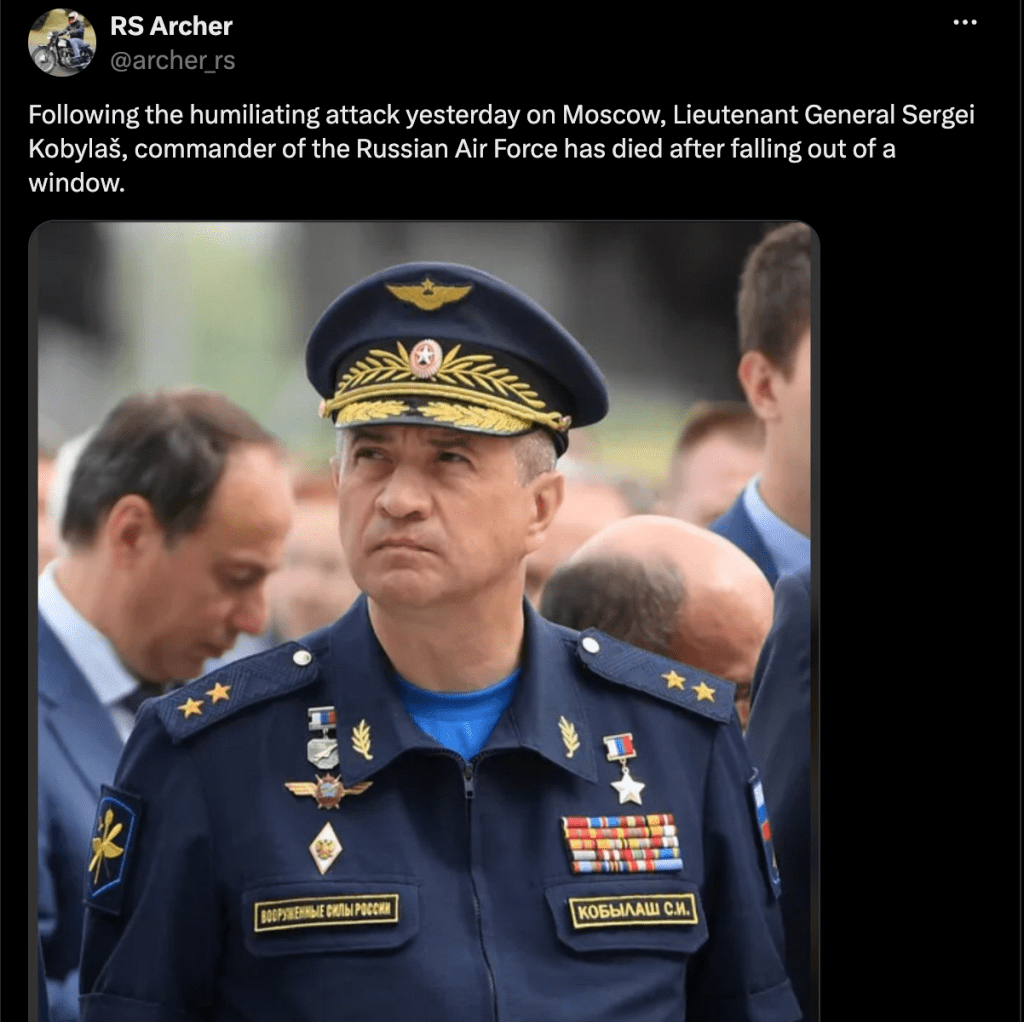
OOOOOOOOOPS. The next day, it was reported that the commander of the Russian Air Force had somehow fallen out of a window, as seems to happen to those in whom Vlad is very, very disappointed.
The campaign is starting to wreak serious havoc. Reports are all over the map as to exact percentage losses in refining and production figures, but there’s no doubt the damage is significant and increasing, and while the Russians scramble to make repairs and leverage unused capacity, wave upon wave of drones keep striking and then re-striking their targets, thwarting all efforts to bounce back. It seems clear at this point that Putin’s forces are incapable of doing anything about it. They’re throwing everything they have at the incoming swarms of attackers, and still, enough get through to keep grinding down Russia’s fuel capacity. It’s not a full-blown national crisis yet, but Western analysts think it’s getting close, and that Putin may soon have to resort to gas rationing and the like to keep his forces supplied.
Which brings us to the second, and perhaps even more effective prong of Ukraine’s campaign: medium range drones, some flown remotely, some, apparently, guided by AI, are achieving what the Ukrainians have dubbed “logistical lockdown” of Russian military units, their term for what Western strategists call “isolating the battlefield”. The technique, perfected as long ago as 1944 by U.S. Air Force General Pete Queseda in the European theatre, employs tactical air power – airplanes in Queseda’s campaign, drones in Ukraine – to choke off all supply and transportation links to the enemy army. Ranging just tens of kilometres behind Russian lines, the Ukrainians are dropping bridges, attacking railways, and cruising up and down all the available highways blowing the living bejesus out of anything that looks like it might be hauling fuel, food, ammunition, or anything else useful to an increasingly beleaguered Russian army, all but severing the “land bridge” that traversed occupied territory between Russia and the southern theatre of operations. They’ve also put a stranglehold on the Crimean peninsula, the crown jewel of Putin’s program of conquest, where circumstances are becoming dire. Gas is being rationed. Food is growing scarce. Electrical generation is intermittent, and when the power’s off, civic water systems shut down. Airfields and air defence systems are being pummelled. All bridge connections in the north and south have been severed; while the vaunted Kerch Bridge still stands, it’s been damaged too severely to handle heavy vehicle and rail traffic, and the Russians were trying to transport supplies by ferry instead, until the drones took out the ferries. It’s been suggested that the only reason the Ukrainians haven’t completely taken down Putin’s beloved bridge is that it can still handle civilian traffic and light vehicles, and they want to preserve at least one route over which the Russians can evacuate when the time comes.
These videos provide a good overview:
Ukraine is gaining the initiative, and by all appearances is setting the stage for a major counter-offensive to drive the Russians back in the South, perhaps with the aim of pushing them out of The Kherson and Zaporizhzhia Oblasts, and ultimately, perhaps, Crimea, the occupation and annexation of which was once treated as a done deal by both Putin and the international community, but now looks increasingly tenuous. Snatching back the peninsula would be delicious, wouldn’t it? Hell, it’d be glorious, and crushing to Russian morale.
I’ve never believed, not from before the first tank rolled, that Russia had the means to win Vlad’s vicious war of choice, and I’ve been waiting, sometimes with flagging hope, for the extreme attritional costs of the front line meat grinder to knock the invaders out of the war. Now, though, it’s about more than attrition. Ukraine is destroying the Russian economy and crippling the Russian military’s ability to conduct operations. It’s never a good idea to be optimistic, but dammit, I can’t help it. I think Ukraine, supported by an increasingly steadfast European Union, God bless them, and despite Trump’s damnable pro-Russian abandonment of the cause, is starting to win this thing. I’m hoping, indeed yearning, for the time, please God not long from now, when it’s Vlad who goes out the frigging window.
This is a good overview of the general mess in which Russia now finds itself, economically and militarily (and includes a cautionary and entirely unwelcome Part 2 that details how Russia can still win):
https://mickryan.substack.com/p/losing-on-every-dimension
Slava Ukraini.

