If you were granted magical access to one round trip in a time machine, and only one, to which time and place would you travel? It’s a tough call, isn’t it? So many things I’d love to see with my own eyes. I could go back to the day at the Cavern Club when a curious and out of place Brian Epstein made his way through the overheated crowd to check out a sensational new rock & roll combo. I could sit in the stands of the Luzhniki Ice Palace, and witness the eighth game of the Summit Series, or maybe go to the Boston Garden to see Orr clinch the Stanley Cup. I could be there at Cape Kennedy to watch Apollo 11 lift off and roar into space on its way to the Moon. On the other hand, it would answer a lot of vexed questions if I could go back five millennia and spend the day taking video of how, exactly, the work gangs were pulling stones into place as they erected Khufu’s pyramid at Giza. Then again, I’d love to visit vanished wonders like the lighthouse at Alexandria, or the legendary library over which it loomed.
All enticing prospects, but if I could go anywhere, any time, for my only visit to something wonderful now lost forever in the vanished past, I think I’d spend a few days at Chicago’s World Columbian Exposition of 1893.
The Exposition was conceived as a celebration, albeit occurring one year late, of the 400th anniversary of the arrival of Christopher Columbus in the Americas (which in 1893 was still considered an unambiguously positive thing), and also to highlight Chicago’s complete recovery from the devastating Great Fire of 1871, thus establishing the rebuilt city’s status as America’s Second City, rivalling New York. To that end, the organizers pulled out all the stops, taking over 600 acres of the Lake Michigan lakefront and turning it into a sprawling fantasyland of enormous Renaissance and Greco-Roman exhibit halls, complete with canals, a moving sidewalk, life-size replicas of naval vessels and a Viking long ship floating off shore, elaborate and often quite beautiful pavilions erected by countries from all over the world, classically themed statuary, and a giant spinning wheel, 260 feet high, designed by an engineer named George Ferris to serve as a spectacle to rival the Eiffel Tower (the centrepiece of the next most recent World’s Fair). The huge rotating wheel mounted enormous gondolas, each as big as a box car, that held 72 paying customers apiece, almost none of whom would ever have seen what the world looked like from 25 storeys high. The grounds were sculpted by pioneering landscape architect Frederick Law Olmsted, who also designed New York’s Central Park, and, wonder of all wonders, the entire grounds and the outlines of all the gigantic buildings were illuminated in the nighttime by Tesla’s brand new polyphase electrical system, conclusively demonstrating the superiority of Alternating Current over the rival Direct Current system then being pushed by Edison. Most who stood gawking at this festival of light had never experienced the illumination of unflickering incandescent bulbs, or lighting of any kind at such scale, much less the incredible focused beams of light shot into the night sky by the enormous searchlights mounted on rooftops all over the grounds.
Visitors wandered through the fair sporting sunglasses, munching a new and highly popular snack food that acquired the name Cracker Jack, and sipping the Pabst beer that had just been awarded its Blue Ribbon in a tasting competition held as part of the festivities. Inside the giant themed exhibit halls, they saw all manner of arts and artifacts gathered in from all over the world, and advanced technology that heralded the dawning of a new age, including neon lights, the first electric household appliances (even an electric dishwasher!), the first practical electric car, and huge industrial machines representing the very zenith of human productivity and ingenuity. German munitions giant Krupp even shipped in enormous 15 inch rifled guns, the existence of which didn’t seem particularly ominous at a moment when the Western World was still luxuriating in the unusual era of peace dubbed the Belle Epoque in Europe, and the Gilded Age in America. If you liked, you could move about the fair on the electric trains of the world’s first elevated railway, or hitch a ride on the electric boats that plied the canals. Those looking for more ribald diversions could stroll through the sideshows assembled along a great avenue dubbed the Midway Plaisance, which set the model for every State Fair to come, none of which could ever again do without its own midway based upon the original.
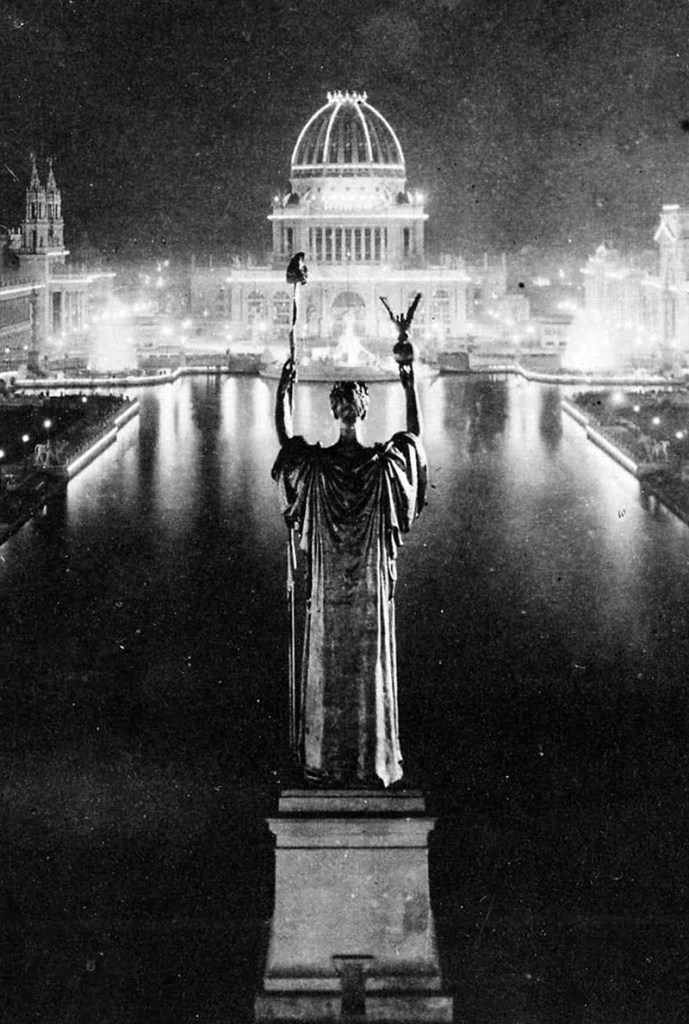
In a nation of approximately 64 million, 27 million people cycled through the Exposition over the summer of 1893, which, in world without air transport or cars cruising over interstate highways, tells you something about the zeal with which various American firms had been laying rail lines. Think about that for a second: 27 million people, 40% of the nation’s population, all of them utterly gobsmacked to witness a new golden age coming into being, all of them overwhelmed by the sheer scope and aesthetic purity of the place. In a time of boundless optimism, millions upon millions of ordinary folk revelled in the achievements of a rising global power, a country on the make in which, clearly, almost anything already was or soon would be possible. You and I have never seen anything like it, nobody outside of the millions who were there in 1893 ever has, despite the magnificence of subsequent expositions throughout the 20th century, such as Montreal’s Expo 67, and the great New York World’s Fairs of 1939 and 1964. Nothing would ever again quite match the vision, the ambition, the utter, mind-expanding beauty of what came to be called the White City. Look:
Those who’d suddenly had their eyes opened to what was possible wondered why American cities couldn’t be remade over time to resemble the White City, and many came together to form the City Beautiful movement, the influence of which had a lot to do with the architecture of the Washington Mall, New York’s Columbia University, and a few other places. Sadly, though, there never was a general urban redesign to reflect the aesthetics of the White City, and a move to convert the temporary structures of the fair into permanent buildings, which would have been hugely expensive, became impossible anyway when a fire burned down most of the Exposition grounds the following winter. The avenue that was the Midway is still there, and one of the surviving structures was turned into the now famous Field Museum, but in subsequent years, the memory of the great 1893 fair took on the character of a beautiful, lingering, unrealizable dream.
Still, my God, what a dream. What a triumph. That was them, once. Back in the day, when America wanted to mark a major historical milestone, it assembled an aspirational wonderland, previewing the utopia that was surely just around the corner, and filling the souls of everyone who visited with hope and wonder.
Yeah, well, that was then, and then ain’t now.
Now, to mark another anniversary of tremendous significance, this is all they can muster up:
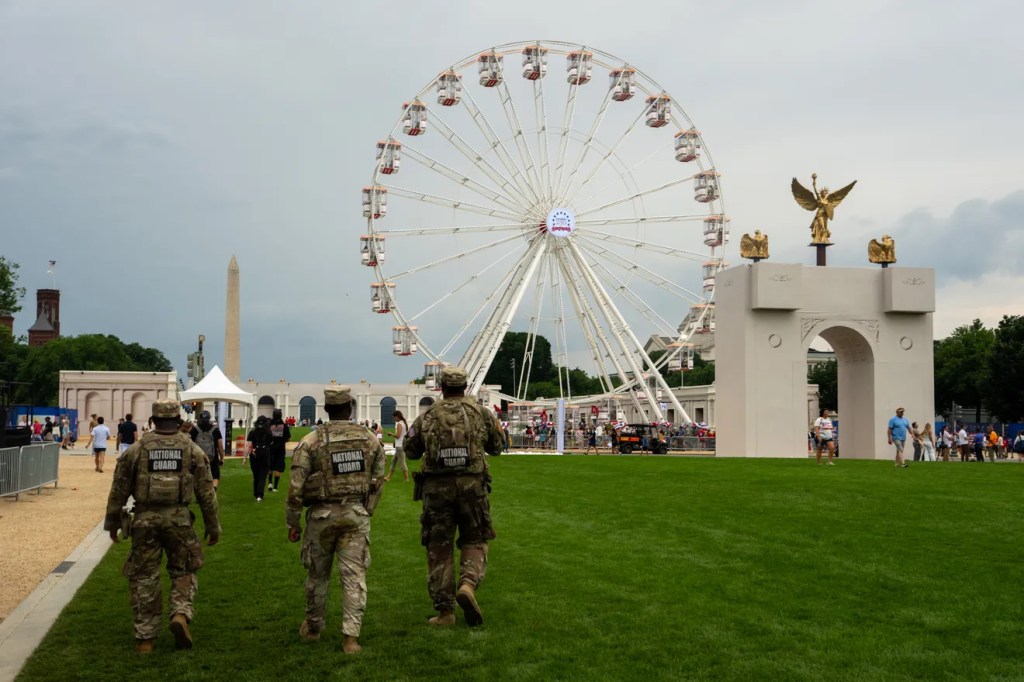
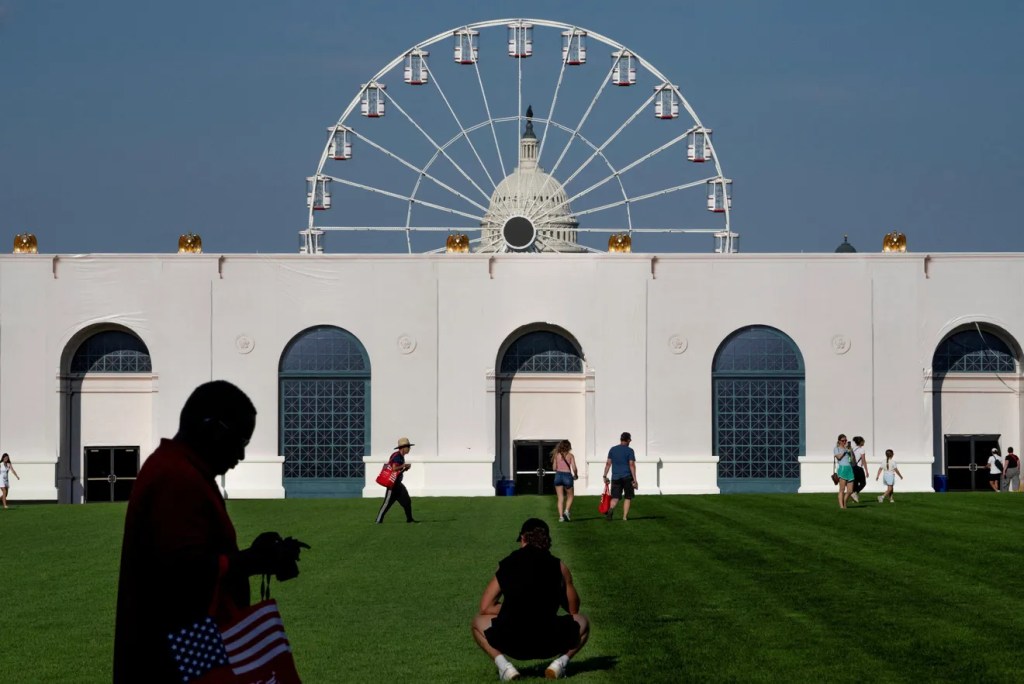
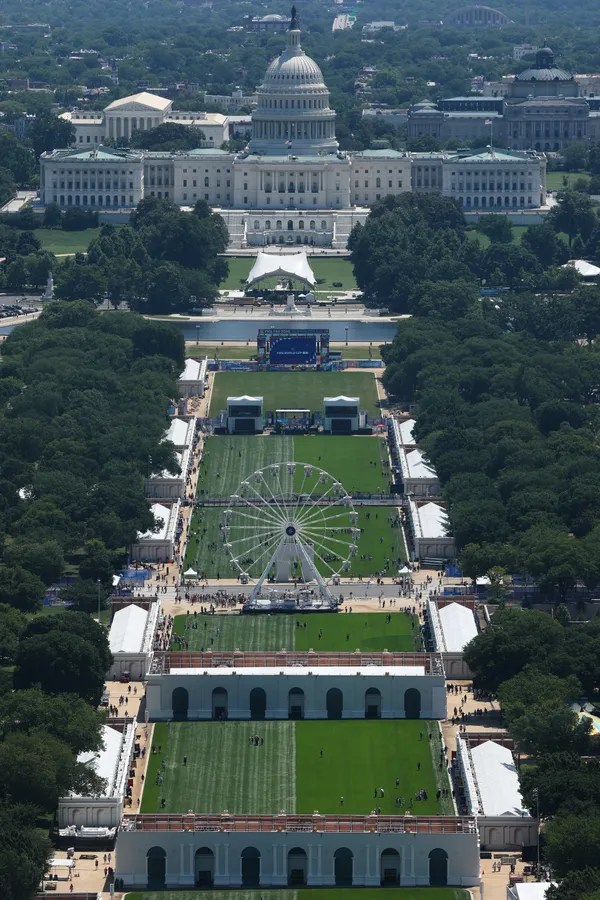
Behold Donald Trump’s self-promoting vision for the celebration of the 250th anniversary of the Declaration of Independence. That’s it. You’re looking at all of it. That’s all there is. Dubbed, with typical Trumpian hyperbole, The Great American State Fair, it’s a ramshackle collection of shoddily constructed and pathetically appointed so-called State pavilions, mere holes in the wall strung together like the rooms of a motel, none of them air conditioned in the 105 degree heat, most of them sporting nothing more than a few blown-up postcard shots on the walls, and a couple of armchairs. No, really. You can march in, look at the walls, then maybe sit in a chair, and that’s a wrap on Montana, on to the Kansas pavilion.
Booked for nightly entertainment was a supremely mediocre slate of washed up musical has-beens, who would have been underwhelming even if they’d shown up, which none of them did, once it became obvious that the whole affair was designed to be a deluxe Trump rally, not an apolitical celebration of the American Experiment; nobody, not even Milli Vanilli, was able, this time, to buy into the aphorism that all publicity is good publicity. In their stead, watched by audiences numbering into single digits, have been Dr. Oz, a few obscure dance troupes (one of which nearly had members killed when something big and heavy fell from the stage ceiling and plummeted amid the rehearsing dancers), some female acrobats in front of whom a MAGA punter dressed up as Uncle Sam proceeded to masturbate until the cops hauled him away, and, swear to God – I shit you not – a MAGA podcaster debating the merits of the Salem witch trials with a 10 year old boy. Mr. MAGA was inclined to the view that the trials had been just and their verdicts reasonable, though of course there were a few failures to grant due process, and from this distance it was impossible to be absolutely sure the women accused of witchcraft were guilty, but on balance, for sure, a good job by the elders of Salem. Meanwhile, the child just looked at him, mute and presumably terrified. I feel it necessary to repeat that I’m not making this up.
So goes Donald’s latest vanity project. Wandering around the shadeless cardboard wasteland in the sun-blasted swelter, the visiting “crowds”, easily outnumbered by the customers you’d find pushing carts in the average Home Depot on a Monday morning, struggle to avoid heat stroke while finding something worth doing. A Ferris wheel, perhaps imitating the one first seen in Chicago, but much smaller, keeps breaking down. The main alternative, apart from the odd carnival act, is to stare slack-jawed at a plywood mock-up of the great arch Trump plans to plonk down in front of Arlington Cemetery. It’s quite the pathetic mess, really, looking like it’s been cobbled together by a bunch of eight year olds as an elementary school art project, and is coming apart so dangerously at its ill-glued seams that it had to be cordoned off to prevent anyone from being clobbered by falling debris. If it occurs to anyone to seek some calories and liquid refreshment in the food hall, they’re soon having second thoughts on account of the high prices and appalling quality of the stuff on offer, supposing the power hasn’t failed, and it’s even possible to buy anything resembling a soggy burger, or a meagre plate of Doritos covered in Cheeze Whiz, that hasn’t been sitting out in the heat, breeding pathogens, for the last five hours.
A particular highlight of the ongoing comedy has been the tenaciously enthusiastic reporting of a rotating cast of on-site Fox News professional hair-dos, who set up shop at the venue like they’re providing colour commentary at the frigging Masters, and sit there touting the massive throngs of delighted visitors. They rave about the truly incredible volume of deliriously overjoyed attendees even while right behind them, plainly visible on camera, lies the abandoned mall with maybe six to nine sweaty fair-goers wandering about aimlessly in the distance, looking like a handful of very small ants crawling around on an oversized pool table. Hey guys, appreciate the zealous gaslighting, and your steadfast commitment to the bit, but you do know we can plainly see the empty nothingness you’re simultaneously broadcasting, right?
In short, The Great American State Fair is an utter fiasco, cheap, ugly, slapped together at the last minute, and amounting to nothing more than an extended, half-assed Trump campaign rally. The Donald is using the opportunity of what was supposed to have been an apolitical national party to celebrate himself instead, and deliver hugely offensive and inappropriately partisan speeches in which he vilifies his political opponents, during which the few in attendance stream out of the place despite Orange Mussolini being nowhere near the conclusion of his North Korean-style harangue.
Almost nobody wants to go. Those who do go turn around and leave just as soon as they take in the complete absence of anything resembling the lively State fairs they hold every year back home.
Of course, it wasn’t supposed to be this way. Fully ten years ago Congress, planning ahead, established a bipartisan committee to organize a tremendous celebration in coordination with the Smithsonian, and appropriated over 80 million dollars to pull it off. Rich private donors lined up to inject even more money. The plan was completed, and it was all lined up and ready to go, when Trump came in, hijacked the planning committee, established his own, made off with the money (under God knows what purported legal authority), and then sent instructions to unwitting donors to reroute their cash into his new accounts, issuing e-transfer information meant to fool them in a manner that seems to amount to criminal wire fraud. Of course he did. With Donald, it’s never sufficient to perpetrate an incompetent botch job. There has to be a grift.
Could there be a better representation of the entire Trump administration in microcosm? Like the screwed up Reflecting Pool, like the demolished East Wing, Trump’s miserable failed fair is the perfect metaphor for everything he’s done, and everything America has become under his corrupt, feckless, ignorant wannabe dictatorship.
It’s hard to believe, now, but this used to be them:
Maybe it will be again, some day.

